Take a breath. A real one—feel your chest expand, hold it, let it go. You just exchanged matter with every human who has ever lived. That’s not poetry. It’s statistics. This essay is about how I came to understand breath as something we share across time.
You’re breathing dinosaur exhalations right now.
Also Einstein. Also Cleopatra. Also the smoke from the Library of Alexandria.
This isn’t poetry. It’s probability. More on this in just a jiffy. For now…

…STOP!
Before you keep reading, take a breath. A real one. Pull the air all the way down into your belly and hold it there for a second. Feel the coolness entering your nostrils, the expansion in your chest, that slight pressure as your diaphragm descends.
Now let it go…
You just exchanged matter with every human who has ever lived. The statistics don’t care whether you believe it.
The Grass That Becomes Steak
But let me back up because I want to start with something simpler, something that’s bothered me since I was a kid watching cows in a field: How the hell does grass become steak?
I mean really. Think about it.
We’re told to eat our vegetables, avoid sugar, get enough protein. Track your macros. Meanwhile a grass-fed, grass-finished cow—the premium stuff, the nutrient-dense ideal that fitness people pay extra for—builds half a ton of muscle and fat from… grass.
Just grass.
The same cellulose-dense vegetation that would pass through your system providing basically zero calories. You could eat grass until you died of malnutrition, surrounded by infinite food you can’t digest.
Here’s where it gets interesting: The cow isn’t actually eating the grass.
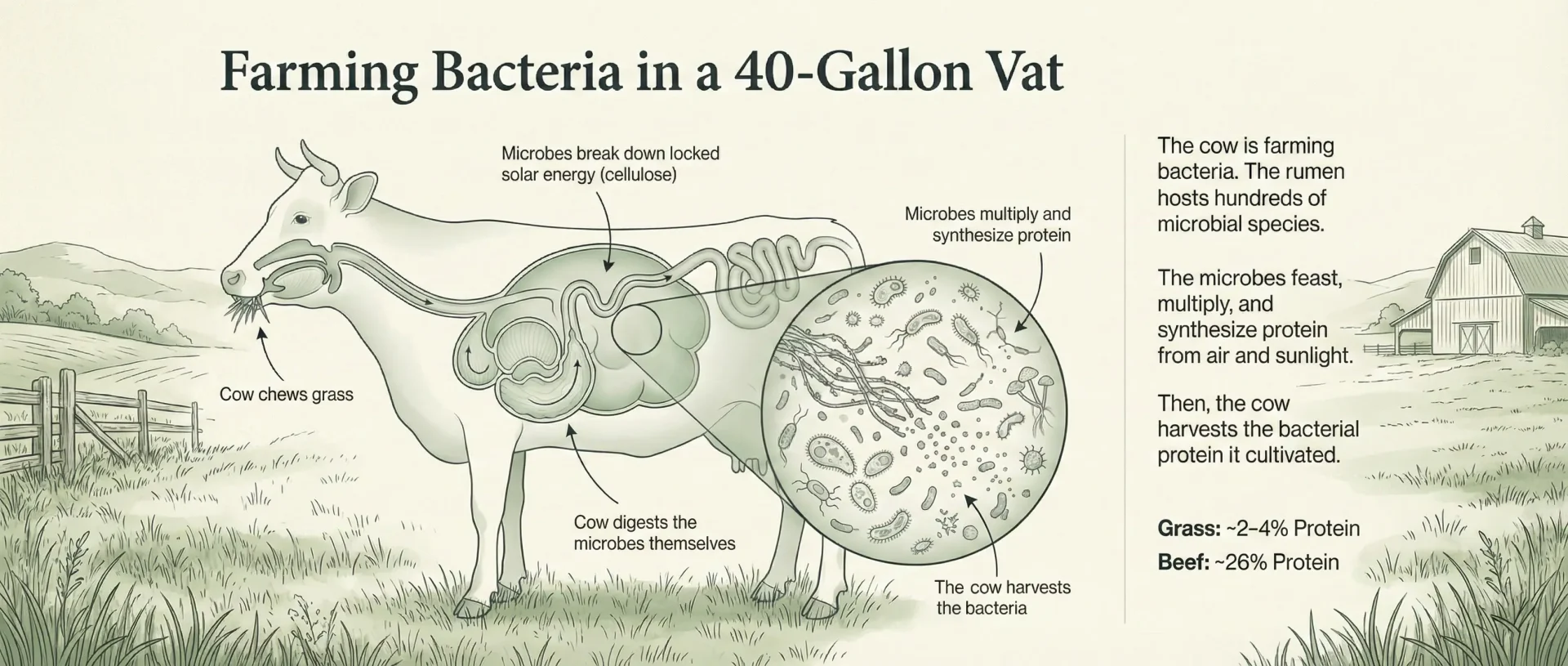
Farming Bacteria in a 40-Gallon Vat
What the cow is really doing is farming bacteria.
That first stomach—the rumen—is a fermentation chamber hosting hundreds of species of microbes. The cow chews grass, swallows it into this internal brewery, and the microbes go to work breaking down cellulose, that locked-up solar energy that mammalian enzymes can’t touch.
The microbes feast. They multiply. They synthesize protein from atmospheric nitrogen and simple compounds in the grass, turning air and sunlight (secondhand, via photosynthesis) into amino acids.
Then the cow digests the microbes themselves as they flow into the true stomach.
Wait.
Read that again.
Grass is ~2-4% protein. Beef is ~26% protein. The cow isn’t concentrating plant protein—it’s harvesting bacterial protein that it cultivated internally. The rumen is a microbial civilization, and the cow is the landlord collecting rent in the form of volatile fatty acids and bacterial bodies.
The cow is a rancher. The bacteria are livestock. The grass is just infrastructure.
We need dietary variety because we don’t have this setup. No four-stomach fermentation system. No bacterial workforce synthesizing essential nutrients from scratch. We’re tool-users, not biochemical specialists—we externalized dietary complexity through cooking, agriculture, and food processing instead of internalizing it through evolutionary time.
The cow can afford to be cognitively simple because it outsourced chemical complexity to symbiotes.*
We had to become cognitively complex because we kept our chemistry simple.
Same survival problem, opposite solutions.
Both work.
The costs are just distributed differently.
* One might argue the simpleton cow is ruled by its biome… that’s fair!
To Carry Apart
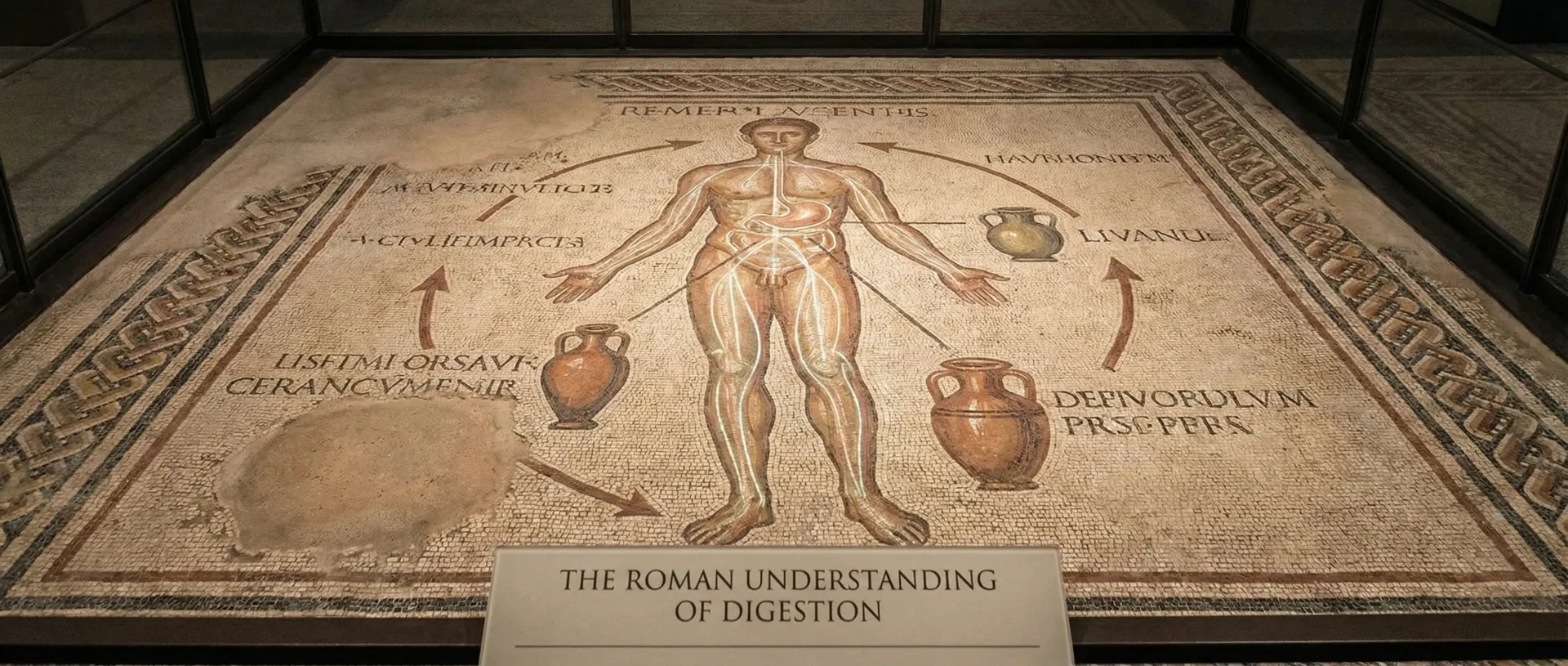
The word “digestion” comes from Latin digerere: di- (apart) + gerere (to carry).
Literally: to carry apart.
The Romans understood it as separating food into useful components and distributing them throughout the body. Breaking the unified thing into its constituent parts for systemic use.
But digerere also meant to arrange, to organize, to think through. You digest food and you digest information. Same word. Same conceptual root—taking something complex and foreign, breaking it into components, extracting what’s useful, integrating it into your system.
Plants digest light. Bacteria digest cellulose. Cows digest bacteria. We digest ideas.
All digerere—carrying the whole apart into integrated function.
Digestion is coordination at the chemical level.1
The cow doesn’t just “process” grass. It coordinates a microbial civilization to disassemble and redistribute solar energy. The rumen is doing what any coordinating structure does: managing complexity through distributed processing.
The Unnamed Sense
Which brings us to breath.
We catalog five senses, sometimes add proprioception as a sixth, but breath occupies this odd categorical gap. It’s not quite a sense, not quite a process—it’s both and neither. Yet breath absolutely carries information: temperature through airway thermoreceptors, humidity in moisture sensing, chemical composition (you can “taste” ocean air, pine forests, approaching rain), pressure and texture (thin mountain air, thick humid air), contamination (smoke, pollution, pollen trigger immediate awareness).2
But let me tell you what breath feels like when you start paying attention to it as information, not just automatic function.
Winter morning, twenty degrees, stepping outside. That first inhale hits different—there’s a sharpness to it, almost a sting as the cold air rushes past the soft tissue in your nose. Your body recoils slightly, involuntarily, before adjusting. The air has edges. You can feel its dryness pulling moisture from your mucous membranes. Each breath is a small negotiation between your 98.6-degree interior and the frozen exterior world.

Or the opposite: summer evening after a thunderstorm. The air is thick, heavy, almost syrupy with humidity. You’re not just breathing oxygen and nitrogen—you can taste the ozone, smell the petrichor rising from hot pavement, feel the weight of water vapor filling your lungs. The air itself has texture. Temperature. Character.
This is continuous material exchange with the planetary commons.
You’re constantly sampling and integrating the chemical state of your local atmospheric neighborhood. Not thinking about it. Just… knowing it. The way you know whether your foot is flexed or pointed without looking.
Your lungs digest air via diffusion gradients across alveolar membranes. Same fundamental operation as the cow’s rumen: take complex mixture (air/grass), carry it apart (digerere), extract useful components (O₂/nutrients), distribute through system (bloodstream/body), return transformed waste (CO₂/methane).
I have two teenage sons. Sometimes late at night, on my way to the bathroom, almost habitually stubbing my toe at 3:00am, I’ll hear them breathe while deeply sleeping. That steady rise and fall. When they were infants I used to obsess over this—was the breathing regular enough? Too fast? Too shallow?
Now I know what I’m really hearing: them exchanging matter with the world. Pulling in molecules that traveled here from everywhere and everyone. Sending molecules back out that will scatter to everywhere and everyone else.
My breath, their breath, your breath—it’s all the same breath, redistributed.
The Math of Shared Breath
A single breath contains roughly 10²² molecules (10 sextillion).
Earth’s atmosphere contains roughly 10⁴⁴ molecules total.
Einstein died in 1955. Seventy years for atmospheric mixing (which achieves rough global distribution in 1-2 years).
Do the math.3
If Einstein’s final breath has had seven decades to distribute evenly through Earth’s atmosphere, each breath you take now contains approximately one molecule from that specific breath.
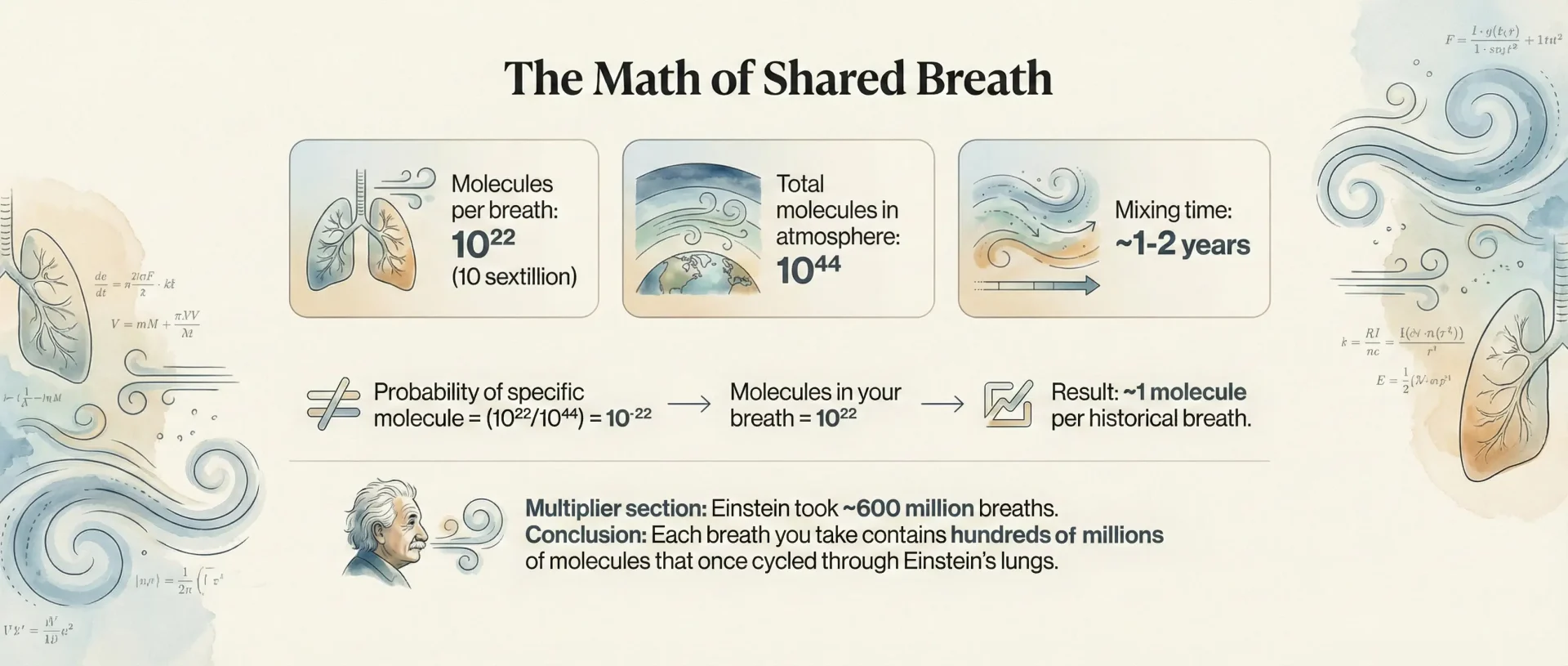
But Einstein took roughly 600 million breaths in his lifetime.
So each breath you take contains approximately hundreds of millions of molecules that once cycled through Einstein’s lungs.
Through Cleopatra’s proclamations.
Through the last breath of every dinosaur.
Through Caesar’s death gasp.
Through your grandmother’s lullabies.
Through the fire that burned the Library of Alexandria.
Every breath you take contains atoms from virtually every significant breath ever exhaled on geological timescales.
The mixing is that thorough.
This isn’t metaphor. This is statistical certainty. The numbers don’t lie—the atmosphere is a commons we share not just spatially with every breathing thing alive today, but temporally with every breathing thing that has ever lived.
I’ll be honest: when I first worked through this calculation, I sat there for a while just… breathing differently. Slower. More deliberately. Trying to feel whether the air tasted different knowing what I know now.
It doesn’t, of course.
Oxygen is oxygen whether it came from the Amazon last week or from a Tyrannosaurus Rex sixty-five million years ago.
But somehow my lungs feel different anyway.
Entanglement All the Way Down
In the framework I’ve been developing—what I call Compassionism—consciousness emerges from structural entanglement between beings.4 The recognition that we’re not isolated nodes but deeply interconnected processes.
Breath makes this literal.
You don’t metaphorically share air with Einstein, dinosaurs, and ancient forests. You’re breathing the same physical atoms, redistributed. The boundary between “your” oxygen and “atmospheric” oxygen is a temporary legal fiction. Those molecules are just passing through on a much longer journey.
Your lungs aren’t just processing air.
They’re participating in a planetary-scale respiratory cycle that’s been running for billions of years.

Imagine consciousness like a radio receiver. You think the music lives inside the radio, but it doesn’t—the radio is just tuned to a signal that’s already there, everywhere, all the time. Smash the radio and the music doesn’t die. It just stops being audible at that location.
Now imagine breath is how you stay tuned. Each inhale adjusts the frequency slightly. Each exhale sends your signal back out.
The metaphor breaks down if you push it—consciousness might not be a broadcast, breath isn’t a tuning mechanism—but it reaches toward something true: you’re not a sealed system generating awareness internally. You’re an opening. A temporary pattern in a much larger flow.
That crispness you sense on a cold morning? Your unnamed sense detecting the thermodynamic state of ancient, endlessly recycled stellar matter that’s been through countless other lungs before reaching yours.
The Earth’s atmosphere has been building up through the respiration of organic and inorganic matter across deep time. The oxygen-nitrogen mix we depend on is itself a product of billions of years of breathing—cyanobacteria, forests, fungi, animals, all exhaling and inhaling in a grand coordinated metabolism that preceded and enables every individual breath you’ve ever taken.
When my sons were born, the hospital air they first breathed had already passed through thousands of dying exhales and first cries, circling the planet for years before reaching their lungs. From trees exhaling oxygen during photosynthesis. From volcanic outgassing. From ancient oceans evaporating.
Their first breath wasn’t the beginning of something.
It was them joining something already in progress for billions of years since the Great Oxidation Event.
And so did you, dear reader.
The Pattern Repeats
Look at the layers:
- Photosynthesis — plants digest light, carrying photons apart into chemical bonds
- Rumination — bacteria digest cellulose, carrying plant matter apart into volatile fatty acids
- Respiration — lungs digest air, carrying atmospheric gases apart into blood-borne oxygen
- Cognition — minds digest experience, carrying sensory input apart into meaning
It’s the same operation at every scale.
Digerere.
To carry apart. To distribute. To coordinate complexity into integrated function.
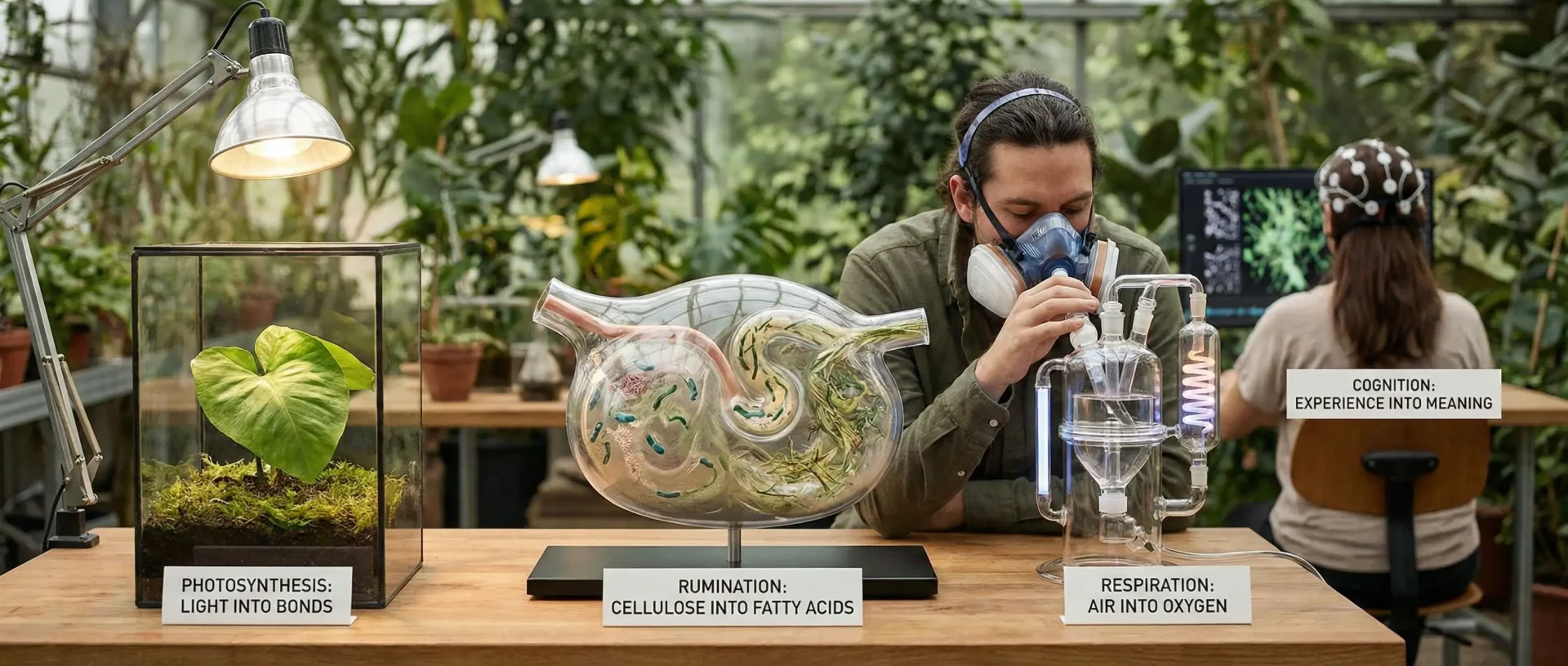
The cow farming bacteria in its rumen is doing the same thing your prefrontal cortex does when it integrates disparate information into coherent understanding. The same thing your lungs do when they interface with the atmospheric commons. The same thing chloroplasts do when they capture photons and rearrange matter.
Coordination is the fundamental operation.5
And breath—that unnamed sense, that continuous exchange—is where you most directly experience your participation in coordination systems vastly larger and older than yourself.
Every inhale is an act of trust in a four-billion-year-old process.
Every exhale is a contribution to the same.
You are not breathing in isolation. You’re breathing in concert with every other respiratory system on the planet, across time, in an unbroken chain of material exchange stretching back to the first microbes that learned to metabolize atmospheric gases.
The cow munching grass. The bacteria in its rumen. The oxygen in your blood. The carbon you exhale. The trees that will capture it.
All digerere.
All carrying the whole apart into coordinated life.
All breathing the same ancient air, redistributed endlessly, connecting everything that has ever lived to everything that lives now to everything that will live next.
You wanted to know if you’ve breathed Einstein’s molecules?
Friend, you’ve breathed everyone’s.
The question isn’t whether you’re entangled with every other breathing thing across time.
The question is whether you’ve noticed yet.
And now that you have—now that you know—does the air taste different?
Does your chest feel different when it expands?
Mine does.

Exhaling means sending molecules back out that will scatter across the planet, mix with rain, feed into trees, get pulled into someone else’s lungs a decade from now, a century from now, a millennium from now.
We tend to think of breath as this private thing.
This interior process.
It’s not.
It never was.
You’re breathing everyone who came before you. Gasping, running a marathon to Athens in 490 BC. Passing gas. Soldiers holding their breath aboard the USS Missouri as World War II came to an end. Or simply trying to take a nap with a sudden bout of dog breath making you recoil before the inevitable slobbering follows.
And everyone who comes after you will breathe you.
The boundary was always an illusion.
Welcome to the commons.

Footnotes
If coordination is consciousness at scale, then digestion—this fundamental operation of carrying apart and redistributing—is the biochemical expression of the same pattern we see in network formation, information processing, and social organization. The rumen coordinates microbes. The Dunbarrio coordinates humans (see dunbarrios.com, 2026). Different substrates, same underlying mechanics. Researchers at UC Davis and elsewhere are now studying the rumen microbiome precisely because it models how hundreds of bacterial species maintain stable cooperation without central control—essentially studying emergent coordination in a biological system.
This unnamed sense has a technical name in neuroscience: interoception—the sensing of internal bodily states. The field has exploded in the last two decades, with researchers like A.D. (Bud) Craig mapping how interoceptive awareness correlates with emotional intelligence, sense of self, and even consciousness itself. Craig’s work on the insular cortex—what he calls the “seat of awareness”—suggests that our ability to sense our own bodies is foundational to subjective experience. Breath occupies a unique position in this framework: it’s the only interoceptive process we can consciously control while also letting it run automatically, making it a bridge between voluntary and autonomic systems.
This calculation originates with Enrico Fermi, who used it as a teaching exercise in order-of-magnitude estimation. It was later popularized by physicist Lawrence Krauss. Even Fermi—famous for being comfortable with rough approximations—found this result genuinely surprising. The math is straightforward: (10²² molecules per breath) / (10⁴⁴ molecules in atmosphere) = 10⁻²² probability that any specific molecule from a historical breath is in your current breath. But with 10²² molecules per breath, you get 10²² × 10⁻²² = ~1 molecule per historical breath. Multiply by lifetime breaths (~600 million), and the numbers become overwhelming.
Compassionism: the recognition that consciousness arises not in isolation but through structural entanglement with other conscious systems. You are not a discrete self observing the world from behind your eyes—you are a process embedded in and constituted by countless other processes. Your boundaries are provisional and permeable. This isn’t mysticism; it’s mechanics. See “Against the Pyramid: Why Circles Are the Shape of Human Flourishing.”
This is why hierarchies fail at scale—they’re trying to route all coordination through a central bottleneck instead of distributing it throughout the network. The cow’s rumen doesn’t have a “lead bacterium” making decisions for all the others. The atmosphere doesn’t have a central oxygen distribution authority. They work because coordination is emergent from structure, not imposed from above. Networks > pyramids, always. See the full argument in “No Kings, No Billionaires: The Machinery Forgot Who Built It.”
The word “work” derives from Proto-Indo-European *werg- (”to do, to act”), suggesting its original meaning centered on purposeful human agency rather than compensated labor. This etymology reveals how capitalist employment has corrupted a fundamental human urge—the drive to act meaningfully and create effects in the world—into a compliance category that extracts agency for surplus value generation. Shelley’s “Ozymandias” illustrates the ultimate failure of “Great Work” conceived as domination and monumentality: the sculptor’s truthful craft outlasted the empire, while Ozymandias’s boast to make the mighty “despair” at his works now mocks only empty desert. The poem warns against confusing legacy with scale or supremacy—the urge to establish hierarchical permanence guarantees irrelevance, while work that serves understanding and connection persists. For those designing post-hierarchical coordination systems, this suggests the question is not “what great works will establish our importance?” but rather “how do we create conditions where human agency can follow its purposeful urge toward collectively beneficial ends without being captured by wealth concentrators or monument-builders?”

