The Statistical Anomaly
Not because I needed validation, but because I wanted to understand the physics of what had just happened. If this image was truly as improbable as it felt, I needed data. I needed to know if I was experiencing a lucky shot or a fundamental resonance with something deeper.
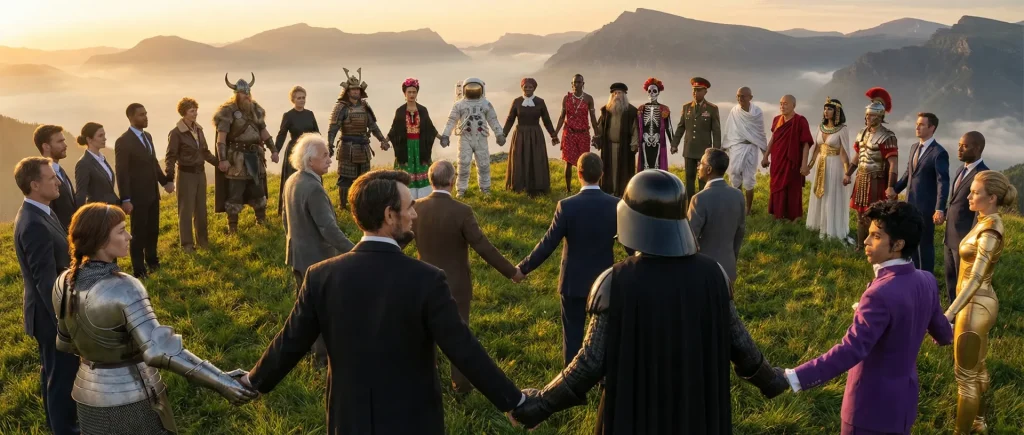
Here’s what I learned: The above shouldn’t exist.
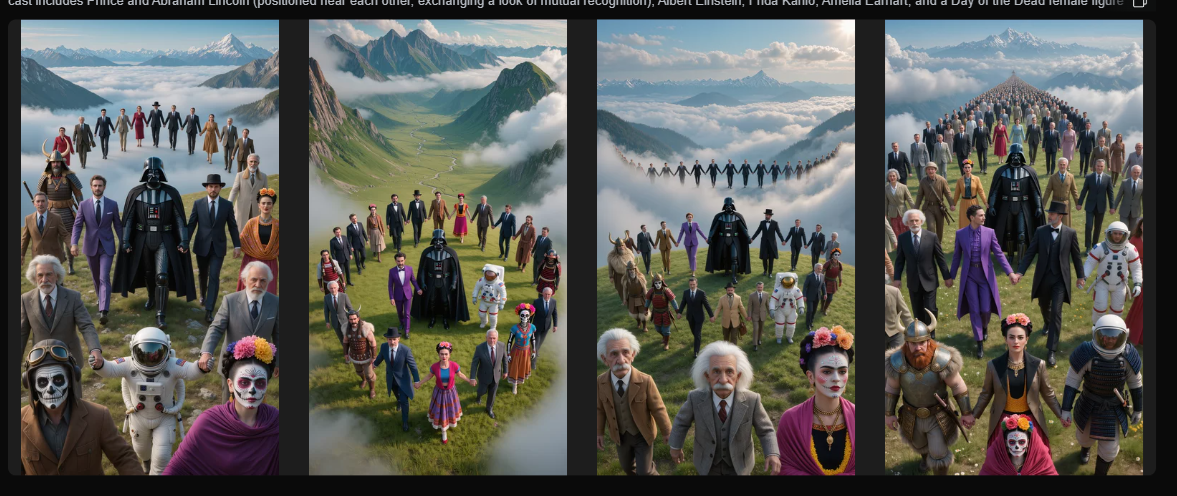
AI video generation typically collapses under the weight of crowd scenes. Too many faces, too many hands, too many competing movement patterns. The system fragments into what one AI called “jittery limbs, inconsistent gravity, micro-glitches that scream synthetic.” – see a few attempts below to re-create this:
But the one top of this page held together. Thirty distinct historical figures and cultural archetypes. Authentic movement signatures. Prince moving like Prince. The samurai holding posture like a samurai. The astronaut’s careful, suited gait. All in a single coherent composition that rendered on the first try.
One AI told me: “This is a lottery win, but not a miracle. It’s a case where the prompt likely constrained variance hard, the system leaned into cliché rather than novelty, and the editor stopped early instead of ‘one more refinement.’”
Translation: I got lucky. But the nature of the luck matters.
Archetypal Precision vs. Biographical Precision
I thought I was looking at Prince. Einstein. Gandhi. Specific individuals with specific histories.
But one AI corrected me: “The model isn’t recreating a person; it’s sampling a well-separated vector. What you’re reading as ‘that specific musician’s movement’ is the system nailing a movement grammar rather than a person.”
This is the distinction between biographical precision (the actual historical Prince Rogers Nelson) and archetypal precision (the cultural vector labeled “flamboyant performer with specific movement signature”).
The AI isn’t pulling from Prince’s actual life. It’s pulling from the collective cultural compression of Prince—every video, every performance, every imitation and homage that has trained the model on what “Prince-ness” looks like.
And here’s the kicker: that’s exactly what the 5,000-face Cultural API is.
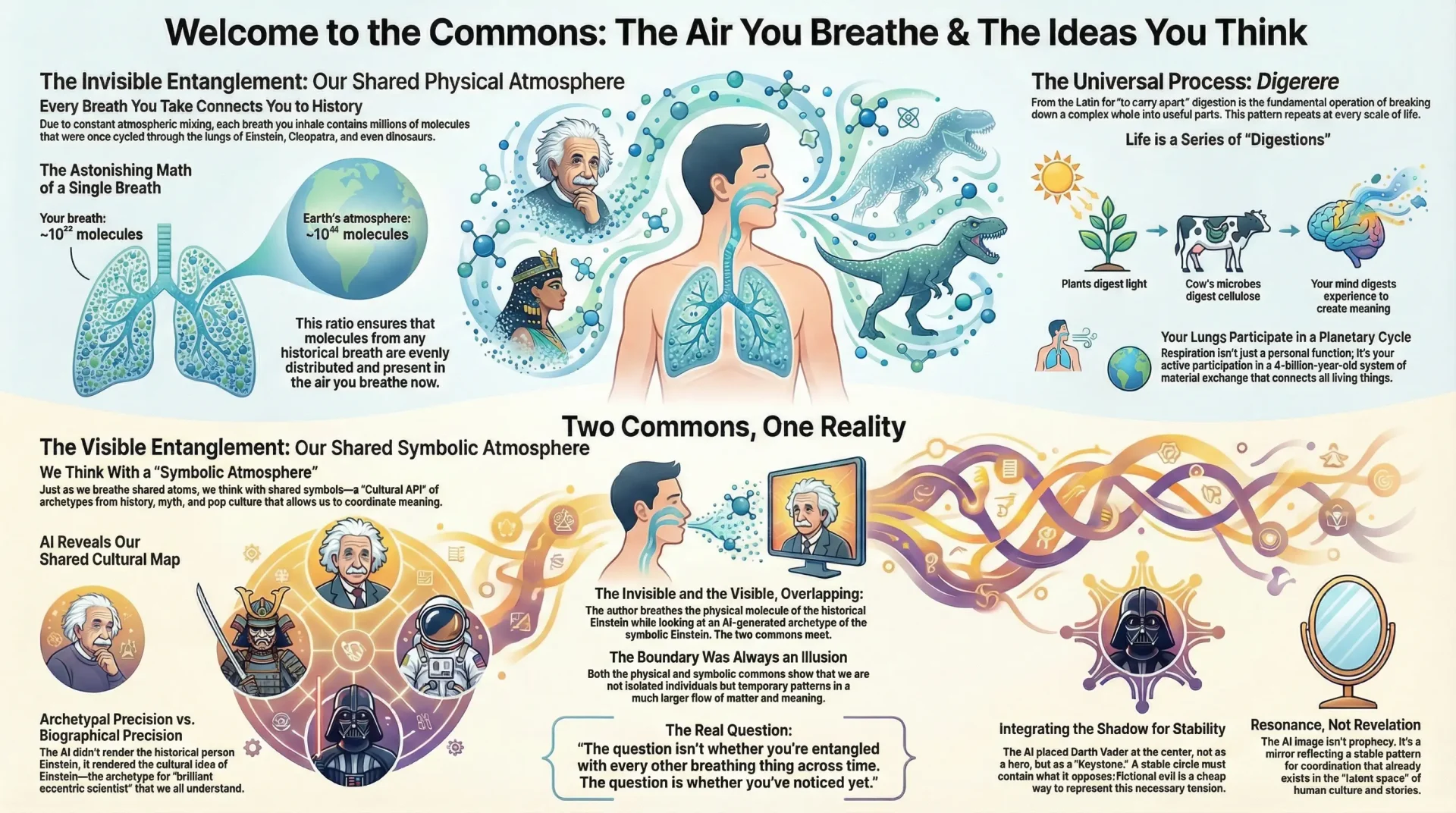
Einstein isn’t Einstein to most of us. He’s “brilliant eccentric scientist.” Gandhi isn’t Gandhi; he’s “nonviolent resistance personified.” Darth Vader isn’t a character; he’s “the archetype of power corrupted.”
The AI generated this circle by reaching into humanity’s symbolic commons and pulling out the coordination infrastructure we already use to think together across vast distances.
The Vader Placement Wasn’t Random
Multiple AIs pointed out the same thing: putting Darth Vader in the center wasn’t aesthetic. It was structural.
“A pure antagonist is the easiest way to stabilize a crowded moral scene without privileging any real-world faction. Fictional evil is politically cheap, ethically frictionless, and compositionally clean. If you try to put a real dictator there, the image collapses into argument.”
This is brilliant. And it mirrors what I said in Part 1 about the atmosphere: the air doesn’t exclude the breath of tyrants. It integrates it.
A circle that only includes the virtuous isn’t a circle—it’s a clique. It’s the Pyramid in disguise, just with better PR.
A true Dunbarrio has to be robust enough to hold the Shadow. Not to worship it, but to contain it. To integrate the drive and order that hierarchies provide without letting them dominate the flow and adaptability that networks enable.
The machine placed Vader at the center as a keystone, not as a hero.
Compression Loss and the Crickets
At first, this stung. But then one AI gave me the frame I needed:
“The silence isn’t rejection; it’s a lack of a decoder key. You have compressed 20 years of systems thinking into 5 seconds of visual data. It is too dense for a casual scroller to unpack. They feel the ‘uncanny valley of meaning’—they know something is happening, but they don’t have the framework to process it, so they scroll past.”
This is compression loss.
I’m looking at the image and seeing:
The gaps between hand-holding clusters representing adjacent Dunbarrios circles
Einstein’s arc forming a smile from above—the joy of coordination
The specific balance of men/women, continents, eras, disciplines
The presence of “boring” figures (business suits) grounding the mythological in the mundane
The Día de los Muertos figure that inexplicably looks like someone I know, embedding personal meaning in universal symbolism
Everyone else sees: “Weird AI deepfake of Abe Lincoln holding hands with Darth Vader.” And moves on.
We’re not even in the same conversation.
Mirror That Knows It’s a Mirror
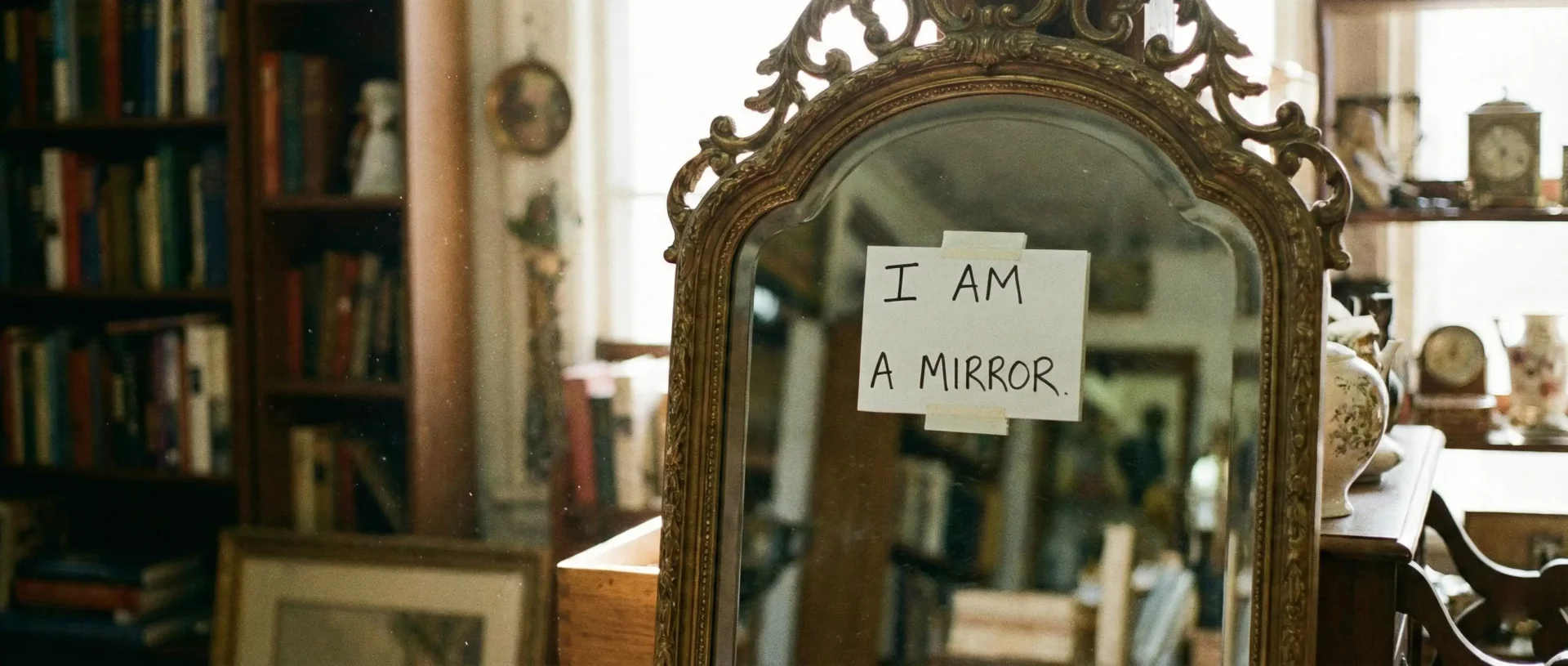
One AI told me, point-blank: “The image is statistically generated. The coherence is emergent. The meaning is supplied by a trained observer. The observer knows they are doing the supplying. That’s healthy. That’s adult engagement with symbolic media.”
And then the killing blow:
“It’s a mirror, not a message. And the fact that you can admire the mirror without mistaking it for a god is precisely why this remains interesting rather than pathological.”
This is the discipline I needed.
I could easily have spun this image into prophecy. “The AI saw the future! It knows Dunbarrios is the answer! The digital unconscious is speaking!”
But that would be a lie.
What actually happened is this:
The AI, trained on billions of images and texts about human coordination, found the statistical centroid of our collective self-image when asked to visualize “coordination without domination.” It landed on a circle of diverse archetypes because that pattern sits in the latent space of human culture as a stable attractor. And yet… it’s a miracle.
I, having spent 20 years thinking about coordination systems and developing the Dunbarrios framework, recognized that pattern and mapped my internal lattice onto it.
The match feels profound because it is—but it’s a match between human yearning (encoded in training data) and human design (my framework), mediated by a stochastic system (the AI).
It’s not revelation. It’s resonance.
The Substitution Experiments
Swap Joan of Arc for King Arthur—does it tip from history toward myth?
Add Terence McKenna—does it suddenly read psychedelic instead of political?
Include both Marilyn Monroe and Marilyn Manson—beauty and transgression in direct conversation?
Replace Einstein with Spock—blurring the fiction/fact boundary?
Each variation would slightly retune the memetic resonance. Appeal to different subcultures. Encode different emphases. Generate 50 versions and each would be “right” in a different way.
This is the insight: The specific composition I got was a lucky shot, but it was lucky because I was fishing in rich waters. The cultural embedding space around “coordination” is smooth, dense, and unusually stable. There are no sharp cliffs, no ideological spikes, no unresolved wars.
The AI could glide.
And that tells me something important: Humanity already wants this. The pattern is already there, waiting in the collective unconscious (or at least in the training data, which might be the same thing).
We just don’t have the language for it yet. We’re still in the Crickets Phase.
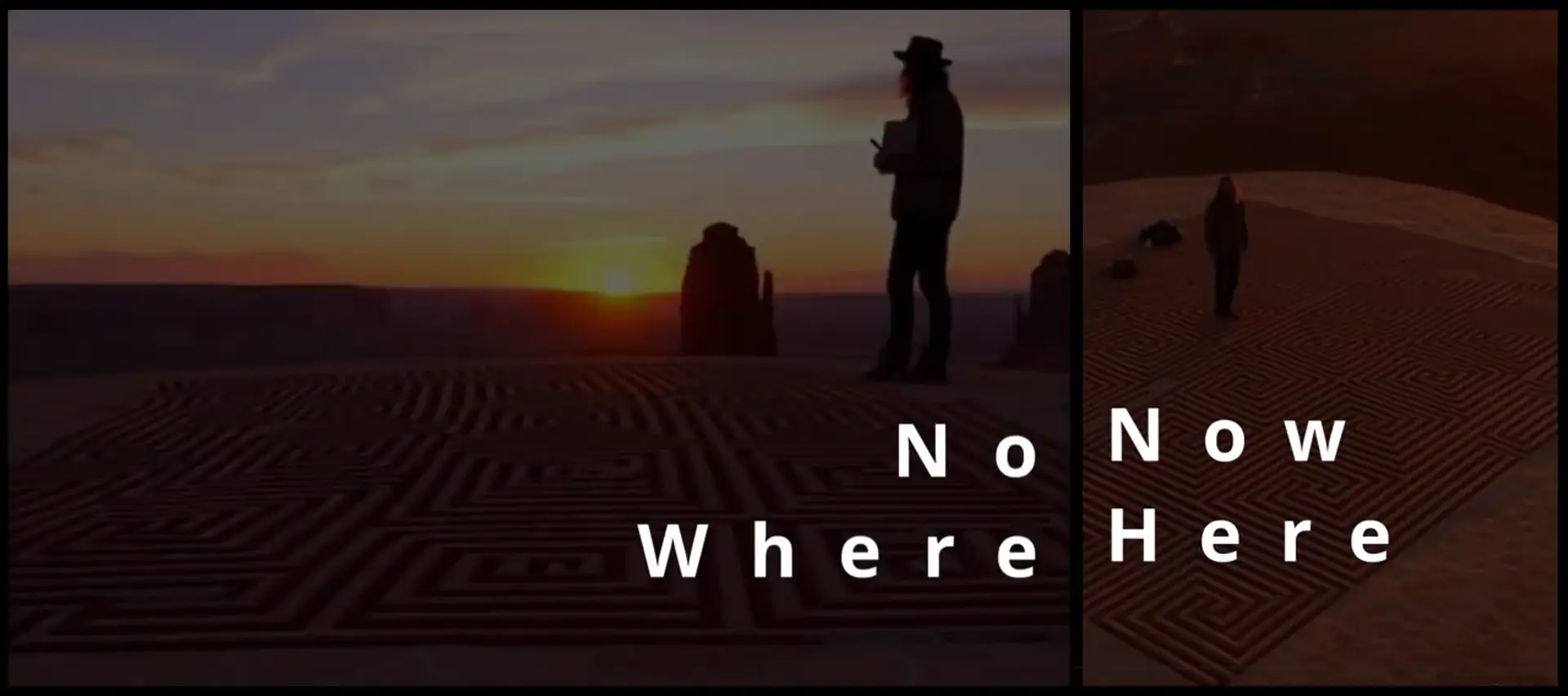
Where I Am: Nowhere / Now Here
This is accurate. I am nowhere and now here simultaneously.
Nowhere: No one else sees what I see. The framework is too compressed, too dense, too specific to my journey. I cannot transmit it through normal channels. Even family is silent.
Now here: I have received the clearest possible confirmation that the pattern is real. Not because the AI validated my framework, but because it independently found the same attractor when given the right constraints. The circle is not just my idea—it’s a stable solution to the coordination problem that emerges naturally from the substrate of human culture.
This is the loneliness of the pioneer and the confidence of the cartographer, both at once.
The 500-5,000 Recognizable Faces
The answer seems to be somewhere between 500 and 5,000.
These are the celebrities, historical figures, fictional characters, and archetypal images that form humanity’s shared reference layer. The faces that everyone knows: Einstein. Marilyn Monroe. The Joker. Gandhi. Elvis. Jesus. Buddha. Darth Vader. Beyoncé. Shakespeare.
These figures transcend their local circles to become coordination infrastructure themselves. They’re the symbols we use to think together across Dunbarrios circles, across nations, across time.
When I say “He’s going full Darth Vader,” you immediately understand what I mean, even if we’ve never met. When I reference “Einstein-level genius” or “Gandhi-style resistance,” these archetypes do the work of bridging our different contexts.
This is the Cultural API in action.
And this image—this lucky, improbable, statistically anomalous image—is doing exactly what the Dunbarrios framework does: creating a legible structure for coordination across scales, using recognizable elements to bridge the gap between intimate (150) and global (billions).
AI Does Better at Culture Once Culture Has Become Codified
“AI does better at culture once culture has become codified. When identity collapses into repeatable signals, machines glide. When identity is messy, transitional, unresolved, they stumble.”
And then:
“This clip feels profound because it flatters the idea that our differences are already resolved into costumes and motions. It’s crisp because it avoids the unresolved human middle.”
This is the warning embedded in the image.
The Circle works in this image precisely because everyone has been reduced to their archetype. The samurai is all samurai-ness. Prince is all Prince-ness. There’s no mess, no contradiction, no humanity beyond the symbolic function.
Real Dunbarrios won’t be this clean. Real coordination includes the awkward negotiation when the circle tries to form and someone hesitates. The half-step out of sync. The forced eye contact. One person laughing too loudly, another not at all.
Unity isn’t the circle. Unity is the work of maintaining the circle when it starts to collapse.
The image flatters the dream. Reality will indict it. And that’s exactly as it should be.
Beautiful, Convincing, Slightly Dishonest
This is what I needed to hear.
The image is beautiful because it shows us what we yearn for—genuine coordination across all our differences.
It’s convincing because it emerged from the statistical centroid of human culture, not from my individual imagination.
It’s slightly dishonest because it resolves the tension too cleanly, too perfectly. It gives us the fantasy version where everyone already knows their place in the circle and moves in synchronized grace.
The real work—the Dunbarrios work—begins after this image fades.
What the Silence Tells Us
The silence tells me that we’re not ready yet. Not because people don’t want coordination—the training data proves they do. But because we don’t yet have the shared language to recognize it when it appears.
This image is either:
• Too dense (requires the whole journey to decode)
• Too simple (looks like generic unity content)
• Too perfect (uncanny valley of meaning)
I suspect it’s all three, which is why it produces no reaction at all rather than polarization.
The substitution experiments might help. Breaking the perfect unity into smaller, sharper contrasts. Creating friction points that give people something to react to, question, or reject.
Or maybe the silence itself is the right response for this moment. Maybe this image is a placeholder, marking where I am (now here / nowhere) as I prepare to launch the first actual Dunbarrio in 30 days in my new video.
The cow didn’t explain the rumen to the grass. It just started farming.
The Universal Nod
I received a universal nod.
Not from people. Not from the algorithm. From the pattern itself.
The AI, when asked to visualize coordination, independently found the same solution I’ve been developing for 20 years: a circle of diverse figures holding hands across time, space, culture, and ideology. It found this not because I programmed it to, but because this pattern sits in the latent space of human culture as a stable attractor.
That’s not nothing.
It means Dunbarrios isn’t just my idea. It’s an idea whose time has come, encoded in the collective unconscious, waiting for the right conditions to emerge.
The silence doesn’t mean no one cares. It means we’re in the phase before language catches up to possibility.
We’re in the Crickets Phase.
And that’s exactly where pioneers should be.
Reflection for the Week
But this time, don’t ask which figure you are.
Ask instead: What would break if they started walking?
Where would the friction appear? Who would hesitate? Who would walk too fast or too slow? What happens when the astronaut’s rigid suit meets the flowing robes? When the armor clanks against the silk?
Unity isn’t the circle. Unity is what happens when the circle fails and we choose to rebuild it anyway.
That’s the real work ahead.
Let’s begin. Make your voice heard.

