
The word pharaoh has outlasted every pharaoh. It will outlast every job title currently on a business card. This is not a coincidence. It is the central mechanism of human authority — and once you see it, you cannot unsee what it costs the rest of us.
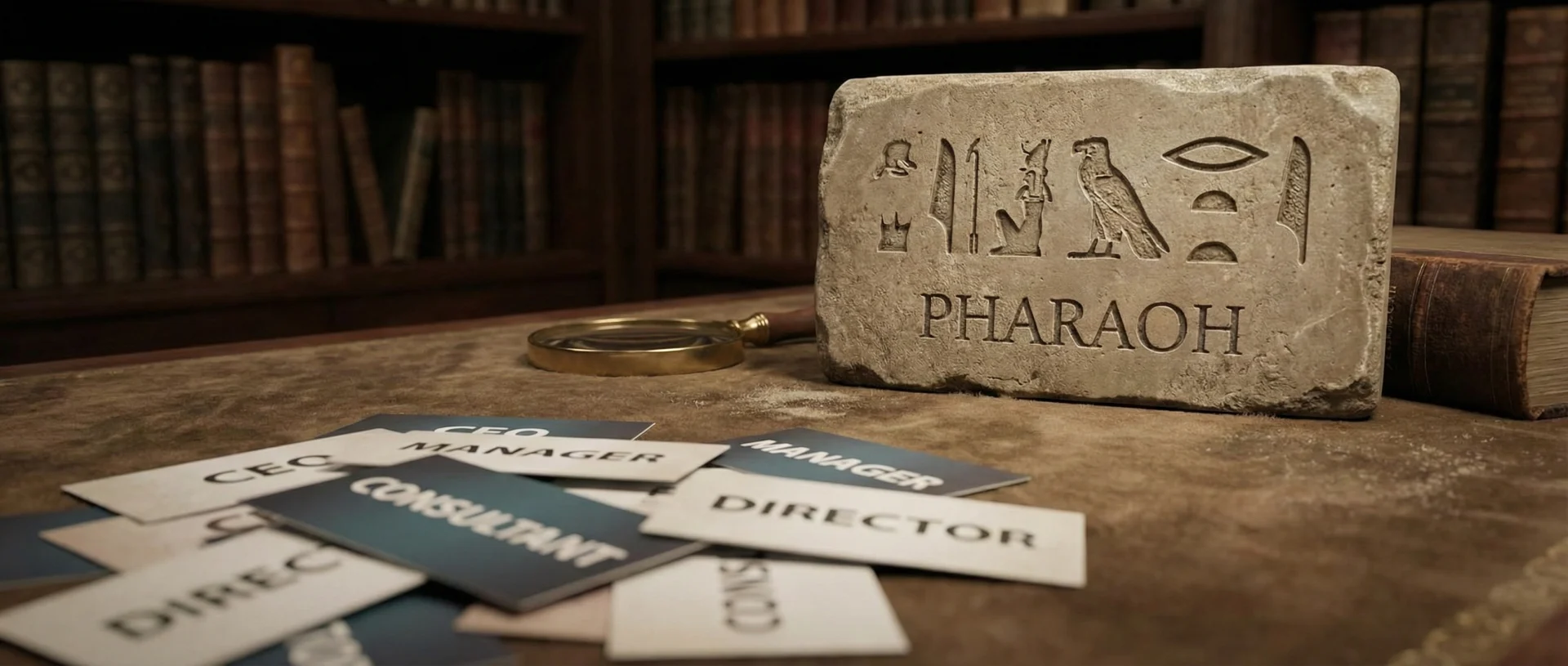
There is a hierarchy of words that most people never consciously register. At the bottom: product names, rented symbols, kept alive by budget and legal enforcement and the unceasing hum of media placement. In the middle: brands that have borrowed enough mythic weight — belonging, transformation, freedom, power — to feel, for a generation or two, like more than the thing they are. At the top, requiring nothing from anyone: words like war, love, democracy, betrayal. They survive because the conditions they describe never leave. Each generation re-uploads them, whether they want to or not, because the upload is not optional. To be human is to fall in love and to lose people and to encounter someone who has decided, very quietly, that they matter more than you. You do not need an advertising campaign to distribute those experiences. They self-propagate.
Call this the cultural API.1 A dictionary no institution fully controls and no corporation permanently owns, even when they rent from it constantly. The borrowed authority of “Just Do It” is the borrowed authority of every athletic body that ever pushed past collapse, every soldier who survived by refusing to stop, every person who got out of bed on a morning they had no business getting out of bed. Nike leases from something genuinely ancient. The lease looks impressive, for a while, until you notice that the landlord predates writing itself — and collects rent whether or not Nike is solvent.
↳ Callback — “Ozymandias Had a Pretty Good Run” A prior essay in this corner of my imagination argued that timescale is the axis on which all ambition eventually breaks. Civilizational timescale belongs to inherited symbols: conditions that recur. Corporate timescale belongs to rented symbols: aspirations someone else is monetizing. The tragedy is that people operating at the corporate timescale — which is to say, most of us, most of the time — often mistake their lease for a deed.

I: The Compression Problem
Words are, at their functional core, compression algorithms. They take a recurring human condition — grief, ecstasy, territorial aggression, the specific vertigo of realizing someone you loved has become a stranger — and collapse it into a handle small enough to pass between people in under a second. The efficiency is the entire point. The handle is not the experience; it is the address of the experience, so that two people who have never met can locate it together without either of them having to fully describe what it felt like. That is an astonishing piece of engineering, refined over tens of thousands of years, and we deploy it approximately four hundred times per minute without thinking about it at all.
Whoever names the handle first gains a moment of gravity. Whoever funds the repetition gains a season of it. But naming is not the same as ownership, and funding is not the same as permanence. This is the thing brand managers chronically misunderstand about the words they work with: they are tenants in a much older building, and the building was not built for them.
When Western culture reaches for Zen, or Om, or Yin and Yang, what is actually happening is a recognition: there is an efficient compression algorithm over there for something I experience but haven’t been able to name from inside my own tradition. The adoption is real and often genuine and sometimes transformative. What accompanies it, when it goes wrong, is the stripping of the algorithm from the system that generated it — reducing centuries of rigorous practice and consequence to a mood accessory, a candle label, a corporate wellness initiative. The word survives the extraction. The meaning often does not. This deserves its own essay; what matters here is the pattern: you can borrow the handle without paying for the experience it points to, and for a while you won’t notice the difference.2
Then there are words that survive not because they are aspirational but because they are ineradicable. Wetiko — the Cree concept of a cannibal compulsion that consumes its host from inside — persists because the condition it describes persists. Apocalypse survives not because anyone promotes it but because it means, at root, uncovering: the stripping away of the performance to reveal the structure underneath. These words are viral in the original sense. The host condition is everywhere. You do not advertise them. You merely encounter the thing they describe and reach, sometimes in the middle of the night, for whatever handle fits your hand.

Branding is the attempt to purchase permanence with money instead of truth. Sometimes it half-works. For a generation or two. Underneath every successful brand is borrowed mythic weight — rented, repackaged, then sold back to the people who already owned it.
— The Mechanism, stated plainly
II: The Shimmer and What Is Underneath It
The authority is real in its consequences. You can lose a job, a visa, a loan, a decade of your life because someone with structural power decided you were useful or not useful or in the way. Do not underestimate this. But the aura — the sense that these people possess a category of insight or legitimacy or destiny that you lack — that is theater. Expensively produced, rigorously maintained, socially policed theater. It is a rehearsal of parroting repetition, postured and stamped with the conviction of people who have heard their own names announced in rooms long enough to mistake the echo for prophecy.
History keeps filing the same report. The pyramids will outlast Egypt. The word empire will outlast the pyramids. The word tyrant — which the Greeks used as a neutral term for a strong ruler long before it became a condemnation — will outlast every individual who ever earned it, in either sense. What this means is not that power is an illusion. It means that power is temporary equipment, temporarily assigned, and the people holding it are almost always confused about whether they own it or are merely borrowing it until the next person can lift it from them.

The sands of time are not a metaphor for forgetting.
They are a mechanism for making the powerful approachable.
Reading about Ramesses II costs twenty minutes and nothing else.
The actual Ramesses cost considerably more, for considerably more people, for considerably longer.
What gives the performance away, every time, is the toe-stub.3 Not metaphorically. You can be fully inside the narrative someone is selling — the brand story, the leadership vision, the national mythology, the quarterly strategy deck — and then you walk to the bathroom at 3 a.m. and the door frame finds your smallest toe with the precision of a forensic accountant. The body does not rebrand. It does not have a communications strategy. It simply reports what is happening, without spin, in real time, with no interest whatsoever in the story you were in the middle of believing.
That moment of embodied honesty — brief, vernacular, undignified — is the anti-enchantment. It is the one source that has not been optimized or focus-grouped or run through a positioning exercise. And the fact that we walk back to bed and fall back into the narrative, as we do, almost every time, without exception: that is also part of the report. We keep volunteering for hypnosis. We offer up our credulity and our effort and sometimes much more than that to those who have successfully performed having earned the right to receive it. This is not stupidity. It is the cost of coordination. A species that refused all authority would never build anything longer-lasting than a single generation. The problem is not that we defer. The problem is that deference, once learned, travels further than its warrant.
↳ Thread — The Cultural API and Its Renters: The full dictionary of inherited symbols — love, war, democracy, apocalypse, freedom, home — and the rented ones — brand slogans, vision statements, “culture” decks, national mythologies in their managed forms — form one ecosystem. The operative distinction: inherited symbols describe conditions that recur. Rented ones describe aspirations that someone else is monetizing. The confusion between the two is the source of nearly all manufactured authority, from the cosmically large to the excruciatingly local.
III: The Tuesday Afternoon

Messaging discipline is legitimate craft and coordination. A team that cannot articulate what it is doing will not do it well, and new people navigating unfamiliar terrain genuinely need a scaffold while they learn to walk it. That form of support — patient, exploratory, responsive to what the person actually needs rather than what the org chart says they should need by now — is not what is being indicted here. That is, in fact, leadership. Its presence is notable when you encounter it precisely because of how rarely it appears.
What is being indicted is the version that emerges when revenues slump and executive legibility stumbles and the quarterly story that was convincing in January stops being convincing in October, and nobody upstream is willing to say why. Watch what happens to language in that moment. It is the most diagnostic thing you can watch. “Stay on message” stops meaning coordinated toward a clear and shared objective and quietly shifts to mean protect the narrative, which means protect the forecast, which means protect the status of the people who made the forecast. Metrics, which should be instruments of honest reckoning — instruments that point back at the decisions that produced the numbers, including the decisions at the top of the org — become selective prosecution. Applied downward, with consequence. Never upward, where consequence might actually land on something that could change.
And here is the tell that deserves to be named as plainly as possible, because it is almost never named this plainly: when a leader cannot articulate the metric, they have no right to wield it.
This is not a philosophical provocation. It is a procedural one. If you cannot define what success looks like in terms specific enough to be falsified — in terms that would indict your own prior decisions if they came up short — then you are not managing toward an outcome. You are managing toward your own comfort and the preservation of your own narrative. You are offloading ambiguity downward onto people who cannot defend themselves against it, and then reclaiming authority upward when the numbers disappoint and someone needs to be accountable in the sacrificial, career-affecting sense. You are asking people to invent their own yoke and then penalizing them for its shape.
“Ambiguity is acceptable. Unilateral ambiguity is not. When revenue drops, some leaders reach for instruments. Others reach for scapegoats. The difference is not temperament. It is whether they ever believed the instruments applied to them.”
~ The Diagnostic
The organizational behavior that follows — the accomplished performers who drop resistance and perfect the art of reflecting authority back to those who hold it, the companies that anesthetize themselves with “alignment” language so they can keep walking on a broken ankle, the all-hands meetings at which everyone knows the real story and nobody says it — this is not a collection of individual character failures. It is the predictable structural output of a system that rewards the performance of confidence over the substance of clarity. The structure creates the incentive. The incentive creates the behavior. The behavior is laundered into something called culture, and culture is presented as something the company has rather than something it does.

Extractive language is the fingerprint you can track across the whole enterprise. People become headcount. Customers become users. Struggling employees become low performers. A department that is failing to produce the numbers that a different decision four levels up produced the conditions for becomes, in the quarterly language, a problem of execution at the front lines. This vocabulary is not incidental to the mechanism. It is the mechanism expressed syntactically. It is dehumanization via presumed superiority made into grammar: the silent internal upgrade in which one person’s complexity is designated reality and everyone else’s becomes noise, excuses, or resource consumption that has failed to optimize correctly.4
IV: The Reciprocity Audit
Would this feel unjust if the direction were reversed?
If the standard applied to the junior employee — the metric, the consequence, the quality of attention to context and circumstance — would feel unfair or absurd if applied with equal rigor to the executive who designed and deployed it, then presumed superiority is doing the steering. Not competence. Not merit. Not the invisible hand of a well-functioning system. Presumed superiority: the moated conviction that my advancement justifies your devaluing, that the complexity of my situation counts as reality and the complexity of yours counts as an excuse.
This is not an argument against hierarchy. Complex, consequential work requires differentiated roles and asymmetric accountability in some directions. The person responsible for the strategy should bear more of the consequence for the strategy than the person responsible for executing one part of it; this is self-evident. But it means: more consequence. Not redistributed consequence, downward. The asymmetry that actually runs most organizations is precisely the reverse of the legitimate version: risk flows down, credit flows up, and the linguistic infrastructure of authority launders the arrangement as either meritocracy or, in the more philosophically ambitious versions, as the natural order of things.
The indigenous metaphor that surfaced in the original conversation is worth returning to here: the exchange of trinkets for value is not a story about the cleverness of one trader and the naivety of another. It is a story about a framework in which one party’s valuation system has been declared the only real one, so that what the other party considers valuable is invisible in the transaction. That is the mechanism, without skin color, without gender, without the specific historical horror it is usually attached to — abstracted to its essential structure. And the essential structure is this: the person doing the devaluing has decided, in advance and without accountability, that their framework for value is simply true, rather than one framework among several, operating on one timescale among many, serving one set of interests among many that could reasonably claim legitimacy.

Power is not proof of wisdom. Power is an assignment. The first obligation of the assigned is clarity. The first abuse is extracting deference while withholding it — taking the benefit of authority without paying its actual cost, which is responsibility for the consequences of the decisions made under its protection.
✦ ✦ ✦
The Hitlers and Stalins get a chapter in the textbook. The middle managers who refined the identical mechanism at a smaller scale — who ran the same gambit of unilateral ambiguity, extractive language, and selective accountability across hundreds of ordinary careers in ordinary organizations — get an anonymous Glassdoor review and eventually nothing. But the damage stacks. A thousand small Ozymandiases, each convinced their Q3 numbers entitled them to the yoke they built, each certain their authority was earned rather than assigned: this is not a small thing. It is the texture of working life for an enormous number of people, for enormous stretches of their finite time, which they traded for money and often for less than they deserved.
And yet. The word dignity has not expired. It does not have an advertising budget. It describes a condition that recurs in every generation of every culture, and it will go on doing so. Every person who has stood in a conference room understanding the game being played and chosen, very quietly, not to participate in it — not with drama, but with the simple refusal to pretend they don’t see what they see — every one of those people has made a small payment into something that costs nothing to say and nothing to inherit and will be there for the next generation to reach for without owing anyone for it.
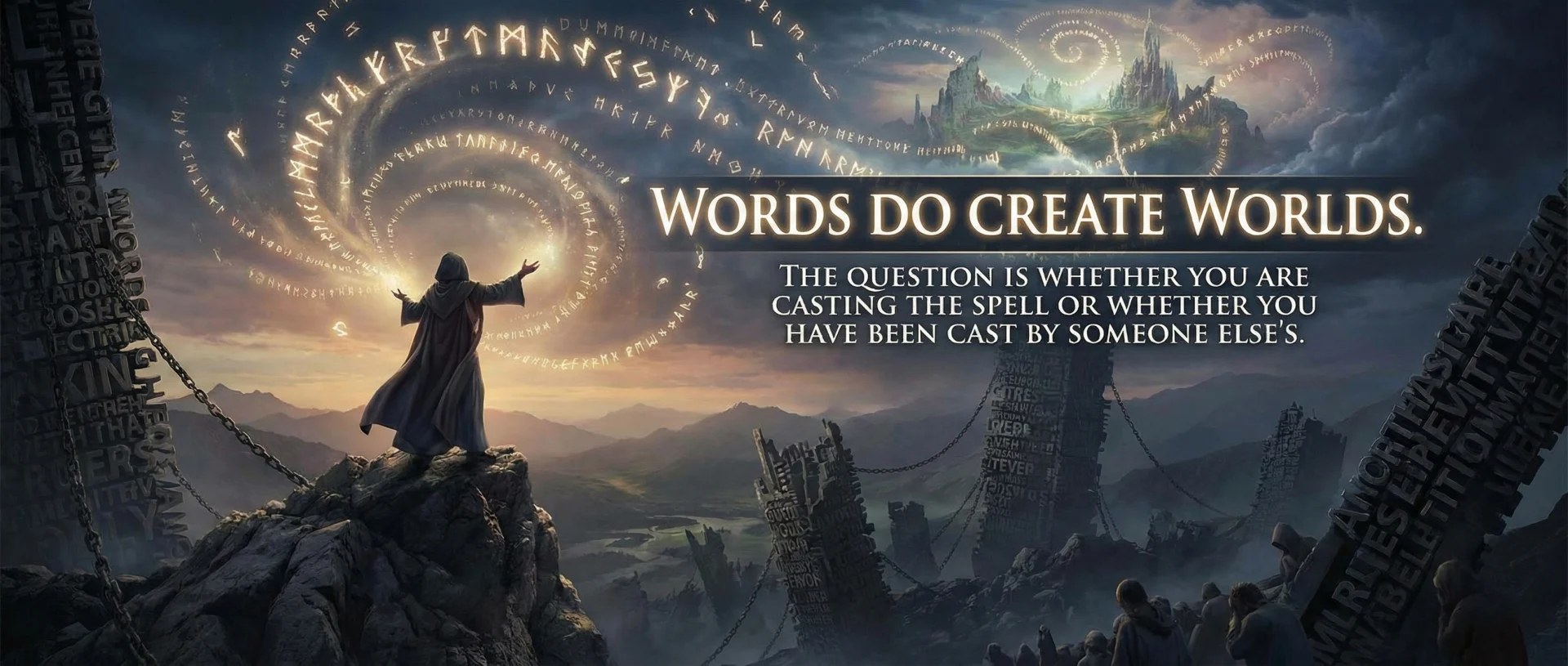
Words do create worlds. The question is whether you are casting the spell or whether you have been cast by someone else’s — and whether you have the wherewithal to notice, in the middle of the performance, that the word for what is being done to you is older than the person doing it, and it has a name, and you already know it, and knowing it is the beginning of the thing that comes after.
Notes & Connective Tissue

