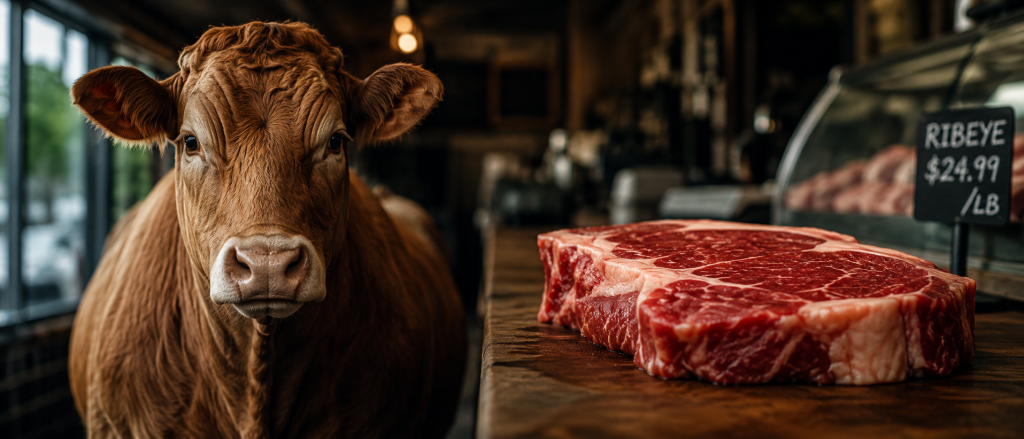
A fresh steak and the animal it came from are made of almost exactly the same stuff. Same protein, same fat, same bacteria tucked into the tissue. An hour after the animal dies, next to nothing has actually been taken out of it. And yet one of them was alive and one of them is dinner, and nobody has ever stood at a butcher counter confused about which is which.
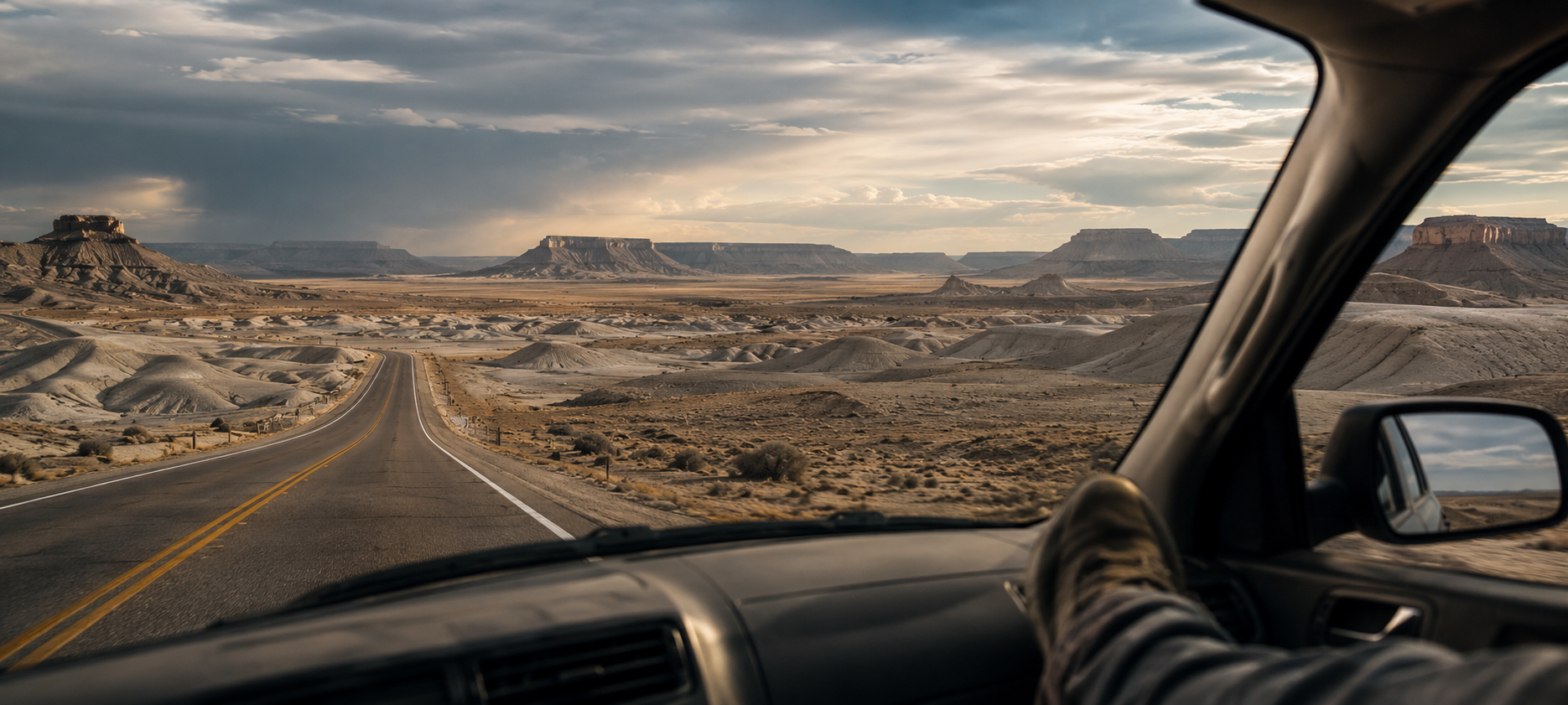
That’s one of the domino thoughts as the surreal landscape zips by. There’s two hundred miles of wasteland left to cross, and I’m in the passenger seat with time to beat. We’re driving to Moab.
Yesterday we stood on the Bonneville Speedway — polygon salt tiles, the remnants of an ancient 20,000-square-mile lake that stretched across western Utah into Nevada and up to its northern lip in Idaho, its old shoreline still scored into the foothills above Salt Lake City like a bathtub ring. As the water evaporated, it left the salt behind: this blank white canvas, so level it invited plentiful daredevils and wanna-be-Evel-Knievels chasing the next speed record.
Today it’s this: beige and gray mounds to the horizon, a few tired bushes, fence posts walking off toward plateaus that have been quietly falling apart since long before anything had eyes to watch them fall.
This land looks empty. It isn’t. Within those bushes there are lizards, ants, beetles, mice, and a whole ocean of bacteria riding shotgun in every one of their guts. Which is what set me off. I started wondering how much life was actually out there, packed into a single cubic foot of it.
The spectrum in my head
And at the top of the whole scale, the fullest cube I could picture — a cube of elephant. One hundred percent life. Obviously. Or so I thought. Let’s ask mankind’s library in my pocket.
The jungle isn’t even the winner
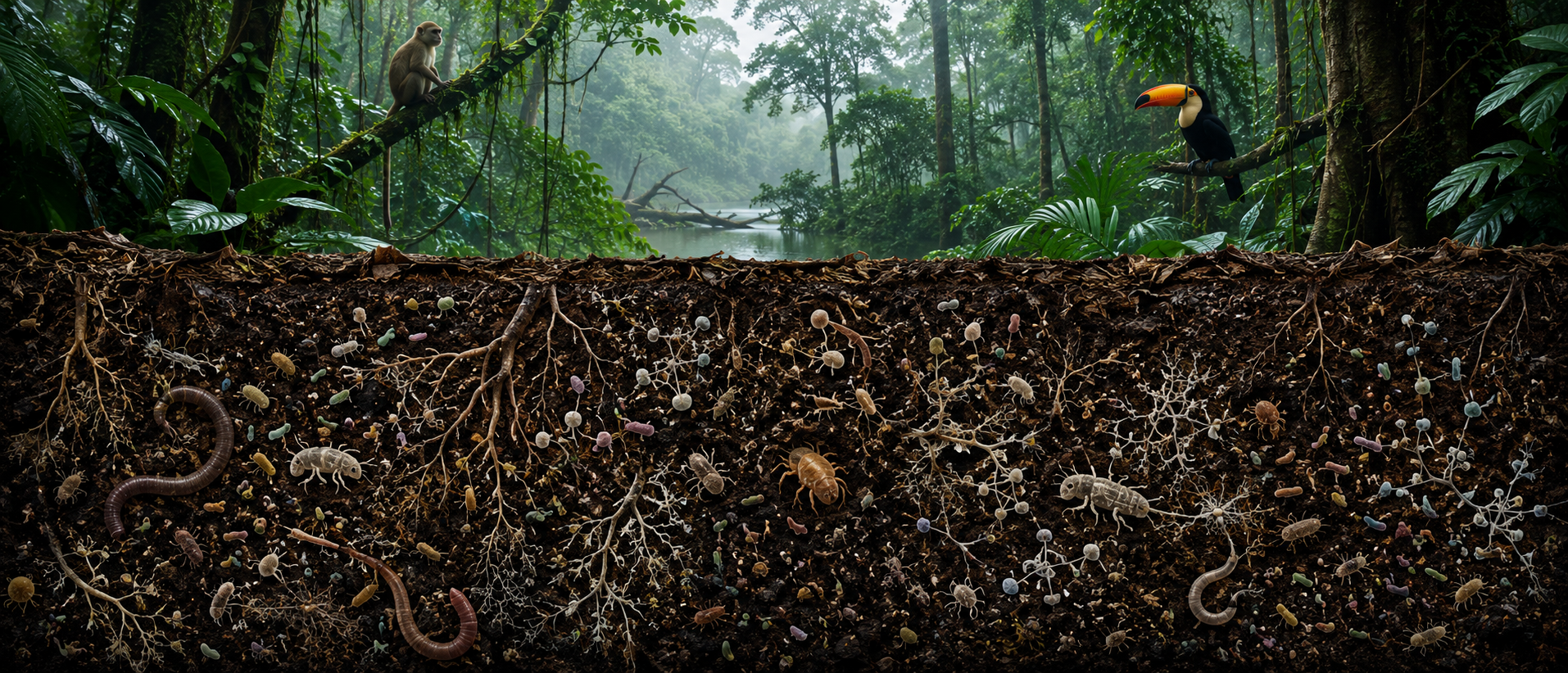
A rainforest is a thin smear of green stretched over a hundred feet of mostly empty air. A leaf here, a monkey there, a lot of nothing in between. Astonishing by the acre. Kind of thin by the cubic foot.
What actually wins? The dirt underneath. One handful of good soil holds something like a billion bacteria, plus fungi and a zoo of things too small to name. Pack that into a cubic foot and the airy canopy doesn’t stand a chance. The plain brown mud under the Amazon is probably more crowded with life than the Amazon.[^1]
Fine. My first stab at ranking this had a bug. But that wasn’t the real problem. The real problem was the elephant.
The elephant cube was two things pretending to be one
The steak has all the material of life — protein, fat, cells, bacteria, the whole grocery list. By pure stuff-per-cubic-foot it scores near the very top, right next to the living animal it was cut from.
And yet it is thoroughly, unarguably not alive.
That’s when it clicked. My whole ranking was two different rulers taped together and read as one. One ruler measures how much biological stuff is in the box. The other measures whether the box is still doing the ‘alive’ thing. The elephant fooled me because in a big warm animal, both max out at the same time, so they looked like a single number. Pull them apart like a cow and a prime rib and the trick falls open.
Life is a verb
One comes from the people who hunt for aliens — fitting, since we were driving straight into country that looks airlifted off Mars. Their version: life is a system that keeps itself running and can change over generations. Built to answer a very practical question — if we find something out there, how will we know?
Another one comes from a physicist. Left alone, everything in the universe succumbs to entropy. Coffee goes cold. Sandcastles slump. Batteries die. Order leaks out of things and never sneaks back in on its own. Life, he said, is the stuff that counters entropy and retains a chemical equilibrium for a while being alive: burning fuel to stay wound up while everything around it unwinds.
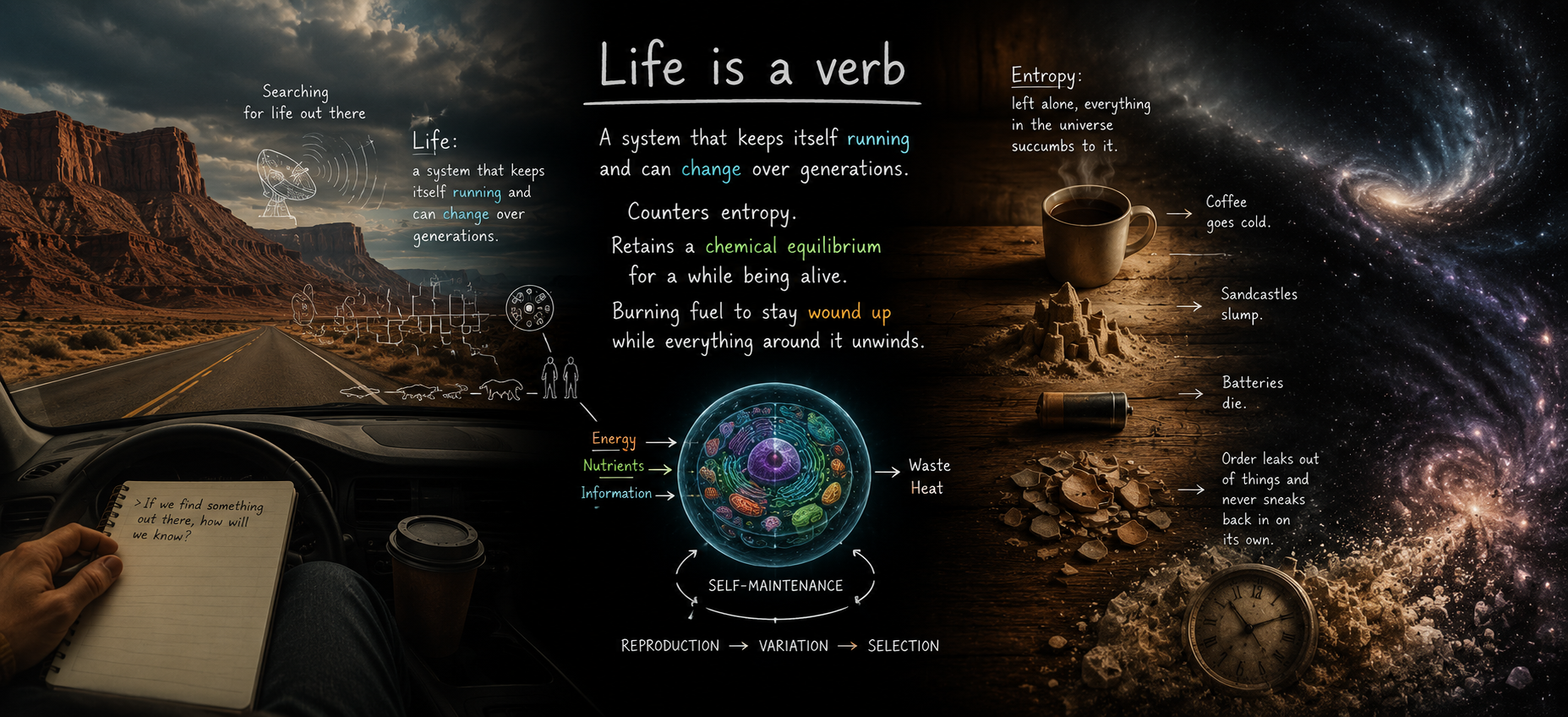
And the one I keep coming back to seems almost too simple: a living thing is a thing that makes and repairs itself, skin and all. A cell builds the wall that protects the chemistry that builds the wall. Round and round, holding itself together from the inside.
That last one earns its keep by what it throws out. A crystal grows — but it doesn’t make itself, it just stacks up. A candle flame keeps itself going, even flickers like it’s trying — but it builds none of its own parts; it just eats wax and air. Both come close. Neither one is repairing itself into existence, moment to moment, the way you are right now without giving it a thought.
So here’s the whole thing in five words: life is a verb, not a noun.
The steak has all the nouns. It just stopped doing the verb. What’s left is sliding back toward the flat gray average — the same flat gray average I’d been staring at through the window all afternoon.
Somebody stirred in the back, asked how much longer. “Another sixty miles, roughly” I said. I did not add and also I’ve been sitting here deciding whether a rock can be alive. Some things take some simmering before they come alive.
The slowest life on Earth is inside the rocks we pass by
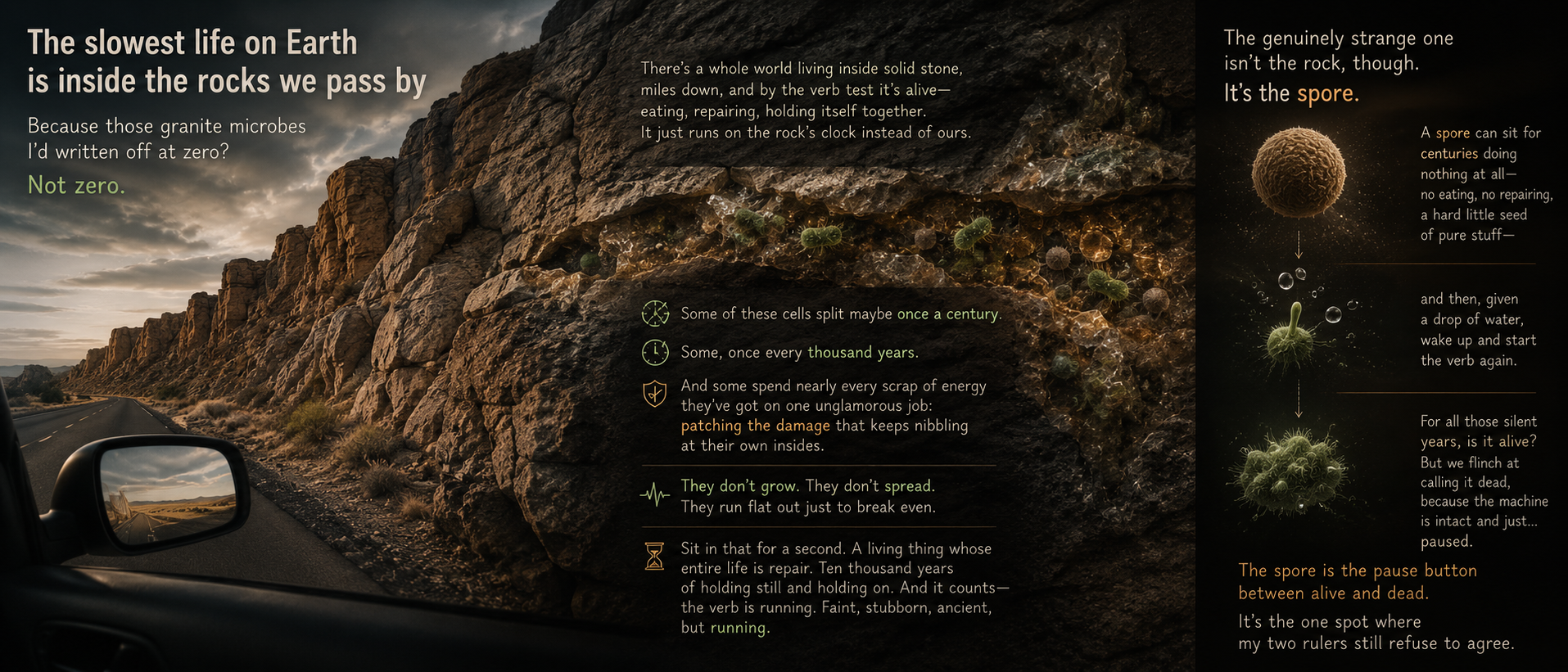
There’s a whole world living inside solid stone, miles down, and by the verb test it’s alive — eating, repairing, holding itself together. It just runs on the rock’s clock instead of ours. Some of these cells split maybe once a century. Some, once every thousand years. And some spend nearly every scrap of energy they’ve got on one unglamorous job: patching the damage that keeps nibbling at their own insides. They don’t grow. They don’t spread. They run flat out just to break even. And by some estimates this stuff accounts for roughly 10% of Earth’s entire biosphere.
Sit in that for a second. A living thing whose entire life is repair. Ten thousand years of holding still and holding on. And it counts — the verb is running. Faint, stubborn, ancient, but running.
The genuinely strange one isn’t the rock, though. It’s the spore. A spore can sit for centuries doing nothing at all — no eating, no repairing, a hard little seed of pure stuff — and then, given a drop of water, wake up and start the verb again. For all those silent years, is it alive? But we flinch at calling it dead, because the machine is intact and just… paused. The spore is the pause button between alive and dead. It’s the one spot where my two rulers still refuse to agree.
The emptiest box in the world is a bio lab on a holiday
The salt flat is empty because it’s brutal.
The edge of the sky is empty because there’s nothing there.
But picture a spotless research lab on a national holiday, everyone home for the day. That room is empty on purpose — held empty by constant human effort against a universe that wants to move into any warm surface with a crumb of food on it.
And look what leaving does. Pull the people out and you’ve pulled the single biggest source of life in such lab. A human being is a walking, damp reservoir — shedding skin, breathing out microbes, seeding every doorknob.
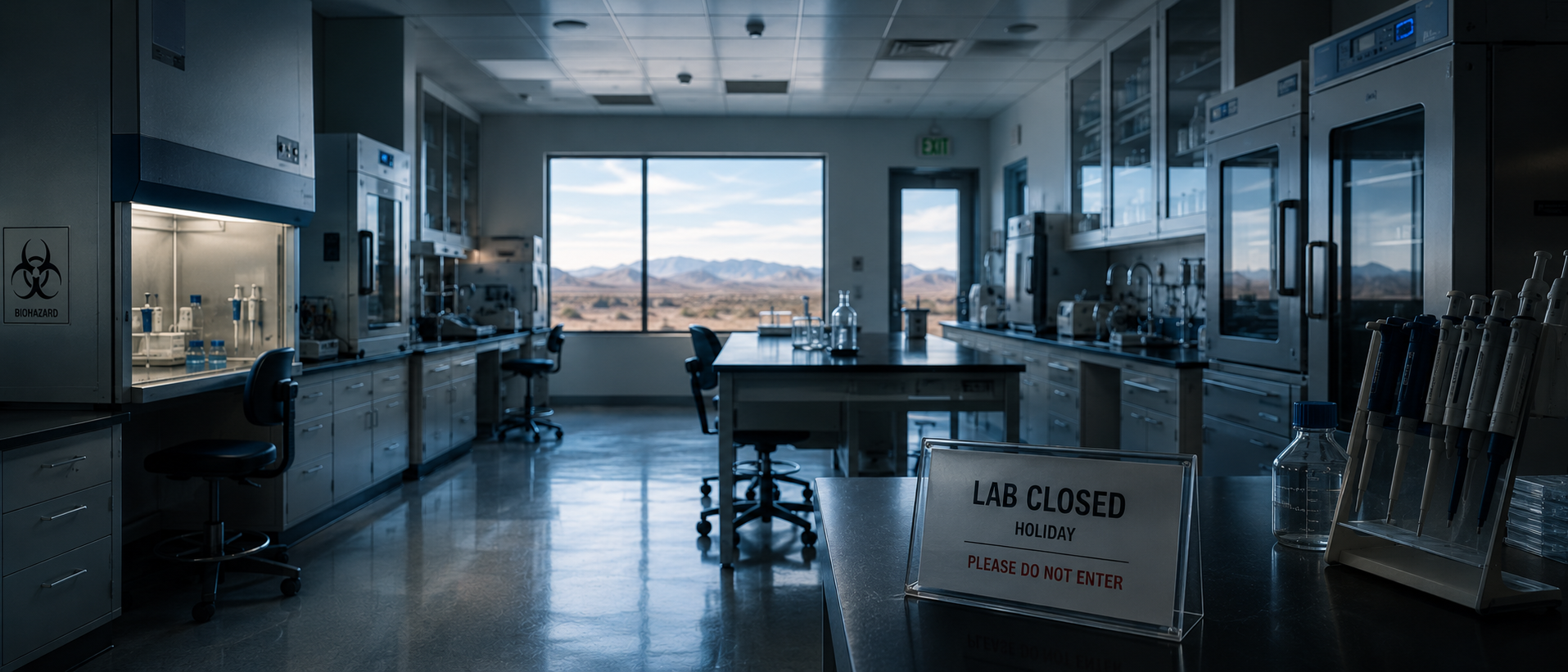
A high security bio lab is claimed sterile… yet, surprise, surprise: The cleanest rooms we’ve ever built are the ones where we assemble spacecraft, scrubbed spotless so we don’t accidentally ship Earth-germs to Mars; but even those rooms grow their own tenants — brand-new extremophile species, found nowhere else, living on the molecular crumbs in the filtered air. One got named after the Mars lander it was discovered next to: Tersicoccus phoenicis, after the Phoenix lander program, tolerating the scrubbing, the desiccation, the radiation, the near-total absence of food, yet still inheriting such artificially hostile place on this planet with all its rooms, nooks, and crannies.
You can’t empty the room. You can only decide who’s tough enough to stay. Scrubbing doesn’t remove life. It holds auditions.
And the viruses? Take them out and you lose nothing on the alive ruler at all — because a virus alone in an empty room isn’t doing a single thing. No eating, no repair, no verb. It’s a machine waiting for a host that went home for the holiday. A lone virus is the steak, not the elephant: packed with biological information, and doing none of the living. The scariest-sounding thing in the room turns out to be no more alive than the countertop.
What the plateau was telling me
The Colorado plateau (and whatever might be living deep inside it…) is, underneath, playing out the same old chemistry over a stretch of time I can’t really fit in my head. Ever changing. Never still.
The rock walls and cliff slowly crumble and tumble, coming apart, boulder by boulder, grain by grain. And the microbes within are holding themselves together, repair by repair. That’s the whole line between alive and not. It was never about moving — the rock moves plenty, just slowly. It’s about which way you’re pointed: coming apart, or holding on.
And here’s the truth I couldn’t shake, the one that kept me staring out the window, realizing what I’m looking at: being alive was never something you have. It’s something you keep doing. The steak has everything a life has except the doing. Stop, and all the stuff stays exactly where it was — only the holding-on ends.
Ten million years from now this plateau will be gravel and wind, long gone, and so will I. Just like my dad passed away yesterday while we were on our way to the salt flats. I love you, dad. I think you travelled this same Moab-bound highway too… full of your own wonder.
[^1]: If you ever want the real numbers, there’s a landmark 2018 census of all life on Earth (Bar-On, Phillips & Milo) that puts the grand total around 550 billion tons of carbon — plants about four-fifths of it — and confirms the humbling part: the hidden life underground vastly outweighs anything our jungle-shaped intuitions expect.

