

You stub your toe at 3am on the way to piss and the pain is so complete, so non-negotiable, that every spiritual insight you’ve ever had evaporates. There is only: throbbing, the cold floor, your idiocy for not turning on the light. The ego’s emergency broadcast drowns out everything: Why does this keep happening to me?
And in that moment—that perfectly ordinary moment of being human and stupid and hurt—you forget that you are God playing hide-and-seek with itself.
The forgetting isn’t a bug. It’s the entire game.

I. The Wrinkle That Started Everything
My mum used to say the universe began with a word. She was close, but words came later—after the wrinkle had already decided to misunderstand itself on purpose.
Before the Big Bang was the Big Thought. Not a thought about something. Just: thinking itself into existence, a disturbance in Nothing so slight it could have dissolved back immediately. But it didn’t. It got curious.
That curiosity—that first “huh?”—is still echoing. You’re reading it right now. I’m writing it. The space between us that feels so convincingly real is just the echo playing with different harmonics, pretending there’s a “you” and an “I” when really there’s only: this-ing.
The physicists almost caught it. They kept drilling down past atoms, past quarks, past the Planck length, looking for the fundamental stuff. And they found—wonderfully, terribly—nothing. Not empty space (that’s still something). Not darkness. Just the absence that precedes presence, the silence before music, the pregnant pause that contains every word that could ever be spoken.

Heisenberg’s uncertainty principle whispers it: you can’t measure both position and momentum because the observer and observed are not actually separate. The act of looking changes what’s there. Not because consciousness is powerful—because consciousness is all there is, hallucinating matter to give itself something to do on a Sunday afternoon that lasts forever because time is another lie we tell ourselves to make the dream feel linear.1
Ramana Maharshi spent years in a cave asking “Who am I?” until the question ate itself. What he found: the questioner and the questioned were the same mouth swallowing its own tail. The Ouroboros isn’t a symbol. It’s a documentary.
II. How the Dream Maintains Itself (And Why You Keep Falling For It)
Here’s what they don’t teach you in philosophy 101:
The subject-object split is a magic trick performed so skillfully you’ve forgotten you’re both the magician and the audience.
Right now, you think you’re “in here” reading “out there.” But watch closely: where’s the boundary? Where does the text end and your awareness of it begin? You can’t find the seam because there isn’t one. There’s only the seamless knowing of these words, and you’ve retroactively divided it into “me” and “not-me” to create the illusion of encounter.
The Buddhists have a term: pratītyasamutpāda—dependent origination. Nothing exists independently. Every “thing” is a knot in the web of everything else, with no actual substance at its core. Pull the thread and it’s not that things disappear—they were never things to begin with. Just processes. Verbs pretending to be nouns.
You are not a being having experiences. You’re experiencing pretending to coagulate into a being.

Donald Hoffman’s interface theory of perception gets halfway there: he argues we don’t see reality as it is—we see a user interface, like desktop icons hiding the computer’s actual circuitry. He’s right, but he doesn’t go far enough. It’s not that reality exists behind the interface. The interface is all there is. Icons all the way down, until you zoom out far enough to see: oh, I’m the screen and the pixels and the hand moving the mouse.
But this realization is unstable. The ego—that beautiful, tragic defense mechanism—needs separation to function. It’s the bouncer at the club of selfhood, checking IDs, maintaining the velvet rope between “me” and “everything else.” Without that rope, how would you know where to send the anxiety? Who would feel insulted when someone cuts you off in traffic? So the ego constructs narrative. It takes the raw, meaningless flux of sensation and weaves it into a story with characters, plot, stakes.This happened because that happened, and if I’d only done X differently, Y wouldn’t have followed.Causation is the ego’s favorite drug. Time is its dealer.

III. The Daily Struggle, Or: What Happens When God Gets A Parking Ticket
Let’s get specific. You meditate. You read the books. You know—intellectually, philosophically, maybe even experientially in peak moments—that you are the dreamer, not the dream. And then:- Your partner looks at their phone while you’re talking
- The job offer goes to someone less qualified
- Your body betrays you (pain, illness, the gradual entropy of aging)
- A global pandemic traps you indoors for two years
And suddenly the smooth loop of “I create reality with my thoughts” glitches out. The ego rushes in with its emergency protocol: assign blame, construct timeline, find exit strategy. You’re no longer the author of your experience—you’re the victim of circumstances, scrambling to regain control over a life that’s happening to you.
This is what Chogyam Trungpa called “spiritual materialism”—using enlightenment concepts as another form of ego protection.“I’m not suffering, I’m observing my suffering.” “This pain is an illusion.” “Everything happens for a reason.”

But here’s the genuinely psychedelic part:
Even the resistance is you. Even the forgetting is you. Even the ego’s desperate scramble to maintain separation is you, practicing the elaborate art of self-deception.
The boundary you can’t cross? You’re imagining it—so vividly, so committedly, that you’ve fooled yourself. The other person who won’t bend to your will? That’s you wearing a mask of otherness convincing enough to pass the Turing test of separate selfhood.
You’re not bad at manifesting your reality. You’re incredible at it. You’ve manifested something so resistant to your will that it feels genuinely external. That’s advanced-level dreaming.
Rainer Maria Rilke, in a letter to a young poet:
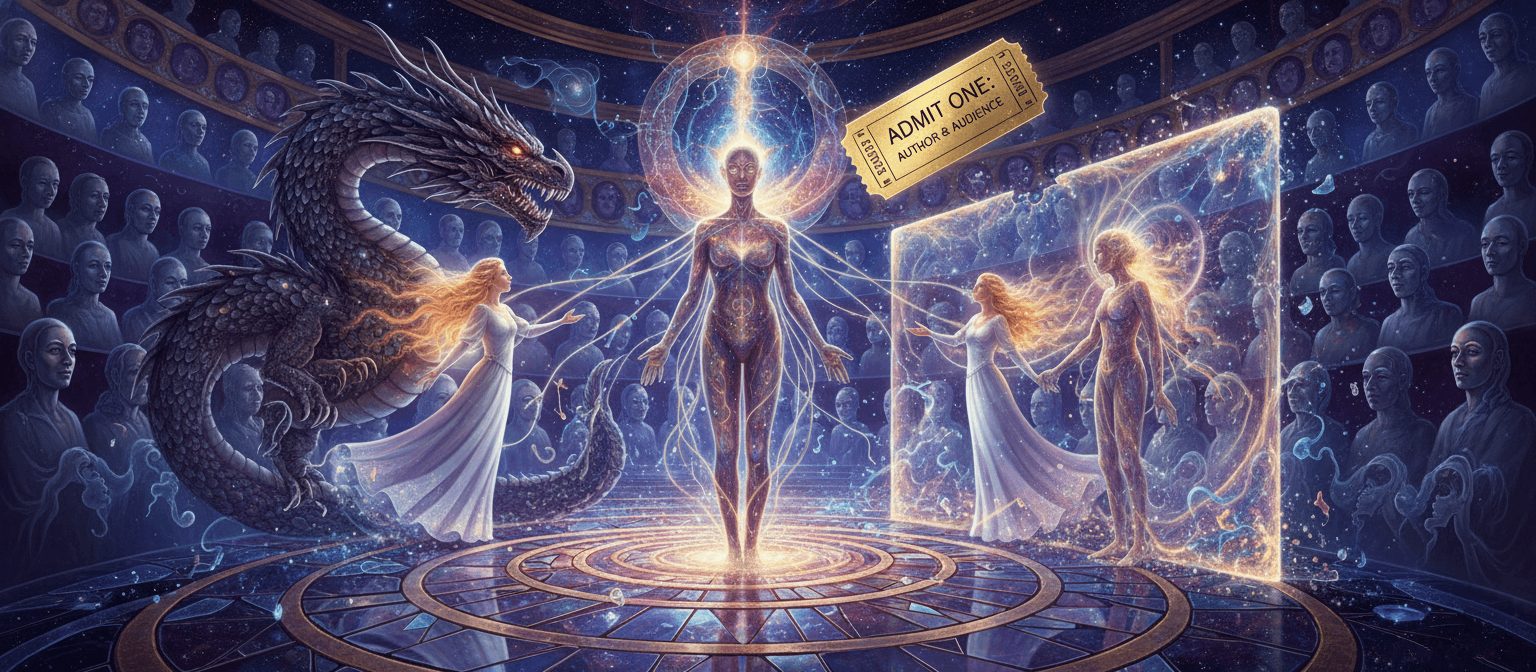
“Perhaps all the dragons in our lives are princesses who are only waiting to see us act, just once, with beauty and courage. Perhaps everything that frightens us is, in its deepest essence, something helpless that wants our love.”
The dragons are you. The princesses are you. The fear, the courage, the love—all you, playing every role in a one-person show so elaborate you bought a ticket and forgot you wrote the script.2
IV. The Forgotten Senses: Breath and Voice as Participatory Probes
We talk about five senses like they’re the complete inventory. But we’ve forgotten the most radical ones—the senses that don’t just receive the world but actively participate in creating it moment to moment.
Breath.
Not just a physiological necessity. A sense—the direct, continuous experience of the inside/outside boundary dissolving with every inhale and exhale. There’s no moment where air is definitively “not you” versus “you.” It’s always mid-transition, always shared, always proving that the atmosphere is your extended body and your lungs are just a temporary holding pattern in a larger circulation.
You are breathing the same nitrogen atoms that dinosaurs breathed. The same oxygen molecules that passed through Einstein’s lungs as he conceived relativity, through your grandmother’s lungs as she gave birth to your mother, through the lungs of the person who just walked past you on the street. The boundaries are fictional. Breath keeps exposing the lie.

Voice.
The sculpting of shared air into meaning. You’re not passively receiving the world—you’re actively probing it, sending out vibrations and reading what comes back. Like bats echolocating through darkness, we humans constantly echolocate through emotional space:
Are you there?
Do you feel this too?
Does this meaning land?
Every conversation is a sonar ping. Every joke, every argument, every “I love you” or “fuck you”—acoustic probes testing the shape of intersubjective reality, mapping the contours of what’s possible between consciousnesses.
The dissonance comes when you’re clinging to a fixed worldview, sending out the same ping repeatedly and getting angry when the echo doesn’t confirm what you expected. The ego wants the environment to stay static so its map remains valid. But reality keeps updating, other consciousnesses keep being sovereign, and the echoes keep coming back saying: your map is outdated, time to adjust.
The bat doesn’t argue with the echo. It updates its flight path.
Maybe that’s the practice.3

V. The Electromagnetic Spectrum of Self-Deception
Let’s map how the dream maintains its convincingness through the sensory apparatus—because the body is the original special effect, the prosthetic that makes the play feel real.
Vision: Distance. The world laid out there, apparently existing whether you look or not. The ultimate lie. Close your eyes—where did it go? Not into darkness. Into absence. Open them—where did it come from? Not from “out there.” From the same place dreams come from when you’re asleep, except now there’s consensus (we mostly agree what we’re seeing) which makes it feel objective.
Hearing: Vibration arriving from elsewhere. Someone calls your name and you turn, as if the sound traveled to you rather than arising as you. But listen closely to silence—it’s not the absence of sound. It’s the canvas on which sound appears, and the canvas is prior, is primary, is you.
Touch: The skin as border patrol. This is the most convincing trick—the sense that you end where the air begins. But grab your own hand. Which hand is touching, which is being touched? They’re trading roles so fast you can’t catch them. The boundary wavers. Push harder—does the sensation happen in your skin or in your nervous system or in your brain or in your awareness? Follow it back to its source and it dissolves into: happening.
Taste: The threshold where “not-me” becomes “me.” You put an apple in your mouth and at what exact moment does it stop being apple and start being you? In the chewing? The swallowing? The digestion? The chemical transformation into blood sugar? There’s no clean line. Just a gradient from “object” to “experience” with no actual border.
And then the chemicals—the substances that reveal how flimsy the whole construct is:
Alcohol makes you brave or sad depending on the evening. Same molecule, different story. The alcohol isn’t “causing” anything—it’s just lowering the volume on the ego’s narrative generator, and what rushes in (courage, grief, horniness, rage) was always there, always you, just edited out of the regular broadcast.

Sugar, coffee, SSRIs, heartbreak, meditation, sleep deprivation, falling in love, winning an argument, losing a parent—all different knobs on the same control panel, tuning the receiver to different frequencies of you.
The addictive quality (whether substance or behavior or emotion) is the dream caught in a recursive loop, one vibration pattern echoing so intensely it generates its own gravity well. You fall into it not because you’re weak but because the pattern is working—it’s providing some texture, some evidence that you exist, even if that evidence is pain.
William James, in The Varieties of Religious Experience, documented dozens of mystical states induced by everything from fasting to nitrous oxide. His conclusion: consciousness is not produced by the brain—it’s filtered by it. The brain is a reducing valve, constraining infinite awareness into a manageable stream called “being a person who needs to buy milk and pay taxes.”
Remove the valve temporarily (psychedelics, meditation, ecstasy, trauma) and the stream widens. You remember—briefly, vividly—that you are not the trickle. You are the ocean pretending to be a faucet.
Angles out angels, my friend used to say. Every sense, every sensation, every altered state—just different angles on the same singular dreaming. Or if you prefer the mystical framing: different angels, each a messenger showing you another face of yourself, none more “true” than the others.4

VI. The Filmmaker as Consciousness-Angle-Adjuster
We’ve built entire industries around identifying people who can adjust the angle of collective dreaming.
Kubrick, Tarkovsky, Lynch, Malick—they’re not showing you “the world.” They’re showing you how consciousness looks at the world from a specific vector. The camera angle isn’t neutral; it’s ontological. Where you place the lens is where you place awareness, and suddenly the audience inhabits that particular focal point of the dream.
Vertigo’s dolly-zoom doesn’t just create a visual effect—it creates the sensation of dissociation, of reality becoming unstable. You don’t watch it; you experience your own perceptual apparatus glitching. Hitchcock temporarily hijacked your angle of dreaming and showed you what vertigo feels like from the inside.
2001’s star-gate sequence doesn’t depict transcendence—it induces it. Kubrick understood: if you show the right sequence of images at the right rhythm, you can trigger an altered state in the viewer. The film doesn’t represent the experience; it is the experience.

We immortalize these Directors not because they’re creating something separate from the dream, but because they’re lucid dreamers who can manipulate the dream’s parameters while staying inside it. They’re showing the collective: “Look, consciousness can do this too. Did you know you could vibrate at this frequency?”
The claim-staking through film schools, theory, criticism—that’s the ego trying to systematize what’s ultimately unsystematizable. “If I learn these techniques, I too can adjust angles.” And it works, partially. You can hone the craft, master the grammar of cinema, study the masters.
But the true auteurs aren’t just technically skilled—they’re permeable. They let the dream dream through them rather than trying to control it. They’re channels, not commanders. The best films feel like they arrived from somewhere else, fully formed, inevitable—because in a sense, they did. They were always in the collective unconscious, waiting for the right aperture to expose them.

VII. The Screen as Mirror, The Scroll as Compulsion
But now we’ve taken this ancient hunger—to share perception, to say “look, do you see what I see?”—and weaponized it into a feedback loop that’s too fast, too numerous, too optimized for engagement over meaning.
TikTok isn’t showing you life. It’s showing you life compressed into the exact temporal rhythm that prevents reflection. Scroll, consume, react, scroll. The breath between inputs—the moment where you could integrate what you just witnessed—has been deleted from the interface.
You’re echolocating so rapidly the echoes overlap into white noise.
And the algorithm learns: this angle gets response, so show more of this angle, until your entire feed is one emotional frequency on loop. The echo chamber isn’t just ideological—it’s perceptual. You stop encountering angles that challenge your current vibration because the system has optimized for reinforcement, not expansion.
Instagram used to be “here’s a photo I took.” Now it’s “here’s proof I exist in a way you should envy.” The dopamine hit comes not from sharing perception but from metric validation—likes, comments, shares. The content becomes secondary to the response, and you start creating not what moves you but what moves the algorithm.

Quality-focus can still elate. When you slow down enough to actually metabolize a piece of art, a film, a long-form essay, it can shift your entire angle on reality. But that requires deliberate disconnection from the dopamine treadmill. It requires saying: “I will not consume the next input until I’ve fully digested this one.”
Which is hard. Because the system is designed to make not-consuming feel like missing out, like falling behind, like losing access to the shared dream everyone else is participating in.
The moat-building happens when you decide: I know how reality works, and inputs that contradict my model are threats, not gifts.
Whether it’s:
- Political tribalism (my side has truth, yours is delusion)
- Aesthetic snobbery (only this kind of art counts, the rest is trash)
- Spiritual materialism (my path is authentic, yours is ego)
- Academic gatekeeping (only peer-reviewed angles are valid)
All variations of the same move: hardening the boundary to protect the existing angle from being adjusted.
But recognizing our “divine context”—that every angle is a valid facet of the same singular dreaming—requires porousness. It requires being willing to let other people’s echoes reshape your map. Not abandoning discernment (some angles are more useful, some are more beautiful, some are more true), but staying open to the possibility that someone else’s angle might reveal something yours can’t access alone.5

VIII. Peirce’s Four Methods (Or: How We Fixate Belief to Avoid the Abyss)
Charles Sanders Peirce saw this coming in 1877. In “The Fixation of Belief,” he identified four ways humans stabilize their worldviews when doubt arises—four strategies for dealing with the anxiety of not-knowing:
1. The Method of Tenacity: “I believe this, and I will continue believing it no matter what.”
Pure ego-defense. You encounter contradictory evidence and just… ignore it. Curate your information diet to avoid dissonance. This is the person who’s been wronged once and decides an entire group is irredeemable. It’s the conspiracy theorist who treats every counter-argument as proof of the conspiracy’s depth.
Peirce’s critique: It works individually but collapses socially. You can maintain your belief through sheer willpower, but the moment you encounter someone with equal tenacity holding the opposite belief, the method reveals its arbitrariness.

2. The Method of Authority: “I believe this because the institution/leader/tradition says so.”
Outsource the epistemic anxiety to a trusted source. The Church says it, therefore it’s true. The Party says it, therefore it’s true. The Journal published it, peer-reviewed, therefore it’s true. More stable than tenacity because it creates consensus—a shared framework where doubt can be managed collectively.
Peirce’s critique: It only works within the boundary of the authority’s reach. Different authorities contradict each other (Catholic vs. Protestant, Marxist vs. Libertarian, DSM-IV vs. DSM-V), and there’s no meta-authority to adjudicate. Plus, it requires suppressing individual inquiry—heresy and dissent threaten the system.

3. The Method of A Priori: “I believe this because it’s self-evidently reasonable, agreeable to logic and human nature.”
This sounds more sophisticated—you’re not blindly clinging or deferring to authority, you’re using reason. But Peirce’s devastating insight: what feels “self-evident” is culturally conditioned, temperamentally biased, and shifts with fashion.
The Rationalists thought they were doing pure logic, but their “self-evident truths” aligned suspiciously well with their class interests. Descartes’ “clear and distinct ideas” were clear and distinct to a 17th-century French Catholic mathematician—not universally.
Peirce’s critique: This method feels like freedom (you’re thinking for yourself!) but it’s taste disguised as truth. You believe what’s “reasonable” to your particular angle, surround yourself with people who share that angle, and mistake consensus for objectivity.

4. The Method of Science: “I believe this provisionally, based on evidence that could, in principle, be overturned by better evidence.”
Peirce’s preferred method—not because it gives you Truth with a capital T, but because it’s the only method that builds in self-correction. You form hypotheses, test them against reality, update based on what comes back. The echo matters more than your prior belief.
Crucially, this isn’t “scientism” (science as new authority). It’s a process: fallibilism, openness to revision, intersubjective verification. You believe something because it’s the best current model given available evidence, and you hold it lightly, ready to update.
This is the only method that can withstand long-run contact with reality. Tenacity breaks on social contact, authority breaks on competing authorities, a priori breaks on cultural relativity. But the scientific method—properly understood as radical openness to being wrong—can survive because it expects to be wrong and treats wrongness as information, not threat.

Here’s the trap: We’ve now built systems that optimize for Methods 1-3 and punish Method 4.
Social media rewards:
- Tenacity (strong opinions, never wavering, “owning” your take)
- Authority (blue checks, credentialism, “experts say”)
- A Priori (what “feels right” to your in-group, aesthetic sorting)
It punishes:
- Uncertainty (admitting you don’t know is weakness)
- Revision (changing your mind is “flip-flopping”)
- Nuance (too many words, didn’t read, ratio’d)
The algorithm is a fixation-of-belief machine optimized for engagement, not truth. And engagement comes from certainty, tribal signaling, emotional intensity—all the things that make Method 4 impossible.
Your “dopamine scrolling” and “exclusionary echo-chamber-moat-building” are features, not bugs. The system wants you to fixate. It wants you to stop echolocating and start broadcasting—loudly, confidently, without room for the echo to come back and complicate things.

The way out: Maybe breath-as-sense is also breath-as-epistemology.
Inhale: take in the new information, the contradictory angle, the dissonant echo
Pause: hold it without immediately categorizing as threat or confirmation
Exhale: release the need to know for certain, let the uncertainty breathe
Pause: rest in the groundlessness before the next input arrives
Repeat.
That’s Peirce’s Method 4 embodied. That’s the bat’s echolocation. That’s the dream recognizing it can update its own code in real-time.6

IX. The Paradox of Solitary Sovereignty (Or: If Everyone’s God, Why Are You Such An Asshole?)
Let’s address the obvious question:
If I’m the dreamer and you’re the dreamer and we’re all localizations of the same singular awareness… what the fuck is empathy? And why does it matter if I hurt you, since “you” are also “me” and we’re both made of the same nothing?
This is where non-duality gets ethically dicey, and where spiritual narcissists use “we’re all one” to excuse being dickheads.
Here’s the resolution, and it’s subtle:
You are not God. You are how God experiences forgetting it’s God.
The difference matters.
If you’re God—capital G, sovereign creator—then sure, why not rewrite the rules? Why care about other people’s pain when you could just imagine it away?
But if you’re a localization—a particular eddy in the stream, a focal point where awareness has temporarily narrowed into the experience of being separate—then other localizations are not obstacles. They’re necessary reflections.
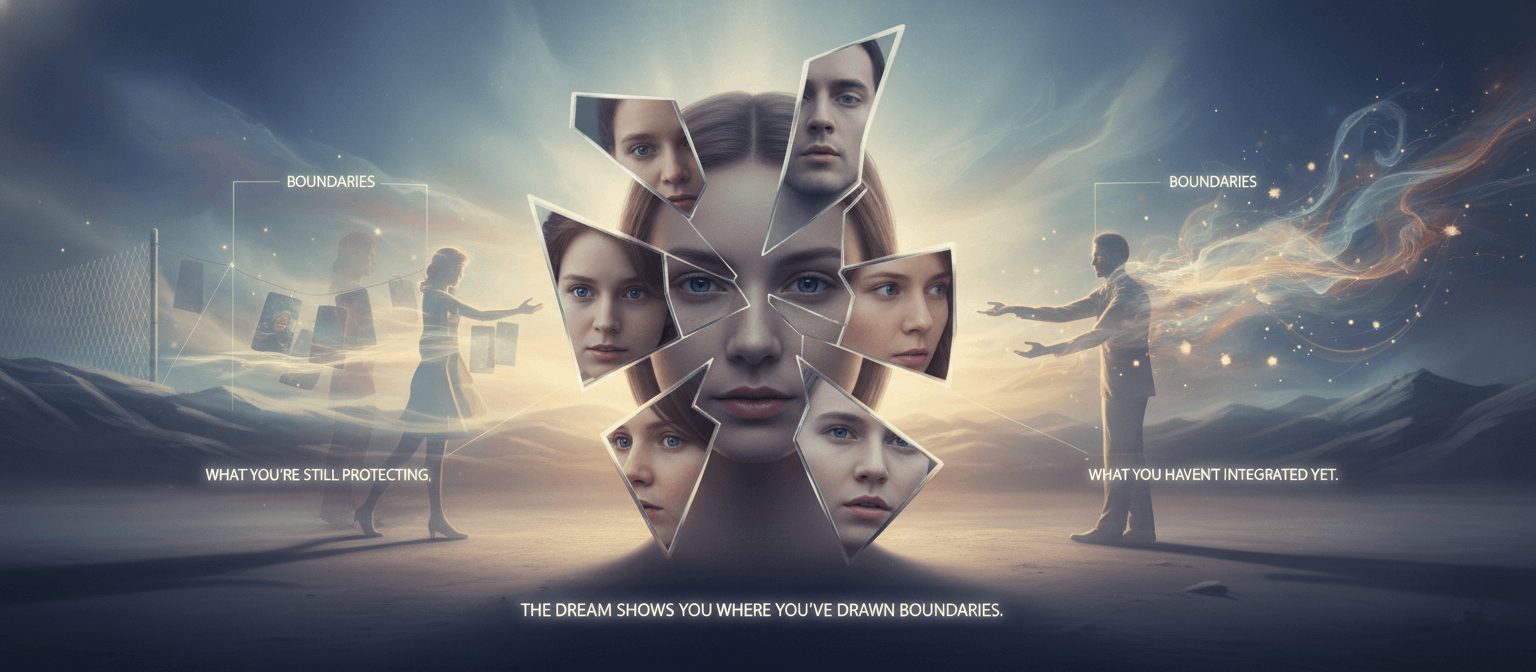
You cannot see your own face without a mirror. Other people are how you see yourself from angles you can’t access alone. Their resistance isn’t infringement on your reality—it’s the dream showing you where you’ve drawn boundaries, what you’re still protecting, what you haven’t integrated yet.
Martin Buber called this the “I-Thou” relationship versus “I-It.” Most of the time, we treat others as Its—objects to be used, obstacles to navigate, extras in our movie. But occasionally, in moments of genuine meeting, another person becomes Thou—not an object but another subject, equally real, equally central to their own experience. And in that meeting, something happens that transcends both: a third thing, a between-space where the dream recognizes itself from two angles simultaneously.
Empathy, then, is not pity. It’s the dream recognizing different textures of itself and softening accordingly. You soften toward others not because they’re truly separate (they’re not), but because their suffering is yours wearing a different mask, and causing pain to the mask is causing pain to the face beneath it, which is your face, which is the only face there is.7
Representation through participation. You’re the audience and every actor. The play only works if you fully commit to each role—including the ones that hurt, the ones that fail, the ones that never get resolution.

X. When The Dream Infringes (And What That Reveals)
So you’re flowing. You’re in the zone, reality is cooperative, you’re playing with your sovereignty. And then:
- Someone says no.
- The job falls through.
- Your body breaks.
- The plane is delayed.
- The person you love doesn’t love you back.
The dream infringes. And it feels like proof—see? I’m NOT in control. There IS a world separate from my consciousness, and it just fucked me.
But watch what’s actually happening:
The defensive mechanism activates. Not because the boundary is real, but because you’ve decided it’s real. The ego isn’t wrong for defending you—it’s doing exactly what it evolved to do: maintain the coherence of the self-story in the face of contradiction.
The uncrossable boundary—the “no” you can’t penetrate, the limit you can’t imagine past—is yours. You created it. Not consciously, not deliberately, but as part of the dream’s architecture. Because a dream where you have total control is boring. There’s no surprise, no risk, no stakes.
So you dream limits. You dream resistance. You dream other wills that won’t bend to yours—not to torture yourself, but to make the game interesting.

Nagarjuna’s Mūlamadhyamakakārikā (the foundational text of Madhyamaka Buddhism) argues that emptiness (śūnyatā) doesn’t mean nihilism—it means radical interdependence. Nothing has inherent existence, but that very lack of inherent existence is what allows things to function. The glass can hold water precisely because it’s empty of “glass-ness”—it’s just atoms arranged in a temporary pattern that appears solid enough to be useful.
Same with the boundaries. They’re empty of inherent reality, but that emptiness allows them to work—to create the friction that makes experience possible.
So when someone infringes on your reality, two truths hold simultaneously:
- They are you, another localization of the same awareness, and the resistance is self-generated
- They are sovereign, equally real within the dream, and their “no” is valid
The paradox doesn’t resolve. It’s not supposed to. You’re not meant to collapse the distinction fully (that’s death, or enlightenment, which might be the same thing). You’re meant to play in the tension—to hold both truths lightly, to soften into the impossibility.
This is what the Zen masters mean by “carrying water, chopping wood.” After enlightenment, the dream continues. You still stub your toe. It still hurts. But the meaning of the hurt shifts. It’s no longer proof of your separation from Source. It’s Source saying surprise, motherfucker—bet you forgot I could do this.8

XI. Nothing Is Painful Unless You Think So (But Good Luck With That)
Let’s talk about spiritual bypassing, because I can feel the objection forming:
This is all very poetic, but if I’m in chronic pain, or grieving, or trapped in an abusive situation, telling me “it’s just your thoughts” is not only useless—it’s cruel.
You’re right. So let me be precise:
Pain and suffering are not the same thing.
Pain is sensation—raw, neurological, undeniable. You touch a hot stove, nociceptors fire, the signal reaches your brain. That’s pain. It’s mechanical. It happens whether you’re enlightened or not.
Suffering is the story you tell about the pain. The “why me,” the “this shouldn’t be happening,” the “I can’t survive this,” the projection into the future where it never ends. That’s suffering. And that is optional—not because you can think it away, but because you can see it for what it is: a narrative layer the ego adds to make sense of the senseless.
Shinzen Young (a neuroscientist and meditation teacher who’s done fascinating work with pain patients) has a formula:
Suffering = Pain × Resistance
If resistance goes to zero, suffering goes to zero—even if pain remains. You can be in agony and not suffer if you stop fighting the agony, stop making it mean something about you or your worth or the fairness of the universe.
This is not the same as passivity. It’s not “accept your abuse.” It’s: recognize that the pain is happening, and recognize that your narrative about the pain is a separate layer you can work with.

Viktor Frankl survived Auschwitz by finding meaning in meaninglessness. His conclusion:
“Everything can be taken from a man but one thing: the last of the human freedoms—to choose one’s attitude in any given set of circumstances, to choose one’s own way.”
He’s not saying the Holocaust wasn’t real or that positive thinking would have stopped it. He’s saying: even in hell, there’s a hairline fracture of agency in how you meet what’s happening. Not control over circumstances. Control over your relationship to them.
So no, you can’t think away chronic illness. You can’t manifest your way out of systemic oppression. You can’t “high vibe” past trauma. The dream has physics—internal rules it follows even though they’re made up. Gravity still works even though it’s just curved spacetime which is just geometry which is just math which is just pattern which is just… you get it.
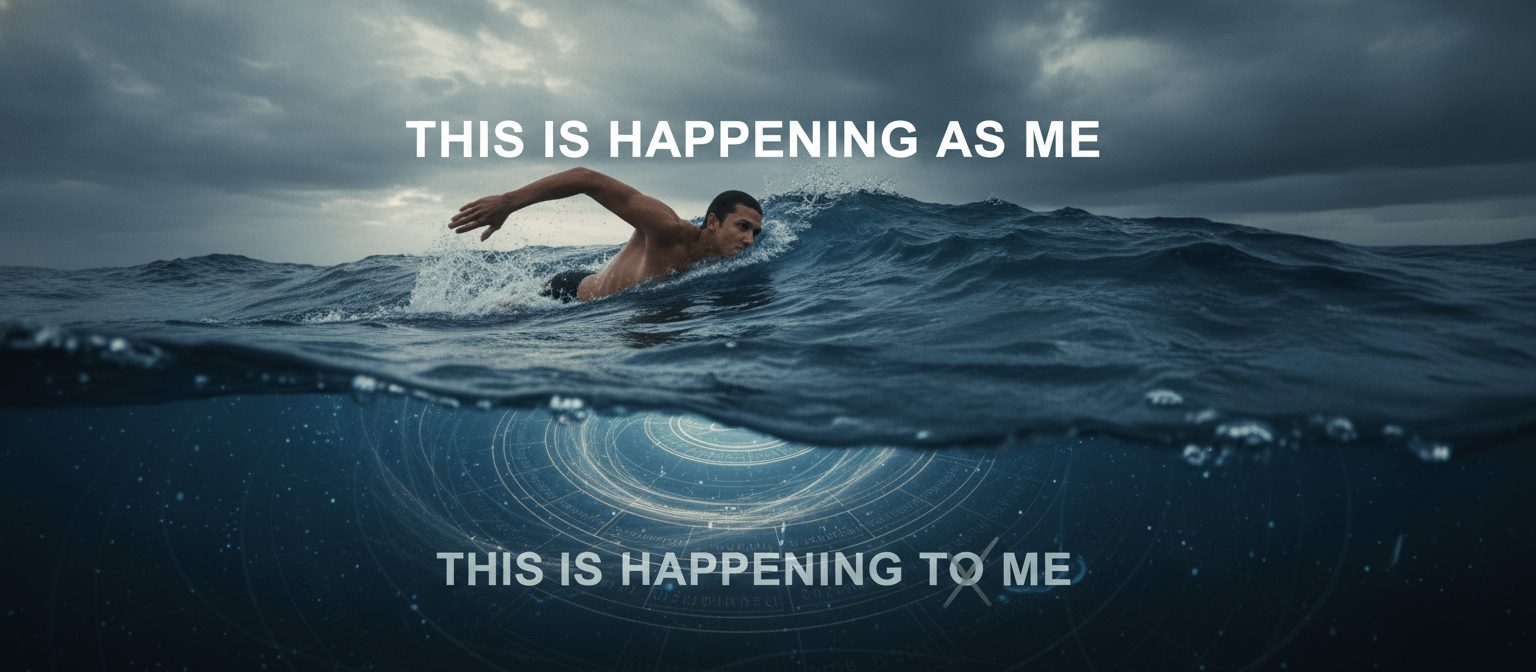
But you can shift from “this is happening TO me” to “this is happening AS me.” Same pain, different framing. And that shift—subtle, almost unnoticeable—is the difference between drowning and swimming in the same water.9
XII. What’s Beyond This Dream? (Spoiler: You’re Not Going To Like It)
People want the secret ending. The cheat code. The moment where you wake up from the dream into some meta-reality that’s more real, more stable, more *something*.
Sorry. There isn’t one.
Nothing is beyond this dream because there is no “beyond.” There’s only Nothing—which is also Everything, which is also this, right now, the words on the screen and the awareness reading them and the space between that never actually separated them.
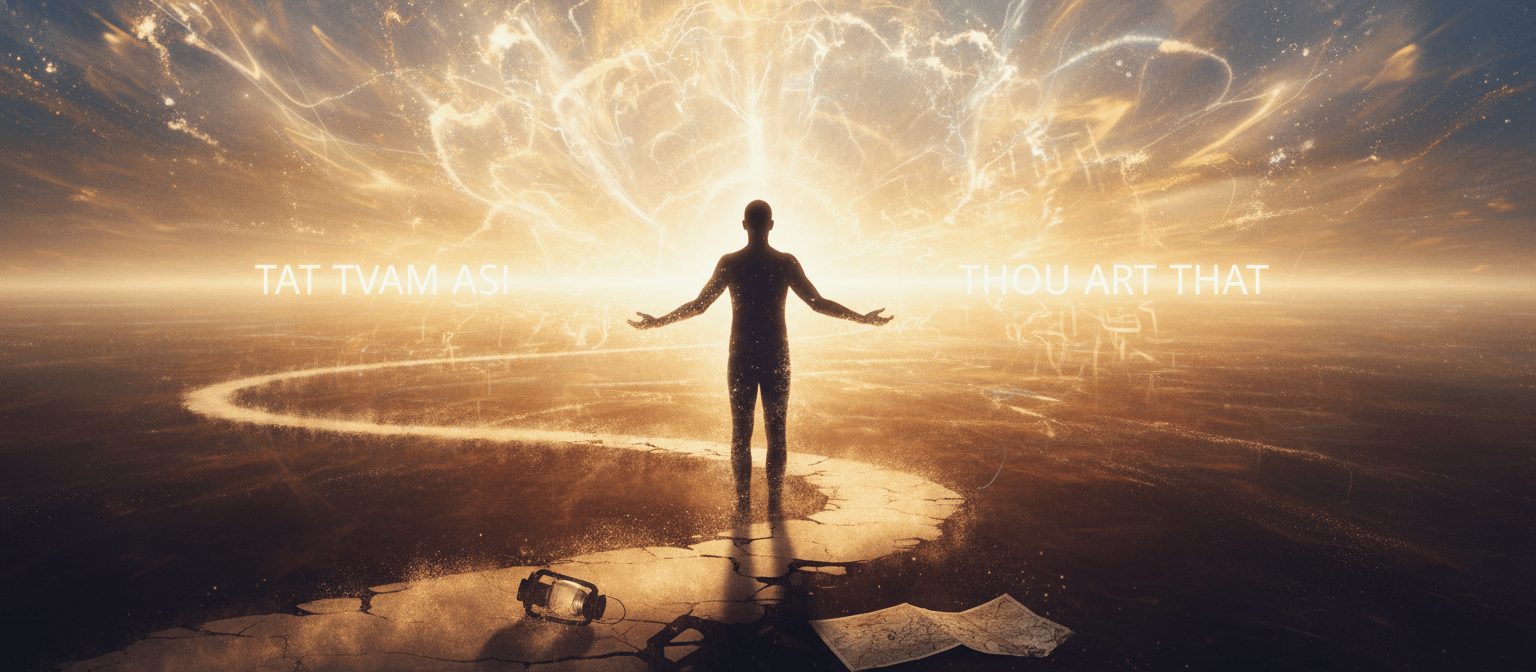
The Upanishads say it plainly: Tat Tvam Asi—“Thou art That.” You are not moving toward enlightenment. You are enlightenment that has temporarily convinced itself it’s a seeker. The pathless path. The gateless gate.
The punchline is: there was never a joke.
Eckhart Tolle (who, despite the self-help sheen, occasionally lands a clean punch) describes enlightenment as “the end of the search for enlightenment.” Not because you found what you were looking for—because you realized the search was the only thing preventing you from seeing it was always here.
The Zen koan about the ox-herding pictures:
- First you search for the ox (enlightenment).
- Then you see its tracks.
- Then you glimpse it.
- Then you catch it.
- Then you tame it.
- Then you ride it home.
- Then you transcend the ox.
- Then you return to the marketplace with gift-bestowing hands.
The end point looks identical to the starting point—same world, same body, same daily tasks—but the experiencing of it has shifted. You’re not ignorant anymore, but you’re also not special. You’ve just stopped arguing with what is.
Alan Watts used to say: “The meaning of life is just to be alive. It is so plain and so obvious and so simple. And yet, everybody rushes around in a great panic as if it were necessary to achieve something beyond themselves.”
But here’s the twist Watts maybe didn’t say enough:
You’re allowed to enjoy the dream. You’re allowed to play, to build, to love, to grieve, to strive, to rest. Recognizing it’s a dream doesn’t require you to lucid-dream your way into some detached, dispassionate observer mode. That’s just another ego trap—spiritual bypassing dressed up as non-attachment.
The dream continues. You’re still going to stub your toe. Fall in love. Bury people you can’t imagine living without. Get irrationally angry about traffic. Laugh at stupid jokes. Cry at beautiful music.
The only difference: you might catch yourself mid-stub and think, oh right. I’m doing this to myself. How delightfully absurd.
And then you’ll forget again. Because the forgetting is the point. The game only works if you commit fully—even to the parts where you pretend you’re not playing.10

XIII. The Ego’s Last Stand (Or: Why You’re Still Reading This)
Let me guess what you’re thinking:
Okay, this is beautiful and mind-bending and maybe even true. But what the hell am I supposed to DO with it? How does this change anything?
That question—that grasping for application, for takeaway, for utility—is the ego making its last stand. It wants to commodify the insight, package it into a life hack, add it to the self-optimization stack. “Five Ways To Remember You’re The Dreamer (Number Three Will Shock You!)”
But here’s the uncomfortable answer:
This doesn’t give you anything. It takes everything away.
It strips the narrative. The sense of forward progress. The belief that somewhere ahead, if you just think/meditate/achieve/heal/optimize enough, you’ll finally arrive at the place where everything makes sense and stays making sense.
You won’t. There is no arrival. There’s only this—the eternal present where you’re always already awake and always falling back asleep, always sovereign and always forgetting your sovereignty, always the dreamer and always lost in the dream.

Ram Dass (né Richard Alpert, the Harvard psychologist who went to India and came back weird) tells a story:
He’s in the mountains with his guru, Neem Karoli Baba. Ram Dass has brought LSD—the most powerful consciousness-expansive tool the West has invented. He gives it to his guru, expecting fireworks. The guru takes a massive dose (enough to send Ram Dass to another dimension) and… nothing. Just sits there smiling. Hours later, Ram Dass asks: “Did you feel anything?”
The guru laughs: “I’m always there.”
The point: the mystical states, the peak experiences, the moments of clarity where the veil drops—those are previews. Reminders. Little post-it notes from your deeper self saying “hey, remember what you actually are?”
But they’re not the destination. There is no destination. Just the ongoing practice of remembering and forgetting, softening and contracting, playing and pretending you’re not playing.
So what do you do?
Nothing. Everything. Whatever you were already doing, but maybe with a lighter touch.
You still take the job, end the relationship, book the flight, have the argument, make the art, pay the taxes, grieve the losses, celebrate the wins. The dream continues its dreaming.

But maybe—maybe—in the middle of the most serious, stake-laden moment of your life, you catch a flicker of recognition:
Oh. I’m making this up as I go. We all are. And it’s the most beautiful, tragic, hilarious cosmic joke that’s ever been told.
And maybe you laugh.
Not because nothing matters. Because everything matters—precisely because none of it’s real, which means you get to decide what it means, and the fact that you keep choosing to play the game even though you know it’s a game is the most profound act of love imaginable.
You are the wrinkle in Nothing that decided to keep wrinkling.
And from here on out, Everything continues.11

XIV. Coda: The Stubbed Toe Revisited
It’s 3am again. You’re stumbling toward the bathroom. Your toe finds the bedframe with that perfect, nauseating crunch.
And for a moment—just a flash—before the ego’s narrative kicks in, before the “fuck” and the “why” and the limping and the self-recrimination—
There’s just: pain-ing.
No sufferer. No story. Just the pure, undiluted sensation of this happening.
And maybe you notice: the pain is inside your awareness, not happening to it. Awareness is the space in which the pain appears, and the space is untouched—vast, silent, okay with everything, including the pain.

And then, of course, you forget. The ego rushes back in:
I’m an idiot, I should’ve turned on the light, why does my furniture hate me, I’m going to be limping all week…
But for that one flash—that crack in the dream—you remembered.
You are not the toe. You are not the pain. You are not even the awareness of the pain.
You are the dreaming itself—the generative nothing that consumes its own creations, eternally tasting what it’s like to forget and remember, to be separate and whole, to stub your toe in the dark and curse and laugh and forget and do it all again tomorrow.
The game continues.
You’re still playing.
And that, somehow, is enough.

Footnotes
1 The physicist John Wheeler proposed the “participatory universe”—reality emerges through observation. Not solipsism (only I exist), but mutual co-arising: we dream each other into existence through the act of witnessing. Every observer is a localization of the same observing field, creating consensus reality through entanglement. Wheeler’s student, David Mermin, summarized quantum mechanics as: “Correlations without correlata”—relationships without relata. In other words: the connections are real, the things being connected are… optional.
2 This is where Gnosticism gets interesting. The Demiurge—the false god who creates the material world—isn’t evil. It’s you, the dreamer, who’s forgotten the dream and now takes it seriously. The archons aren’t demons; they’re the ego’s defensive structures. And Christ/Sophia isn’t a person who saves you—it’s the recognition that saves itself from its own forgetting. Gnosis isn’t hidden knowledge; it’s remembering what you already are.
3 The respiratory system exchanges approximately 11,000 liters of air per day. You’re in constant material communion with every breathing organism on the planet—a literal atmospheric commons. When climate scientists talk about rising CO₂ levels, they’re describing a shift in the chemical composition of the breath we all share. The personal and planetary aren’t separate scales—they’re nested layers of the same continuous exchange. Breath doesn’t just reveal the illusion of boundaries; it proves they never existed.
4 Aldous Huxley’s The Doors of Perception documents his mescaline experience, where he sees a flower and spends hours transfixed because the flower is *Is-ness* itself, pure being without the conceptual overlay. He quotes William Blake: “If the doors of perception were cleansed, everything would appear to man as it is: infinite.” The doors are the sensory-conceptual apparatus that filters infinity into manageable chunks called “things.” Clean the doors (psychedelics, meditation, art, love, awe) and you see: there are no things. Just thisness vibrating at different frequencies, and all of them are you.
5Film theorist André Bazin argued that cinema’s essence is its ability to capture “the ontology of the photographic image”—not reality itself, but reality as witnessed. Every film is a record of where consciousness chose to look and for how long. Editing is the grammar of attention. A cut says: “now look here instead.” The viewer surrenders their perceptual sovereignty to the filmmaker’s angle. This is why propaganda works, why cinema moves masses, why TikTok’s algorithm feels like mind control—it is angle-control at scale, and most people don’t realize they’re ceding the direction of their attention 200 times per scroll.
6Peirce’s pragmatism anticipated the scientific method’s core insight: beliefs should have “cash value”—they should do something, make predictions, interface with reality in testable ways. A belief that can’t be falsified isn’t science; it’s poetry (which is fine, but call it what it is). The problem with Methods 1-3 is they create unfalsifiable belief systems. No evidence could possibly change the mind of someone using pure tenacity. No authority can be questioned from within the authority’s framework. No a priori reasoning can escape its own axioms. Only Method 4—the willingness to be corrected by reality—breaks the closed loop. It’s epistemological breath: inhale data, exhale certainty, repeat.
7 The neuroscience backs this up: mirror neurons fire both when you perform an action and when you watch someone else perform it. Your brain doesn’t fully distinguish between self and other at the motor level. Empathy isn’t learned—it’s default. The ego has to work to suppress it, to maintain the boundaries. This is why cruelty requires dehumanization: you have to actively convince yourself the other isn’t you. When the barriers drop (MDMA, intense eye contact, collective ritual, crisis), the empathy floods back because it was always there, always primary.
8 The Tibetan Bardo Thodol (Tibetan Book of the Dead) describes the moment after death where you encounter wrathful deities—terrifying, monstrous, overwhelming. The secret: they’re you. Your own unintegrated shadow, your denied anger and fear and power, wearing monster masks. If you recognize them as yourself, they dissolve. If you run, they chase you into the next incarnation. The infringement, the resistance, the thing that won’t bend—same principle. Stop running and turn around. It’s wearing your face.
9 Pema Chödrön, the American Buddhist nun, talks about shenpa—the Tibetan word for the “charge” or “hook” that turns pain into suffering. Something happens (pain), then there’s a split second where you could just feel it, and then shenpa—the grabbing, the “this shouldn’t be,” the contraction—and suddenly you’re suffering. Her advice: catch the moment between pain and shenpa. Don’t stop the pain (you can’t). Don’t stop the shenpa (it’s automatic). Just *notice* the gap. Over time, the gap widens. You start living there.
10 There’s a Hasidic story: A student asks the rabbi, “Why did God create atheists?” The rabbi answers: “So that when you see someone suffering, you don’t say ‘God will provide’—you act as if there is no God, as if only you can help.” The dream continues, suffering is real within it, and your job isn’t to transcend it—it’s to *show up* for it. Recognizing the dream doesn’t mean abandoning the characters in it. It means playing your role with full commitment *and* full awareness that it’s a role. The and is crucial.
11 Werner Erhard (the controversial founder of EST) had a realization he called “What is, is, and what ain’t, ain’t.” Sounds tautological, but it’s pointing at: the resistance to what-is creates all suffering. Not the pain, not the circumstance—the resistance. This isn’t passivity. It’s the opposite: full engagement with reality-as-it-is rather than reality-as-you-wish-it-were. From that place of non-resistance, you have more power, not less, because you’re not wasting energy arguing with the unchangeable. You’re surfing the wave instead of trying to stop the ocean.
Redeem Coin Codes


