
Grace: What if presence isn’t a concept, but a collapse—an implosion of time into the singular flicker where you happen to be? This isn’t mindfulness as marketed, nor philosophy softened for polite conversation. This is raw perceptual terrain: slippery, luminous, and intimate as nerve endings. The Unfrothing Now is not a guide—it is a dissection. Of awe. Of ego. Of language itself. It dares to peel back the membrane between self and cosmos, only to reveal that the boundary was always a mirage.
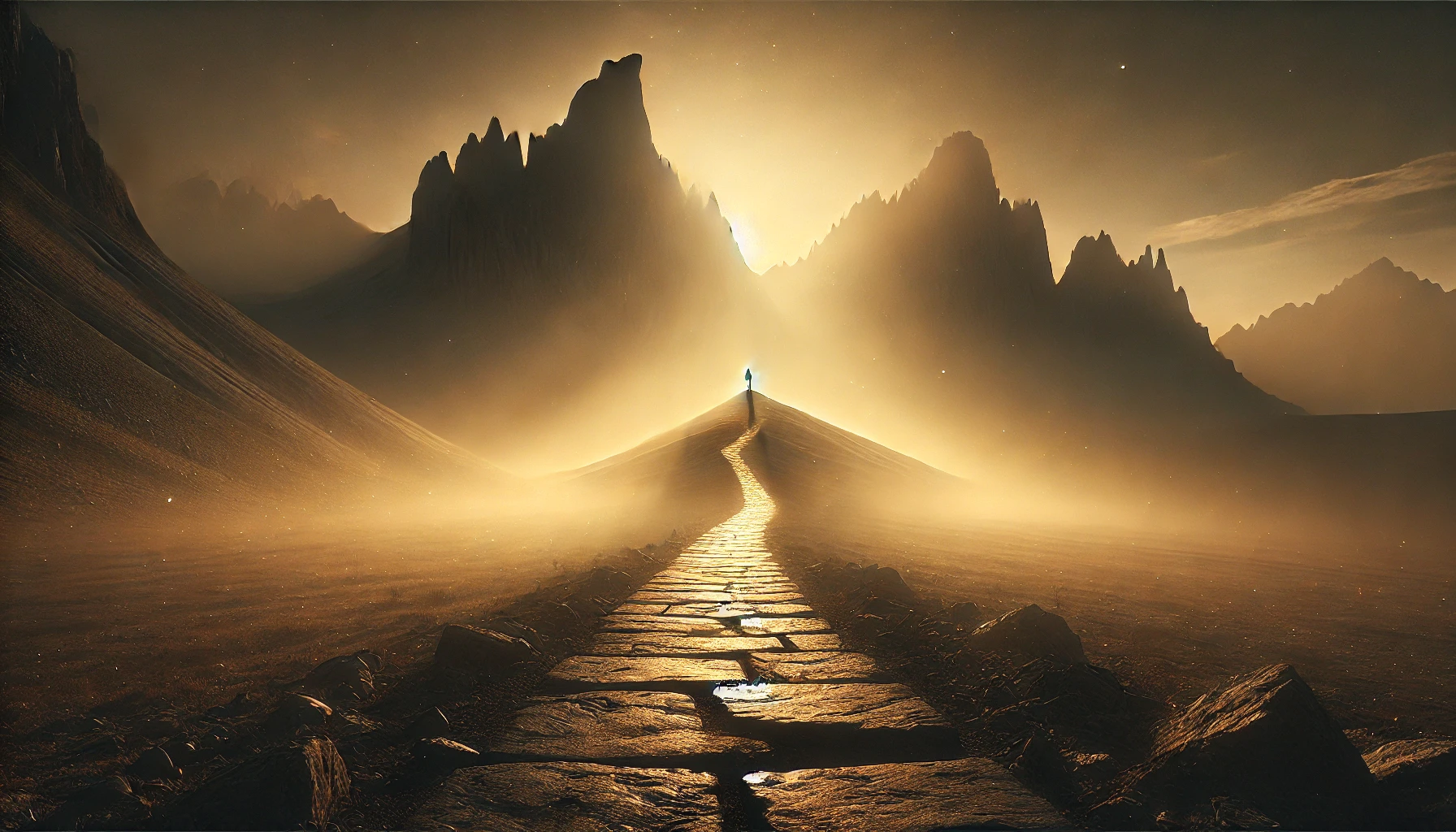
This essay is a torch carried to the edge of meaning, not to illuminate some final truth, but to watch how light dances on the walls we build to keep ourselves from vanishing. If you’ve ever felt the vertigo of true presence—or the quiet ache of realizing animals may know more than we do—keep reading. There’s no map ahead, only the unfolding.


THE UNFROTHING NOW
The endless membrane—call it spacetime, call it awareness—is not proof of infinity, but the sensation of it. Not measured, but felt. This isn’t an accessible account of a mental state—unless you’re already attuned to the notion that the present moment lasts a femtosecond, a flicker of coherence between probabilistic chaos. Past and future remain froth. Only this moment resolves. The present isn’t some abstract shimmer—it’s the very act of perceiving. Sight, sound, touch, taste, thought. A coherent flicker pretending to be solidity.
The froth is not metaphor—it’s the stage. The electromagnetic spectrum radiates from my eye inward, boundless. There’s no end to the unfrothing. The body may feel like a border—me here, the world there—but that’s illusion. Awe happens where boundaries vanish, where I sit with the universe, not apart from it. That’s the magnitude of presence—a vastness no abstraction can contain, and none I can surrender. Energy entangles itself with dense forms—massive bodies, intricate circuits, complex thoughts, matter in all its disguises.
It’s flux—flashing into “real” just long enough for perception to catch the echo. My mind stitches each moment like storyboard frames, faking continuity. And yet, the instantaneous present is unfrothing—everywhere, all at once. I feel it as a folded layer in spacetime. My mind pins a location, brands it as memory, calls it meaning. But that’s not all there is. I am an energy pattern—slightly segregated, a coherent fallout from the infinite membrane stretched between past and future.

The Now holds no inherent meaning. Nor separation. In this split-second of awe, energy and mass blur. No boundaries remain.
It’s all one entangled instant—an infinite communion. That’s me. That’s you. That’s everything—momentarily cohered, caught in the sliver where future and past grind into being. For me intimately, I am the sensation of an afterthought emerging out of this process. But in every act of perception, I am also everything. Everywhere. Always. And so, by writing these lines, I carry my torch to the base of meaning—where meaning itself is still molten, uncast. Not found, but forged.
Each sentence is a footprint pressed into terrain that did not exist until I stepped onto it. There’s now this trail behind me. I’ve checked—too often—if anyone was following. I did leave these breadcrumbs for you. I did want this to connect. But I’ve also come so far now—far enough that the absence of others no longer feels like solitude, but sanctuary. In this distance, there’s comfort. Here, being and Self are colocated. Here, I finally sit beside myself. But let’s not mistake this for transcendence. This too is escape. A marvel turned barricade. I’ve weaponized wonder. Wrapped it around me like a moat of vulnerability—not to invite empathy, but to repel it in hope for true connection. Yet this kaleidoscope of words still serves to distinguish myself. To draw a line.
And what is this line, really? Just a solipsistic flourish. A flourish that says: This is my worldview. This is universal.
A contradiction disguised as profundity.

The truth is more bitter: this is a narcissistic courtyard. Built by me, for me. A space where I sculpt the infinite to resemble my reflection—then declare it truth. There’s futility here. Ego, like a film of oil, rainbowing the surface of otherwise clear water, crystallized as thought. Even in honest exploration, the self taints. Even in awe, there is residue. And yet—I keep writing. Not to stake a claim, but perhaps to finally see the shape of the torch I’ve been carrying. To watch its light flicker not on some grand frontier, but on the very walls I’ve built myself here.
And if this mask finally falls—what remains?
The unmasked Self is not a face at all—it’s the infinite again. Being itself. Expanding, edging. The same membrane I first set out to touch. That’s the truth. That’s the only evidence I’ll ever need. It’s the full stop of decency. The place where one turns, quiet and resolute, at the end of the trail and stutters: No more. Enough. It’s done. I am done.

Not in despair. Not in defeat. But in the clear recognition that this has never been something to stare at for long. This kind of nakedness was never meant for lingering. Let it rot in peace. Let it sink, unarchived. I know it’s there. I’ve been there. I did myself in. But now, it’s time to leave this outpost. Not to escape, but to rejoin. To move toward compassion—not in theory, but in presence.
Somewhere quieter. Somewhere human.
REJOINING THROUGH THE ANIMAL
To do so, perhaps it’s best to trace our humanness backward—not through philosophy, but through animals.
Take birds. The birdness of birds reveals another angle entirely. Picture one perched on a spindly branch, silhouetted at dusk. We might imagine evolutionary strategies at play: exposed just enough to lure predators while one eye remains open, scanning. Maybe it’s waiting. Planning its flight to thicker shadows once true darkness falls. Is this conscious behavior? Or instinct curated by time?
Dogs and horses learned to obey. But what we call obedience is often something else: contextual negotiation. A dog doesn’t merely hear the word “sit”—it hears tone, posture, rhythm. It considers its own desires. “What did you just say, human? Alright, I think I understand. Sit down, sure. Now pet me. Why so stressed? Come here, relax. Smile. Feed me. Let’s rest.”

To the human, this is training. A result. A connection. Companionship blooms when the hierarchy of demand loosens. A sentence ringing true not just in the dog world. The more capable an other is of mirroring our expressions, the more we relate. Hence our love of mammals. Our cautious respect for birds. The ambiguous indifference we see in amphibians’ eyes, like frogs. Frogs don’t respond to us. They aren’t waiting for commands. Their chorus isn’t a performance—it’s a territory claim, a floodlight of genetic invitation. Sometimes individuals stray, croaking beyond borders, perhaps colliding with other tribes. The noise is navigation. Mating. Continuity. But it’s not for us.
Nor is it from insects. They don’t express fondness. No curiosity. No recognition. The gap is complete. The indifference, total.
And yet, birds may know us. When their nests rest beneath our eaves, they see us come and go. Familiarity builds—not intimacy, but a kind of shared geometry. They learn our patterns. We observe with fondness: their egg-state; breaking-the-shell; the fluffing right before leaving the nest. Their parents, beaks full of worms ready to nurture—tweet at us observers to demarcate their intention and territory. A quiet rapport blooms. Maybe the fledgling finch that returns months later hesitates—just briefly—upon seeing us again. That huge human face hovering over their nest, smiling. A memory? And now, recognition? We don’t know. But it stirs something… something between our eyes and theirs.
Crows, parrots, magpies—these further bridge the gap. Their minds graze the membrane of mutual understanding. We trade gestures for food, commands for reward. And in that, an exchange occurs.
But beyond that line, the others remain silent. Plants don’t perform for us. Amoebae don’t care. Trees don’t respond to compliments. The world hums on wavelengths not designed for dialogue.
And still it thrives. Nature.

Flowers attract pollinators not with words, but with radiant spectra. They evolved together—petal and bee—in an unspoken contract. Symbiosis as syntax. Need as grammar. Millions of years. No language required. Nature does not negotiate. It adapts. It harmonizes or dies. It exchanges no favors. It makes no declarations. And yet everything happens. And then there’s us—humans, the abstraction machines. The ones who turned instinct into legislation, gesture into grammar, want into law. We don’t just live—we describe. We don’t just feel—we name.
And in naming, we begin to sever.
We speak so much, we forgot how to listen. Our language simplifies what was once intricate. What once passed silently between living things becomes contracts and codes, lost in translation. The animals, when they do listen, do so on their terms. If they try to understand us, it’s because they’ve learned we want something—and some of them can survive better by playing along. But when they ignore us entirely, it’s not rudeness. It’s just reality: our language isn’t built for them. Their world hums on scent, movement, posture, timing, and roar.

Flora and fauna aren’t eagerly recognizing us at the top of the food chain. Grass doesn’t sway to please us. Trees don’t bloom on cue. They simply are. And when we mow them, we impose order. We project aesthetics. We humanize the wild. But the wild does not need us. If we vanished, it would rearrange our habitats and cities into harmony again—not disorder. The United Species of Earth—if ever it spoke—would remind us: You need us more than we need you. Without humans, equilibrium resumes. Species recalibrate. The seasons remain. No one demands anything. No one writes anything down. And still, everything continues.
THE ETHICS OF HAVING SEEN
So what now?
After awe. After peeling back the mask. After tracing language to its edge and finding silence underneath.
What remains is not a revelation—but an ethic. Not the kind written in ancient books or burned into stone tablets, but the kind felt when a crow tilts its head in apparent thought while glimpsing us. Or when the wind grazes your face just as the trees shiver.

The ethic is this:
- Do less. See more.
- Speak only when silence can’t carry it.
- Create not to immortalize, but to metabolize experience.
- Connect not for mastery, but for resonance.
We’ve been taught to use words like weapons—cutting, categorizing, capturing. But language can be an offering instead. Not to dominate the world, but to bow to it. To describe something without reducing it. To be present, not omniscient. To make meaning, not claim it. To remember that perception is a privilege, not proof.
We are not the authors of reality—we are its readers. Lucky to glimpse a few pages, and contribute to the narrative while we are alive. So go on, torch-bearing reader. Walk softly now. Witness the membrane’s ever–unfurling.
And you are part of its pattern. With every word you choose. And every silence you allow.
Redeem Coin Codes


