
Introduction: A lawsuit over Amazon workers having to “prove” their right to bereavement leave is the entry point to a larger argument: the problem isn’t bad actors, it’s the pyramid-shaped systems that turn human needs into transactions and people into abstractions. The essay contrasts those hierarchies with Compassionism—the recognition that our lives are structurally entangled, so harm anywhere degrades the whole network—and with Dunbarrios, nested circles of 5–150 people that organize work, justice, and ownership at human scale. In this model, coordinators rotate, wealth can’t hide behind insulation, algorithms and billionaires lose their unaccountable throne, and failure becomes shared information rather than personal shame. The takeaway is simple and impolite: if you feel crushed, you’re not the defect. The shape is wrong, and circles are the blueprint for building something saner.
This is Part II in the “No Kinds. No Billionaires.” exploration and develops the abnormality detected that we mistake the organizational chart for natural law.


The allegation: employees forced to produce documentation proving their grief is legitimate before being granted bereavement leave. Not “my mother died, I need time,” but “my mother died, here’s the death certificate, here’s proof of relation, now will you approve my request to mourn?”
This isn’t about Amazon’s HR policies. It’s about what we’ve accepted as normal: systems where your right to grieve requires verification from someone who controls your livelihood. Where loss becomes a transaction needing approval.
The shape is wrong. And once you see it, you can’t unsee it.
ACT I: THE PYRAMID’S BEAUTIFUL LIE
I’ve been in tech for over two decades. Individual contributor, senior engineer, eventually managing sixteen people. Here’s what nobody tells you about climbing: how much becomes theater.
Not building. Not solving. Theater. Performing authority for people above who need to believe someone’s in control. Performing confidence for people below who need to believe you know what you’re doing. The actual decisions? Half the time they’re made a few levels up. You’re just the one announcing them while pretending you had input.

Hierarchies are magnificent anti-entropic machines. They concentrate decision-making, channel energy upward, create artificial gradients in systems that would otherwise flatten. The Egyptian pyramids required this. So did Apollo. So does the banana supply chain reaching Alaska in February.
But fighting entropy costs fuel. And we’re finally noticing what burns: us.
The pyramid breeds billionaires who’ve become untouchable, institutions that forgot their purpose, and everywhere—at every level—middle managers whose job is simple: replicate the trauma downward. You were dominated, so now you dominate. The chain descends until it reaches someone with no one beneath them, and they can only turn that energy inward.
We call this “organizational structure” and pretend it’s neutral. We’ve mistaken a choice for natural law.
What We Actually Lost
You learned circles before you learned words. Family, when it works, is a circle—bounded, where everyone belongs, where roles differentiate but don’t dominate. I’ve got two teenagers. Watching them become distinct people has shown me that hierarchy in families is mostly inherited bullshit. Yes, I know things about crossing streets and signing leases they don’t yet. But their judgment on technology, social dynamics, what’s actually relevant? Already sharper than mine.
The family circle at its best isn’t command and obedience. It’s differentiated roles in a shared project: keeping everyone alive and helping each other become who they actually are.
Robin Dunbar gave us the numbers: 5, 15, 50, 150. These aren’t suggestions—they’re cognitive architecture. The scales where your brain can maintain real relationships, where you know not just names but contexts. Beyond these thresholds, people become abstractions. Headcount. Human resources.
Circles respect the limit. Hierarchies pretend it doesn’t exist, then wonder why everyone feels alienated.

ACT II: COMPASSIONISM (The Philosophy Hierarchies Can’t Acknowledge)
Before mechanics, we need foundation. Here’s the principle I’m calling Compassionism: we’re not separate agents competing in a zero-sum game, but interconnected expressions of a unified field. Your suffering diminishes me. Your flourishing enriches me. Not metaphorically—structurally, through the network of systems we’re all embedded in.
This isn’t mysticism. It’s observable. When your coworker is miserable, it affects your work. When your neighbor’s kid struggles, it destabilizes community. When billionaires hoard while others can’t afford insulin, it warps the entire economic system you’re navigating.
Hierarchies require forgetting this. They demand we believe:
Your boss’s interests are separate from yours (so their gain can come at your expense)
The top was earned through merit alone (so we ignore everyone stepped on)
Wealth accumulation doesn’t harm those left behind (so we celebrate billionaires)
Authority flows from above, not collective agreement (so we accept domination as natural)
Every one is a lie hierarchies must perpetuate to survive.
Compassionism starts differently: we’re looking at the same universe through different windows. What we do to others, we do to ourselves—immediately, through the network we’re part of.
When you organize hierarchically, you fight this reality. When you organize in circles—in what I’ll call Dunbarrios, nested human-scale communities—you work with it.

ACT III: THE ARCHITECTURE
Dunbarrios: Fractal Human Scale
The term fuses Dunbar’s thresholds with barrios—neighborhoods where life happens. Not administrative divisions imposed from above, but organic structures that emerge when you take human cognitive limits seriously.
The fractal:
5 – Intimate unit. Household, closest collaborators.
15 – Primary Dunbarrio. Your productive circle. Daily coordination.
50 – Range of motion. Adjacent circles, familiar faces.
150 – Economic unit. Multiple Dunbarrios for larger undertakings.
750 – Village scale. Formal federation begins.
3,750 – Small city. Nested coordination without hierarchy.
Each level maintains the same logic: federation without domination. Representatives at higher scales don’t rule—they facilitate coordination. The Coordinator role rotates. Long enough to build competence, short enough that power can’t calcify.
A Dunbarrio of fifteen might be software developers, mutual aid organizers, artists, craft guilds, research groups. Function isn’t prescribed. Scale is. Because Dunbarrios exist in networks rather than hierarchical pyramids, they can morph, split, merge—adaptive, not rigid.

Knowledge Trees: How Ideas Flow
How does knowledge created in one Dunbarrio become discoverable without centralized authority?
Imagine knowledge as a tree. Trunk = fundamental understanding. Major branches = broad domains. Smaller branches = specializations. Twigs = active investigation. Leaves = specific contributions.
Each node links to Dunbarrios actively working there. Want earthquake-resistant bamboo construction? Follow the tree to a Dunbarrio of fifteen in Taiwan, twelve in Colombia, both documenting experiments, sharing designs, learning from failures.
Wikipedia showed us collective knowledge creation. But it still has hierarchies—admin privileges, edit wars, gatekeepers. Knowledge trees push further: transparent attribution without gatekeeping. Dead ends don’t get deleted—they’re marked as explored paths that didn’t work, contributing to collective understanding.
We either win or we learn. That’s the evolutionary principle. Failure is information, not verdict.

ACT IV: THE PRACTICE
How Circles Actually Work
The Coordinator: Rotates every 3-6 months. Purely logistical—scheduling, documenting decisions, tracking bandwidth, flagging blockers. What they don’t have: veto power, hiring/firing authority, compensation differential, approval rights.
AI Facilitation: Handles meeting notes, tracks patterns, flags issues the circle might not see. “Sarah’s dominated the last six discussions” or “This decision resurfaces every two weeks.” It’s version control for human coordination—a mirror showing interconnections we might miss. The data belongs to the circle, visible to everyone.
When disagreements deadlock, circles bifurcate or experiment. Two approaches? Build both, reconvene with evidence. We either win or we learn—both attempts teach something.
Justice Without Hierarchy
What happens when someone lies, steals, harms?
Hierarchies punish from above—manager fires, court imprisons, state exercises violence. Also where most abuse concentrates: power without accountability.
Circles make harm visible. In bounded groups where work is transparent, you can’t hide systematic harm. Credit-stealing? Everyone was present. Harassment? Multiple people notice before it metastasizes.
Response protocol:
Direct address – Person harmed speaks to person who caused harm, one witness present
Circle review – Full circle convenes if direct address fails
Cross-circle mediation – Adjacent circles facilitate if the circle’s too close
Exclusion with transparency – Transfer to different circle with full history
For serious crimes, rotating investigative circles drawn by sortition. AI tracks evidence, proceedings are public unless victims request privacy. Decisions from randomly-selected circles, not performative court hierarchies. Consequences focus on restitution and prevention, not vengeance.
Compassionism in practice: when harm to another is harm to the system you’re part of, justice becomes restoration.

Wealth Without Extraction
Current systems let billionaires position themselves where all value flows converge. Circles change this structurally:
Transparent contribution: In bounded groups, you can’t fake magnitude. Everyone saw the work happen. AI tracks patterns—who proposed what, who solved blockers.
Distributed ownership: Not equal necessarily, but visible and negotiated. If your circle builds software generating $10M, the circle decides allocation.
Federation limits: Growth beyond Dunbar thresholds requires splitting. Prevents concentration enabling billionaire-scale extraction.
Exit costs: You take your share of what the circle created while you were present. No perpetual rent on past contributions.
From a Compassionist lens, extreme accumulation isn’t just immoral—it’s systemically destructive. When one node captures that much flow, it starves the network.
Wealth, Power, and the Accountability Gap
Let me be clear about something this essay risks avoiding: extreme wealth concentration could, theoretically, yield extreme good.
World War II showed us what coordinated resource deployment achieves when the wealthy actually believed they shared a collective fate with everyone else. Vaccine development, infrastructure at scale, the research apparatus that gave us everything from the internet to cancer treatments—these required concentrated capital directed toward shared challenges.
The problem isn’t that billionaires exist. It’s that the system lets them exist without accountability to the rest of us.
Here’s what actually happens when someone accumulates extreme wealth within hierarchical structures:
The Merit Delusion
They often did something genuinely impressive to get there—founded a company, made shrewd bets, worked obsessively. And once there, they’re surrounded by confirming evidence of their specialness. The system rewards them. People defer to them. Their decisions move markets. It becomes rational within their experienced reality to believe they earned it, that they deserve it, that they’re simply better at the game.
And maybe they are. But that’s not the pathology.
The Insulation Pathology
The pathology is what wealth buys within hierarchical systems: insulation from shared reality.
Lower effective tax rates than the people who clean their homes. Legal teams that navigate systems differently than public defenders do. Political access that lets them rewrite rules in their favor. Social networks where everyone has similar wealth, similar worldview, similar distance from the consequences of policy.
The Epstein files aren’t an aberration—they’re what happens when wealth buys enough insulation that even predatory harm can be systematically hidden, enabled, protected. Not because billionaires are uniquely evil, but because the structure lets them operate in a different legal and social reality than the rest of us.
The Broken Social Contract
There was a time—brief, imperfect, but real—when extreme wealth came with at least performative obligations to the collective. Rockefeller built libraries. Carnegie built universities. The New Deal era rich accepted 90%+ marginal tax rates because the alternative was pitchforks and they knew it.
That contract has shredded. Now we get “philanthropy” that functions as PR and tax avoidance. We get “job creators” demanding subsidies while fighting living wages. We get “Get a real job!” as a response to systemic critique, as if working three gigs to afford rent is a personal failing rather than economic restructuring.

The gap between rich and poor has become untenably wide not because some people are wealthier—societies can handle that—but because the wealthy have stopped pretending they’re part of a shared system. They’ve bought their way out of public schools, public healthcare, public infrastructure, public risk. They’ve seceded from society while retaining the right to shape it.
What Compassionism Actually Demands
This isn’t about eliminating wealth differentiation. Some people will contribute more, take bigger risks, create more value. Compensate that—fine.
What you can’t do is use that wealth to opt out of shared reality while retaining power over it.
In a Compassionist framework:
You can be wealthy, but your wealth doesn’t buy different laws
You can deploy capital at scale, but not while insulated from the communities affected
You can accumulate, but not into dynasties that compound across generations without renewed contribution
You can have power, but not without ongoing accountability to those impacted by how you wield it
The Dunbarrio Difference
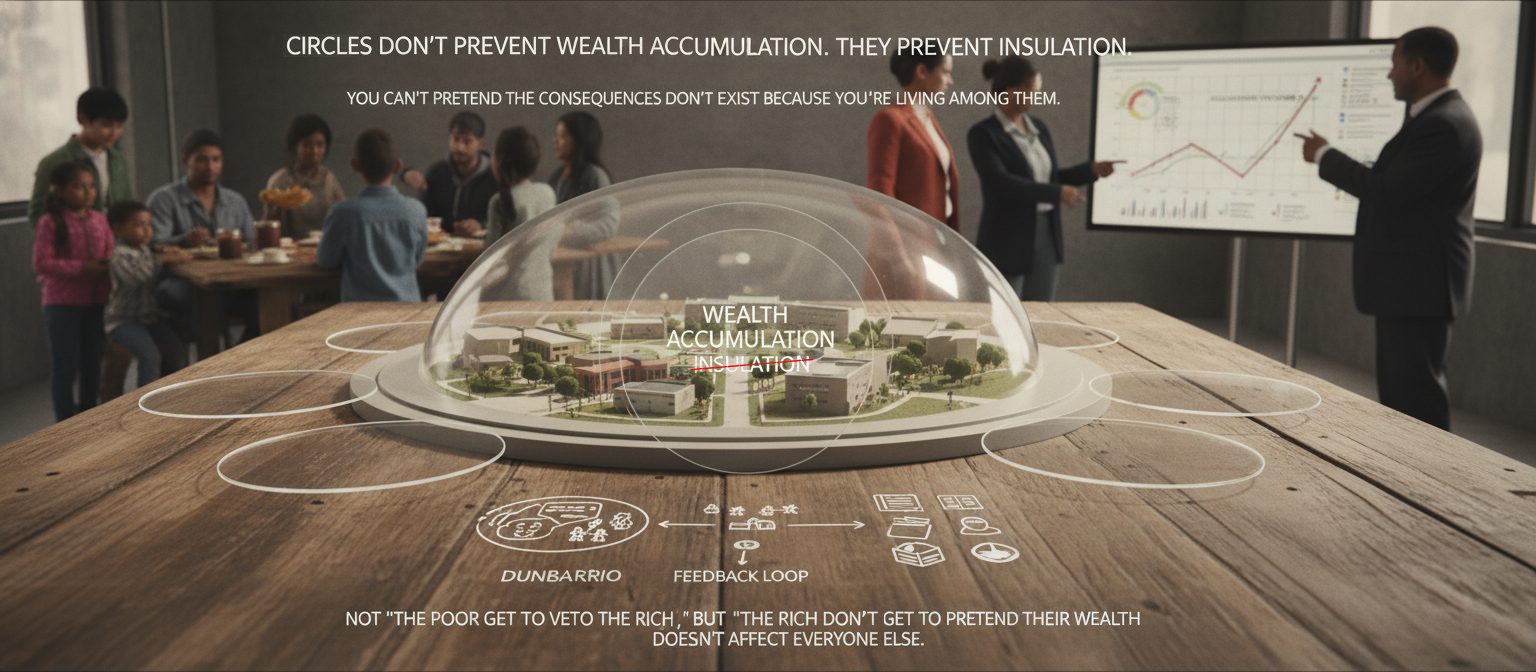
Circles don’t prevent wealth accumulation. They prevent insulation.
When you’re in a Dunbarrio—when you see the faces of people affected by your decisions, when your kids go to school with their kids, when you share the infrastructure your wealth helps shape—the feedback loop stays intact. You can’t pretend the consequences don’t exist because you’re living among them.
At larger scales (150, 750, 3,750), as wealth increases, so does accountability structure. Not “the poor get to veto the rich,” but “the rich don’t get to pretend their wealth doesn’t affect everyone else.”
Progressive taxation isn’t punishment—it’s the price of remaining connected to shared systems while having disproportionate power to shape them. If your wealth gives you 10,000x more influence over how society functions, you don’t get to pay 0.1x the effective tax rate of the people your decisions impact.
The Transition Question
“What about existing billionaires?”
Not expropriation—that’s the path this essay explicitly rejects. But accountability that currently doesn’t exist:
Wealth taxes that prevent dynastic accumulation (you can be rich, your great-grandkids can’t inherit power)
Legal accountability that doesn’t have different tiers for different wealth levels (Epstein should have been prosecuted in 2008)
Democratic structures that can’t be captured by spending (overturn Citizens United, publicly fund campaigns)
Progressive taxation that actually funds the commons they’ve opted out of
You want to stay a billionaire? Fine. But you’re paying into the society that enabled that accumulation, and you’re operating under the same legal and social rules as everyone else. No more buying insulation.
Why This Matters to Circles
Circles aren’t naive about power. They’re explicit about it.
The reason to organize in Dunbarrios isn’t because everyone’s equal—it’s because everyone’s visible. Power, wealth, influence—these still differentiate. But they can’t hide. Can’t pretend not to affect the network. Can’t buy insulation from consequences.
It’s not “no billionaires because wealth is bad.” It’s “no billionaires as currently constructed because wealth without accountability within hierarchies becomes pathological.” Fix the accountability structure, and differentiated wealth stops being existentially threatening to everyone else.
That’s the offer: coordinate with us, remain visible in the network, accept that your power comes with ongoing responsibility to those affected—and we’re fine with you being wealthy. Refuse that accountability, keep buying insulation, keep pretending you don’t need the rest of us—and we’ll build systems that work without you.
The choice is theirs. But circles aren’t waiting for permission.
Property vs. Extraction (This Isn’t Communism)
Critical distinction: You can own personal property—home, tools, creative work. What you can’t do is use ownership to extract perpetual rents from others’ labor or need.
The difference between:
Personal property (things you use)
Capital (things you own to extract value from others)
How this handles rental income:
Small landlords (1-3 properties, active maintenance) operate differently than real estate empires. Compassionism doesn’t eliminate housing providers—it restructures incentives:
Housing cooperatives where residents collectively own buildings
Community land trusts separating building ownership from land ownership
Time-limited property claims for investment properties (not perpetual rent extraction)
Progressive taxation on rental income preventing accumulation
Rent tied to maintenance costs plus modest return, not “whatever the market will bear”
You can earn from providing housing. You can’t build dynasties by capturing others’ need for shelter.
This preserves private ownership while preventing the pathology where ownership becomes pure extraction divorced from contribution.

Knowledge Attribution Without Monopoly
If value emerges collectively, how do we handle intellectual property?
Current IP law serves moat-building. The person who patents a gene sequence didn’t create in isolation—they built on centuries of collective knowledge. Yet law grants perpetual extraction rights.
Compassionist framework: ideas get attributed without granting monopoly. The AI layer tracks contribution—who proposed concepts, who developed them, who solved blockers. Not to determine ownership, but recognize the creation network.
Distributed ledgers offer one mechanism. Immutable contribution records, visible to all, allowing attribution without central control. When circles create value, it returns to the circle according to agreed distribution. You get credit, your share of value created. You don’t own the idea forever.
The Algorithm as Invisible Hierarchy
Here’s a contemporary trap worth naming: modern platforms promise democratization—anyone can start a YouTube channel, publish on Medium, build an audience, make a living from creative work. No gatekeepers, no credentials required, just you and your ideas finding people who care.
Sounds like circles, right?
But watch what actually happens. The algorithm is the hidden boss you never see, never negotiate with, that changes the rules without warning and rewards optimization over authenticity.
I watched a documentary recently about child influencer families—parents who started genuinely sharing their lives, their kids growing up, authentic family moments. Within months, every single one had become marketing specialists. Checking stats multiple times daily. Obsessing over upload schedules, thumbnail designs, viewer retention graphs. The camera became omnipresent. Kids became performers. Privacy evaporated. And inevitably, the monsters emerged—predators attracted to the exposure, forcing these families to build security fortresses against the very “audience” they were supposedly serving.
The pattern is always the same:
Authentic beginning → You share because you want to, building real connection with people who care
Algorithmic feedback → Stats become visible, dopamine hits from views/likes
Optimization creep → Content shifts from “what we want to share” to “what performs”
Inauthenticity cascade → You’re performing for metrics, not creating for humans
Addiction loop → Can’t stop even when it’s clearly destroying what you started for
This is hierarchical capture disguised as democratization. The structure looks circular—direct creator-viewer relationship—but functions hierarchically. There’s a mediating authority between you and your audience: the algorithm. And it doesn’t care about your Dunbarrio, your authentic contribution, your Compassionist recognition of interconnection.
It cares about:
Watch time (keep eyeballs glued)
Click-through rate (manipulate curiosity)
Advertiser-friendly content (self-censor for profit)
Engagement metrics that look good to shareholders

You think you’re independent, but you’re performing for an inhuman metric system that rewards exploitation—of your kids, your authenticity, your relationships, your creative vision—and punishes genuine human-scale connection.
The Compassionist Response
Circles can use platforms for distribution without being captured by them. But it requires explicit boundaries:
Decide NOW what you won’t optimize for (no manufactured drama, no clickbait that betrays your message)
Form a Dunbarrio accountability circle—5-15 people who watch your work and tell you when you’re slipping into algorithm-chasing
Track metrics you care about (depth of engagement, quality of dialogue) not metrics the platform surfaces
Build audience relationships outside the platform (email, direct community spaces) so the algorithm can’t hold you hostage
Reject professionalization pressure—amateur in the original sense: doing it for love, not scale
YouTube, Substack, any platform—these are distribution channels, not validation sources. The work exists whether the algorithm promotes it or not. 47 engaged viewers beats 47,000 passive consumers every time.
In Compassionist terms, the algorithm breaks direct relationship. You’re not creating for humans you can see and care about—you’re performing for a system that doesn’t recognize human value, only engagement statistics that serve its advertisers.
Dunbarrios resist this by keeping creation rooted in bounded groups where feedback comes from faces you know. You can use platforms to amplify beyond your circle, but you don’t let them define success or warp what you make.
This tension—how to build Dunbarrios and share knowledge trees in a digital landscape dominated by algorithmic hierarchies—deserves deeper exploration. How do we use these tools without being captured by them? How do we distribute ideas at scale without surrendering to the metrics that demand we optimize away our humanity?
That’s a conversation for another essay. For now, just recognize: the algorithm is a hierarchy pretending to be a circle. Don’t mistake distribution access for actual freedom.
ACT V: AMERICAN IMPLEMENTATION
Democracy as Circle Under Tension
The American experiment tried circular governance—balance of powers, representative system, authority from collective agreement. Then money captured it. Lobbying, corporate boards rotating into regulatory positions. The forms remain, substance leaked away.
Now: permanent deadlock. Nothing moves. But reframe it: what if deadlock isn’t dysfunction but the circle under tension? The system protecting itself from capture by either extreme—a tug-of-war where neither side can drag everyone.

The problem isn’t tension. It’s that we organized it hierarchically. Representatives claiming to speak for millions. Federal systems imposing uniform solutions across radically different contexts.
What if we relocated decision-making to scales where people see each other’s faces? Where “the other side” isn’t abstraction but your neighbor? This is what Dunbarrios offer civically: local governance at human scale where ideological purity becomes harder to maintain.
At 15-person level, disagreement becomes negotiation. At 150, opposing views become parallel experiments. Most decisions shouldn’t happen federally—push them to where coordination actually works.
Practical Bootstrapping in the US
Legal structures that enable this now:
Worker cooperatives (legal in all 50 states)
LLCs with cooperative bylaws
Community land trusts (200+ operating in US)
Benefit corporations (recognizes stakeholders beyond shareholders)
Municipal codes allowing alternative governance (see: Madison WI cooperative development)
Where to start:
Cities with existing cooperative infrastructure (NYC, Bay Area, Madison, Portland, Minneapolis)
Regions with maker culture/mutual aid networks
Communities recovering from industrial collapse (Rust Belt, rural areas) where traditional structures already failed
Federal system interface: Social Security, Medicare, military service—these persist during transition. Dunbarrios aren’t opting out, they’re building parallel infrastructure. As circles provide services better (childcare co-ops, health clinics, schools), people gravitate toward what works.
This isn’t insurrection. It’s succession—the pyramid gets abandoned as better alternatives prove themselves.
First steps: Find 5-15 people. Shared purpose. One rule: no permanent leader, only rotating facilitation. Build something—software, art, mutual aid, knowledge. Use transparent contribution tracking. When it works, federate with adjacent circles. Form 150-person economic units. Pool resources.
Formalize legally as cooperatives or trusts for protection while preserving internal circle governance. As more emerge and network, they provide services traditionally monopolized. You’re not asking permission—you’re building what works.

THE INVITATION
My oldest asked me years back why he had to do what I said. He was eleven, questioning everything.
“You don’t, not really,” I told him. “You have to listen about crossing streets because I’m responsible for keeping you alive. But I’m not in charge of you as a person. After that we’re just two people who hopefully still like each other.”
“So when I’m grown up, you can’t tell me what to do?”
“Right. And you’ll stop listening well before then.”
He grinned. Already was.
We train the next generation into submission and call it socialization. What if we trained them for circles instead? Taught them coordination doesn’t require domination, that disagreement is information, that their voice matters because they’re here?
I’ve been in maybe a dozen situations where circles actually worked. School project whiteboard session at 2am, nobody directing. On a team with crunchtime deadlines where we just worked hand-in-hand—no status games, just problems and trust. Years ago, neighbors starting a tool library. Nobody in charge, yet coordinating who needs what. These examples work because nobody’s trying to yield control.
That feeling—that’s what we’re optimizing for. Not efficiency metrics or scale for its own sake. Aliveness.
The pyramid promised order and delivered alienation. Meritocracy and delivered dynasties. Prosperity and delivered precarity.
The circle, grounded in Compassionism, promises nothing except recognizing what we’ve always been: apertures through which consciousness perceives itself, temporarily convinced of separateness, slowly remembering we’re looking at the same strange sky.

When you truly see another person—not as report or resource but as another window looking out—the pyramid becomes impossible. You can’t dominate someone you’ve recognized as yourself in a different location.
Compassionism is the foundational recognition that makes this necessary. Dunbarrios are the architecture—nested, human-scale communities that can coordinate at any scale. Knowledge trees let distributed expertise stay discoverable. The mechanics—rotating coordinators, transparent justice, distributed ownership—emerge naturally when you honor interconnection.
These aren’t speculative. They’re assembly instructions.
If you’re experimenting with circular structures or watched them fail instructively, share in the comments. This is collective knowledge-building about organizing without domination.
If this resonated, share it with someone trapped in a pyramid who remembers other shapes. Someone who’s felt Sunday-night dread and suspected the problem isn’t them but the structure.
And if you’re that person—reading this during lunch break, trying to imagine arrangements that don’t require shrinking—you’re not crazy. Not lazy. Not ungrateful.
The shape is wrong, not you.
Compassionism says: your body already knows. The exhaustion isn’t personal failure—it’s systemic friction. You’re a collaborative organism forced into competitive structures.
We either win or we learn. Every circle that forms is an experiment. Some will fail—they’ll collapse into hierarchies, fragment over disagreements, reproduce old patterns. Perfect. That’s information about what conditions let domination creep back.
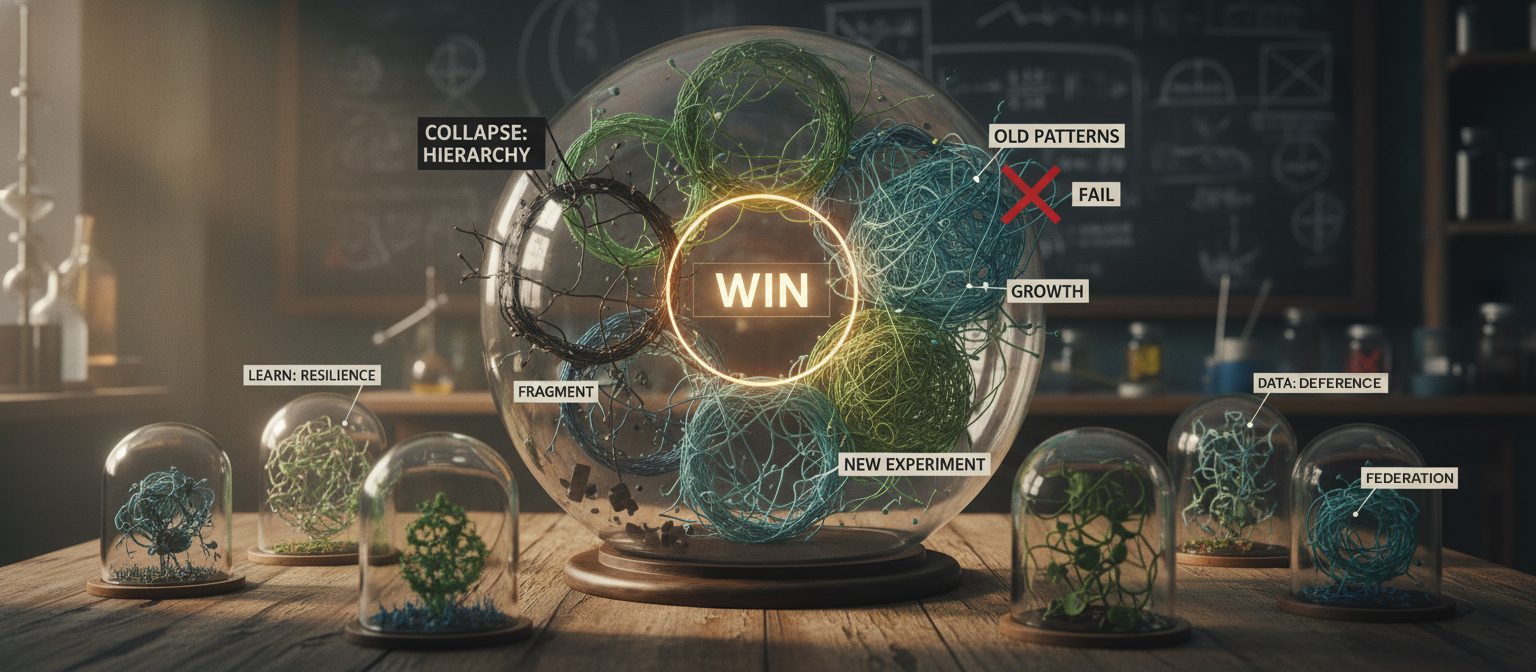
But some will work. You’ll feel it before you can name it. Value emerging from the between. Not performing for evaluation but creating what none of you could build alone.
Start with fifteen. Your primary Dunbarrio. The people you’ll actually work with, create with, coordinate with. Don’t design perfect governance for three months—that’s hierarchy-brain. Start messy. Start now.
Form your circle. See what grows.
The doors are emerging from the haze. Walk through.
Redeem Coin Codes


