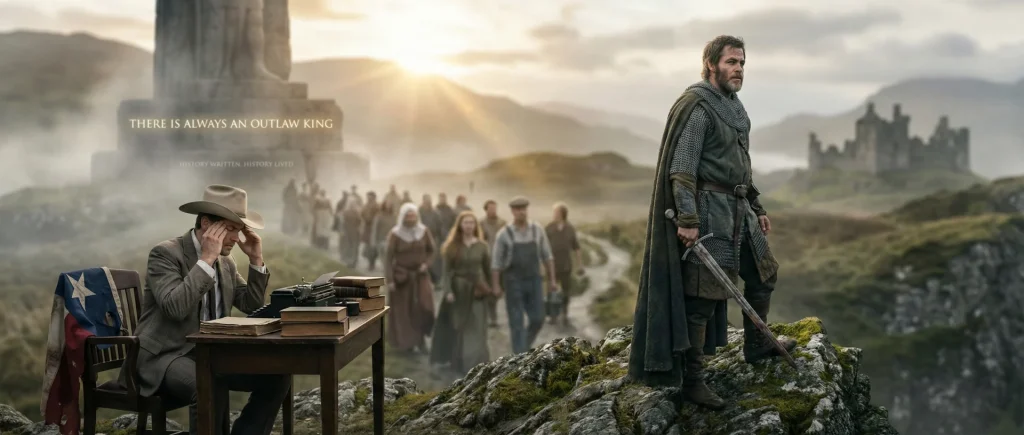
There’s a particular kind of arrogance that watches a $120 million act of cinematic time travel and complains it looked cheap.
I’ve been sitting with those 1-star IMDB reviews of Outlaw King—the ones that objected to “historically inaccurate black actors,” or dismissed the whole enterprise as boring—and I keep arriving at the same conclusion: these reviewers didn’t watch the movie. They audited it. They brought a clipboard to a séance, and then filed the séance as defective.
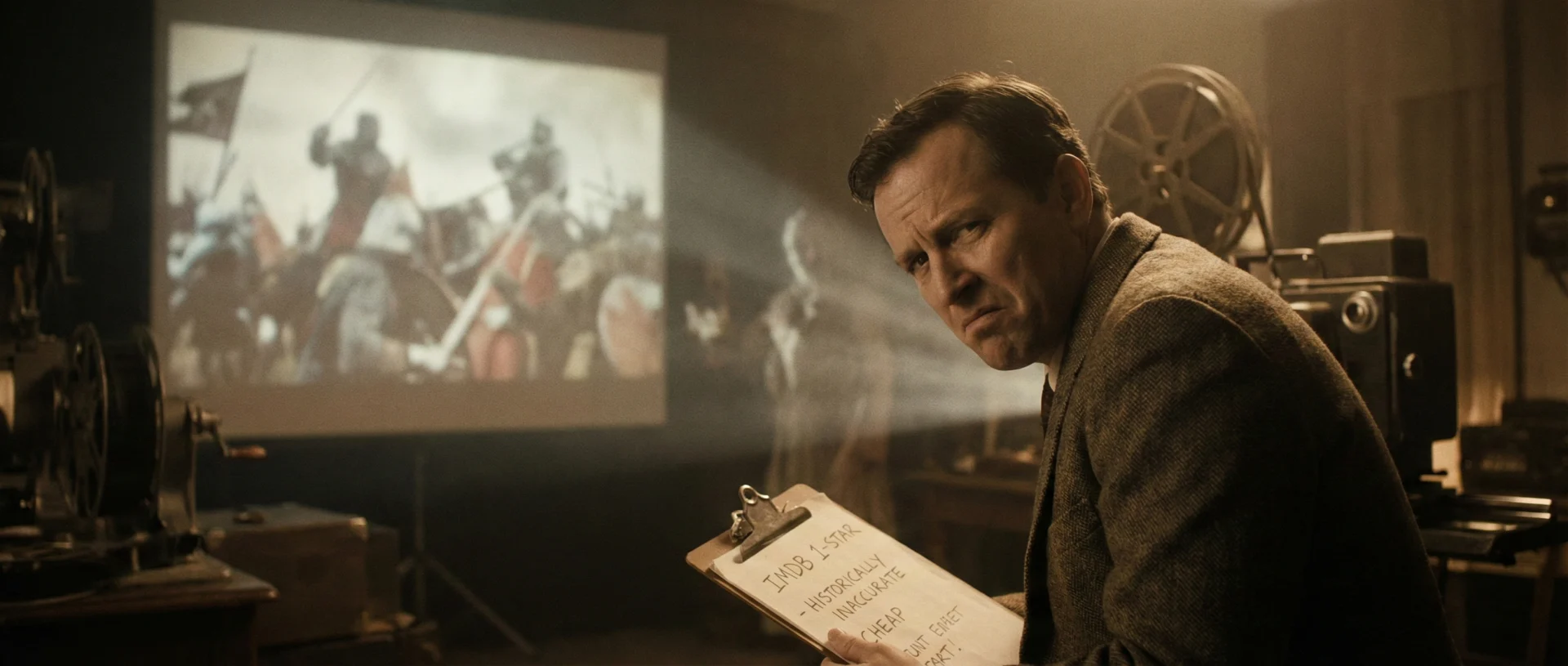
I watched it on a Friday night. Curved office monitor. Netflix subscription quietly doing its extraordinary thing. And somewhere in the first act I lost the thread of the plot entirely, because I was following a much older and much larger one.
By the time the film was over, I was thinking about a man in Texas.
The Double Exposure
The moment before the outlaw becomes the king.
That liminal space. The point where the outcome is unwritten, where the establishment has all the institutional weight and the challenger has only conviction, a scrappy coalition, and the unnerving certainty that what’s currently called order is actually just entrenched disorder wearing a crown.
I’ve been watching James Talarico’s Democratic primary campaign in Texas. I watched him in a Jubilee Surrounded discussion — calm, steadfast, genuinely compassionate in a way that reads as strength rather than weakness, which is rarer than it should be — and something clicked into place that I hadn’t quite articulated yet.
He is, right now, in the Outlaw King part of the story.
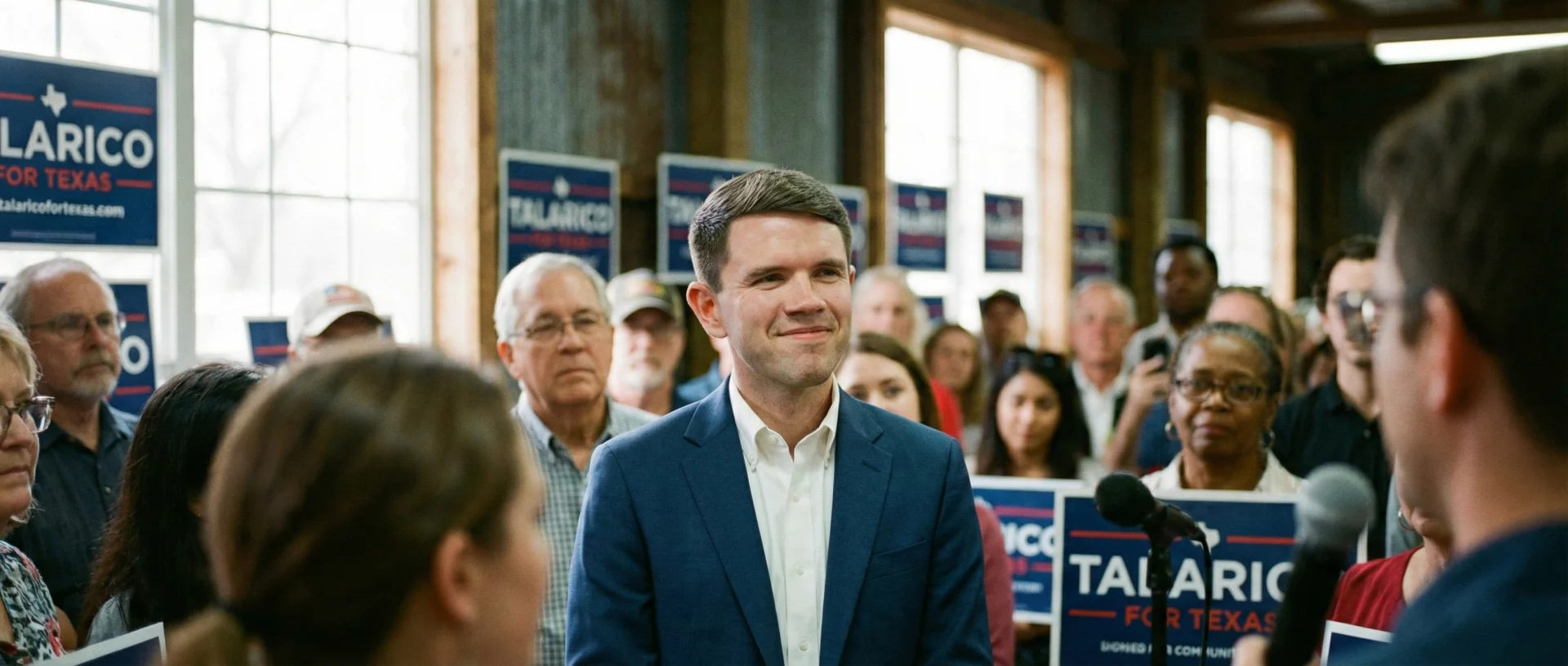
Not the triumphant coronation. Not the documented legacy. The part that hasn’t been written yet. The part where the question is still open, where a whisper on a Friday morning in a Notes app might be the first tiny link in an improbable chain that leads somewhere none of us can see clearly yet.
I feel that. I feel my compulsion to dream that trajectory into reality. And I’m aware that feeling is both completely reasonable and slightly absurd — which is exactly how hope is supposed to feel.
The Untold Census
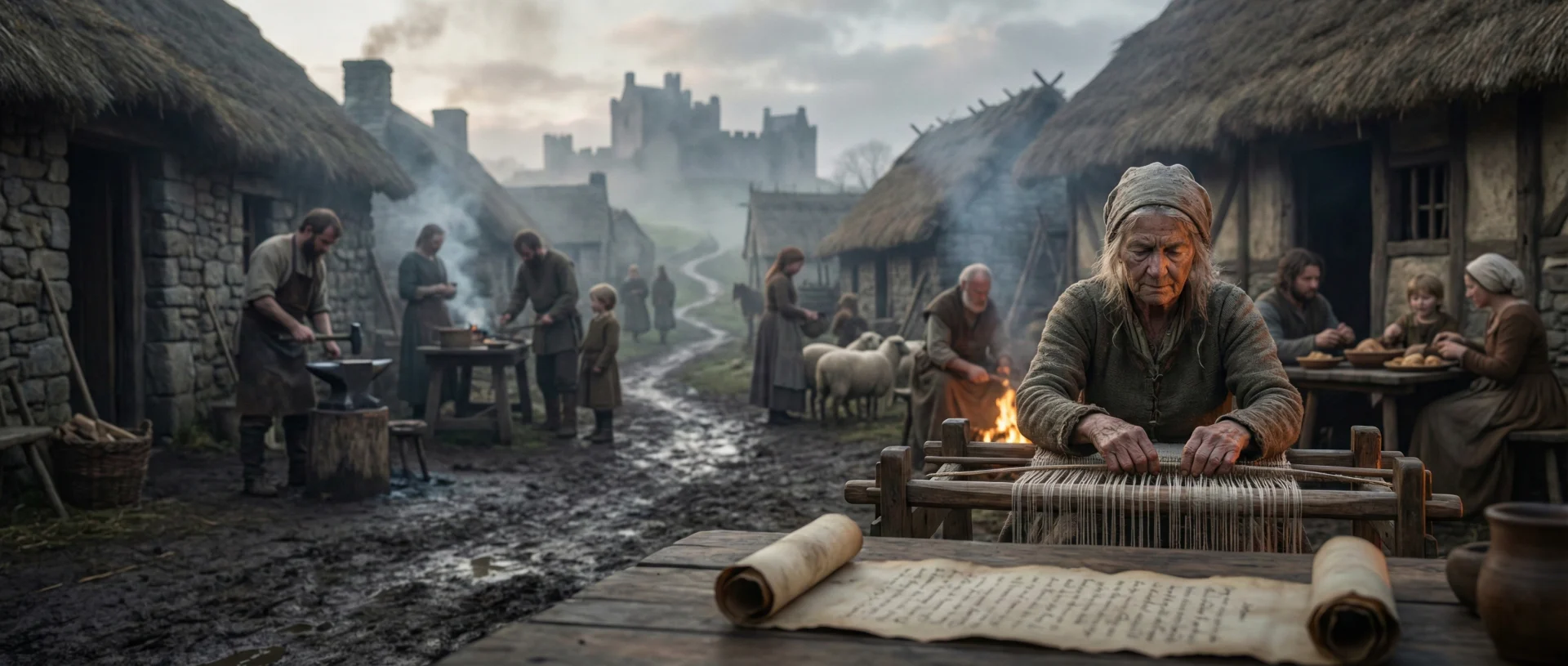
Of all the people alive in 14th-century Scotland during Robert the Bruce’s campaign, an estimated 1 in 500,000 left any kind of historical footprint. The rest — the half-million extras for every named protagonist — lived their lives in the margins of the documented record. Loved people. Made things. Slowly, quietly, imperceptibly raised the living standards of everyone around them through ten thousand small inventions and adaptations and acts of stubborn decency.
The wars are the headline. The peace is the paper it’s printed on.
And here’s what the longer view teaches you: the paper outlasts the headline. Every time. The arrogant leave craters. The humble leave compounding interest. The kings get the movies; the extras get the civilizations.
This is not a passive observation. It has teeth.
Because the same ratio applies now. The billionaires and the aspiring autocrats and the men in their testosterone-drunk prime who presume they can just grab whatever they want, ‘…when you’re a star they let you do it. You can do anything.‘ — they are still the statistical noise. Eight billion strong, and most of us are still the extras. Mostly living in something resembling peace. Mostly building rather than burning. Still compounding to a better tomorrow. Or so we hope.
The exponential curve that makes modern life feel like time acceleration? That’s not the kings. That’s the extras. It has always been the extras.
The Most Democratic Act in Any Century
Robert the Bruce’s wedding night. Gentle. Unhurried. Two people finding each other across the impossible weight of what surrounds them — the politics, the danger, the inherited enmity, the kingdom being wagered on every decision he makes in daylight.
And then: this. The oldest thing. The most private and the most universal simultaneously.
The French have a phrase for the moment of climax — la petite mort. The little death. And it is, in the most literal sense: a brief dissolution of the self, a momentary surrender of the very ego that spends the rest of its waking hours strategizing and conquering and filing 1-star reviews. For a few seconds, king and serf are indistinguishable. The warlord and the farmer. The one who writes history and the half-million who don’t.
The petit mort is what the untold census actually runs on.
Every soul, every extra, every unnamed village-dweller arrived via this same act. Sometimes in love. Sometimes in violence, particularly between warring tribes, and that shadow deserves acknowledgment rather than erasure. But the biological fact itself recognizes no hierarchy. The culmination is the same. The new organism staking its claim to being human once more is the same.
We are all not only mortal. We defy mortality with every orgasm turning new organism.
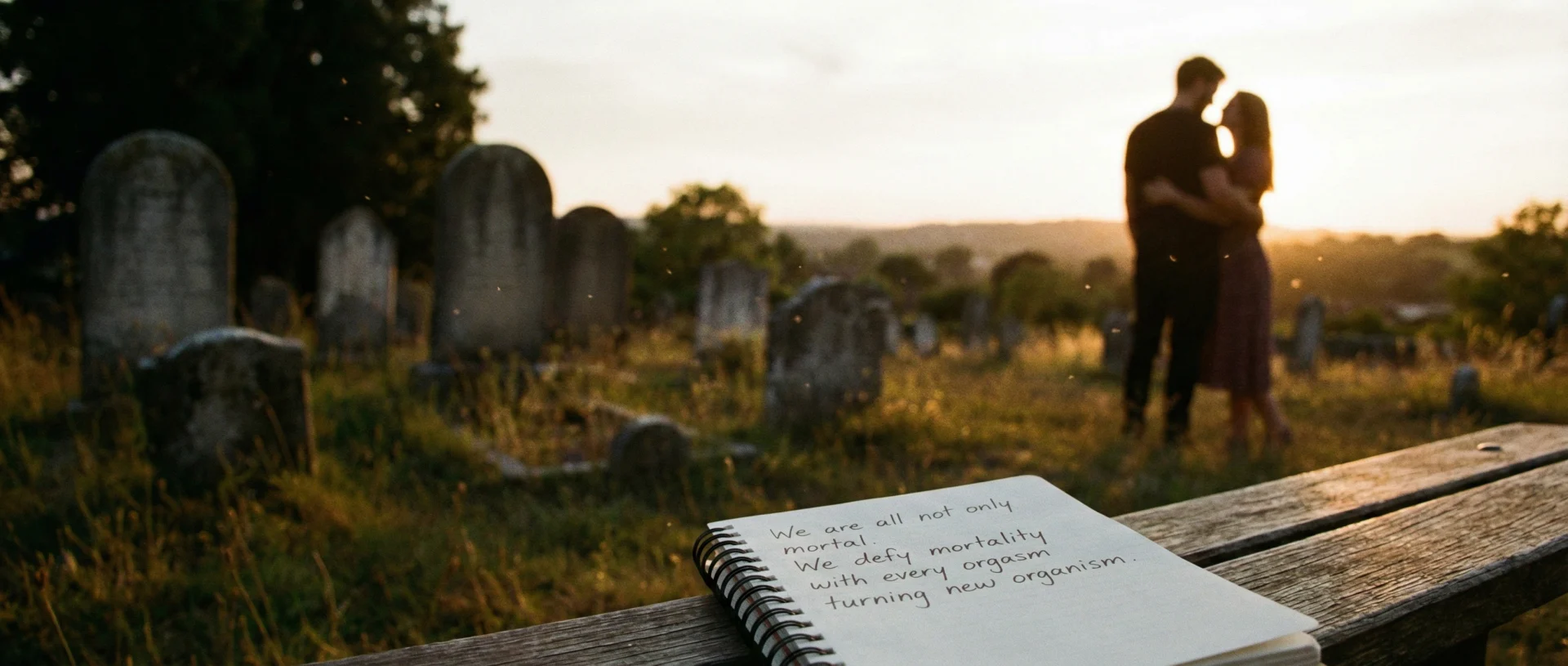
That’s what the wedding night scene understands that the battle scenes don’t quite reach: the sword decides who controls the land. The bed decides whether there’s anyone left to control it. The petit mort is the most quietly radical act in any century — the moment where the grand architecture of power dissolves entirely, and what remains is just two people, bare-naked, equal in the only way that has ever ultimately mattered.
Robert the Bruce can claim a kingdom. He cannot claim that.
Nobody can.
What Dismissal Costs
The 1-star reviewer who calls Outlaw King boring isn’t really reviewing the film. They’re announcing that they couldn’t be transported — and then, crucially, filing the door as faulty rather than examining their own reluctance to walk through it.
That inaccessibility documents something real: an inability — or refusal — to recognize the sheer, almost incomprehensible magic of existence. The blade of grass you walk by every day, doing its impossible photosynthetic thing unremarkably. The subscription service delivering millenias of history to your living room through a fiber-optic cable for the cost of a coffee. The spark in a writer’s head — not yet titled, not yet anything — that traveled through years of production and arrived as pixels on a curved office monitor on a specific Friday night in a specific life.
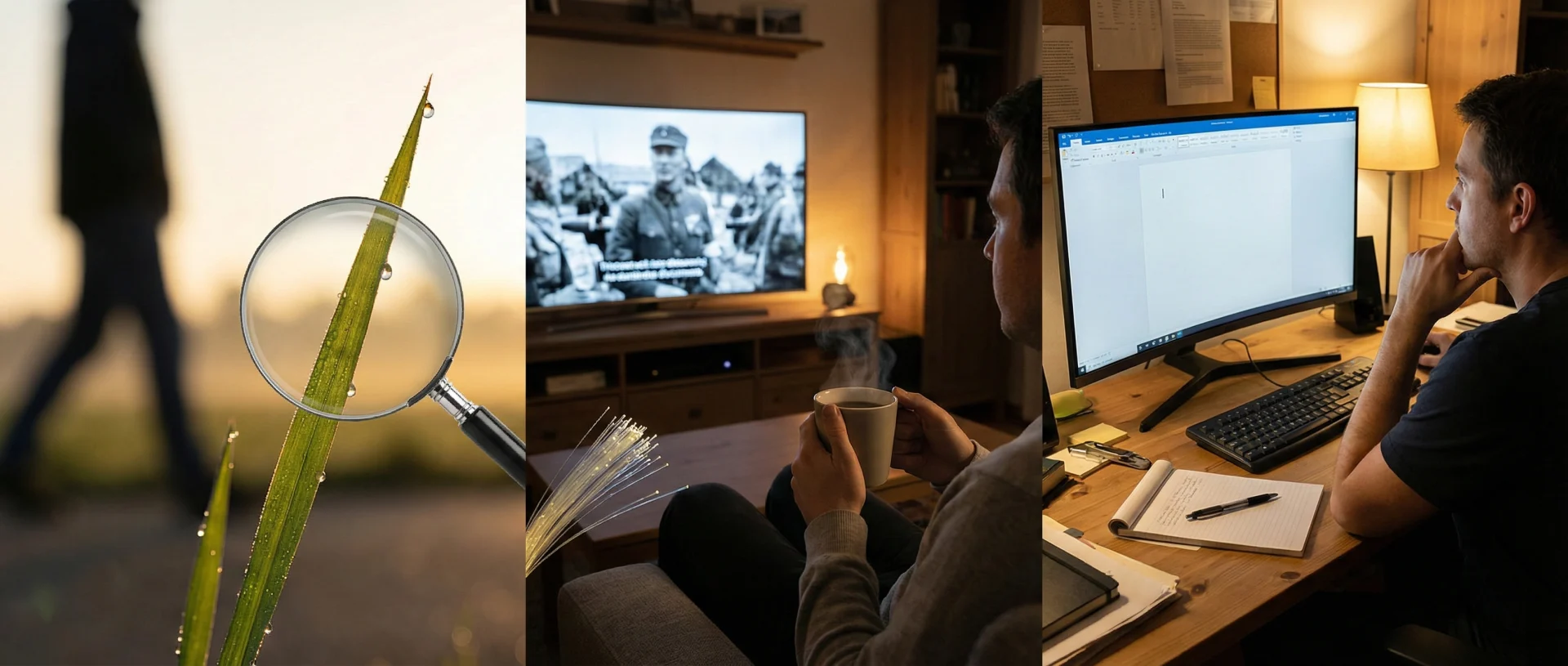
The same software runs in political commentary. The auditors of Talarico — those who will catalogue his inexperience, his idealism, his improbable geography (a progressive in Texas, honestly) — are running the same mental process as the 1-star reviewers. They are inspecting the hinges of the door rather than considering where it might lead.
Hope is an act of imaginative transport. So is watching a period drama. You either let the moving images move you, or you don’t. That choice says more about you than it does about the film.
The Pipeline and the Paradox
The deeper paradox of this particular Friday night: I am simultaneously the beneficiary of immense civilizational accumulation — Netflix, broadband, flatscreen, AI conversation partners, 26 letters in an alphabet I can hammer with my thumbs to encode anything — and a single person, alone in a room, watching a movie about a man fighting to hold onto a piece of land he loves.
The loneliness and the grandeur are not opposites. They’re the same feeling at different magnifications.
And they’re both, I think, pointing at something true: that the most consequential acts in any given era are often invisible at the time. A whisper in a Notes app. A campaign announcement in Texas. A writer’s first impulse toward a story that will eventually become a film that will eventually find its way to a curved monitor on a specific Friday night and connect, across seven centuries, to a feeling that something important is possible.
Six grandmothers. That’s all that separates us from Napoleon’s defeat at Waterloo on June 18, 1815. Six. The entire arc from hand-copied manuscripts to AI-generated Sora2 longform-shorts — compressed into six grandmother-lengths of time. The acceleration is real and it is genuinely difficult for human brains to feel, because we are built for linear time and this is not linear time anymore.
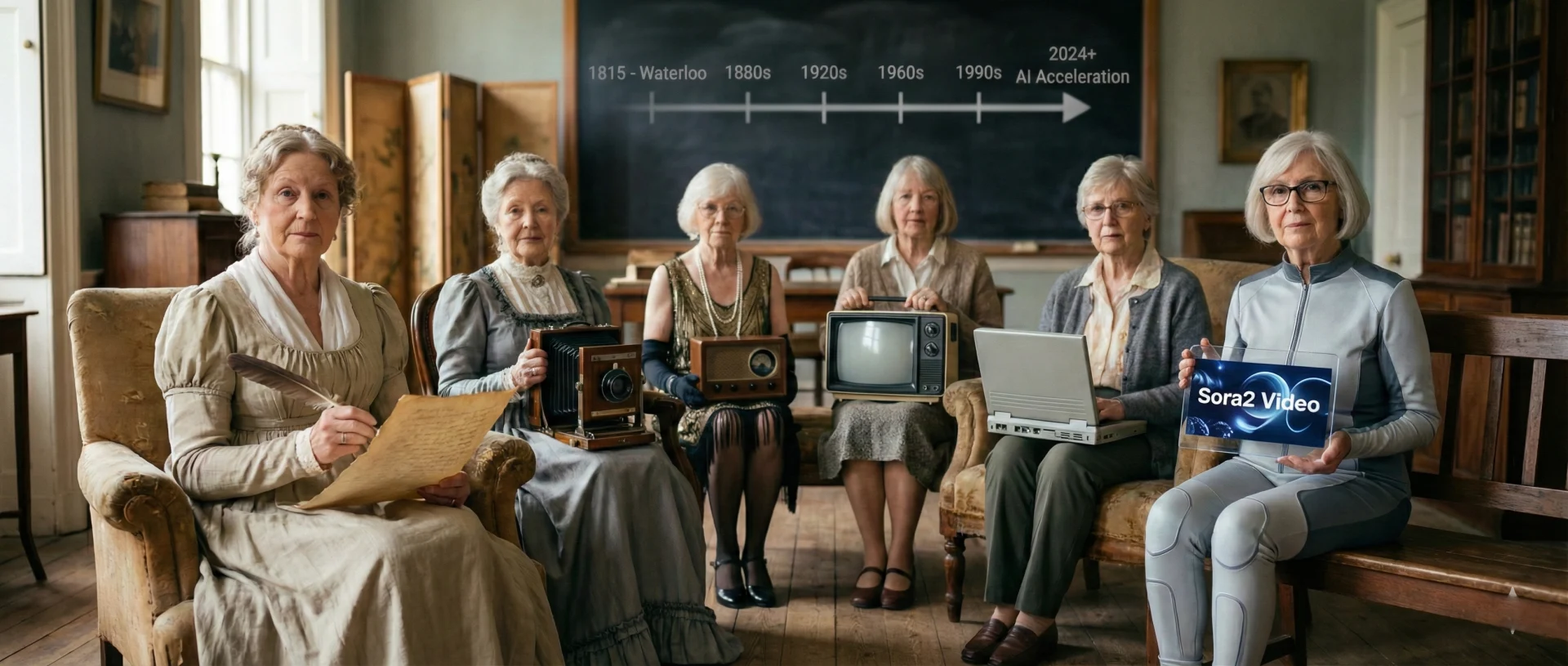
Which makes the question of who leads during acceleration more urgent than it has perhaps ever been.
The Outlaw as Template
What made Robert the Bruce worth a $120 million film wasn’t just that he won. It’s that he won while being outgunned, outresourced, and out-institutionalized — and that the manner of his winning mattered. He didn’t become Edward I in order to defeat Edward I. That restraint, that retention of something essentially himself under enormous pressure to simply become another version of what he was fighting, is what makes the story worth telling 700 years later.
I watch James Talarico hold that same quality — the steadfast calm, the refusal to perform aggression as strength, the genuine compassion that doesn’t read as softness — and I think: this is what it looks like before the history gets written.
I could be wrong. Most outlaw kings don’t make it to the coronation. The ratio is brutal in politics as in medieval Scotland. But the act of recognizing potential, of choosing to believe in a trajectory before its outcome is guaranteed — that’s not naïveté. That’s the fundamental human wager. The thing we’ve been making, quietly, as the extras in someone else’s historical narrative, for as long as we’ve been human.
It’s what distinguishes the ones who build from the ones who merely occupy.
Humility as the Longer Game
Humility compounds. Arrogance craters.
Not always in a single lifetime. Definitely not always in a single election cycle. But across the span that matters — the span where we get from flint tools to DaVinci Resolve, from cave walls to Substack, from warlords on horses to whatever the next six grandmothers will navigate — the quiet ones win. The builders win. The ones who recognize that they are also the extras in someone else’s story, and conduct themselves accordingly, win.
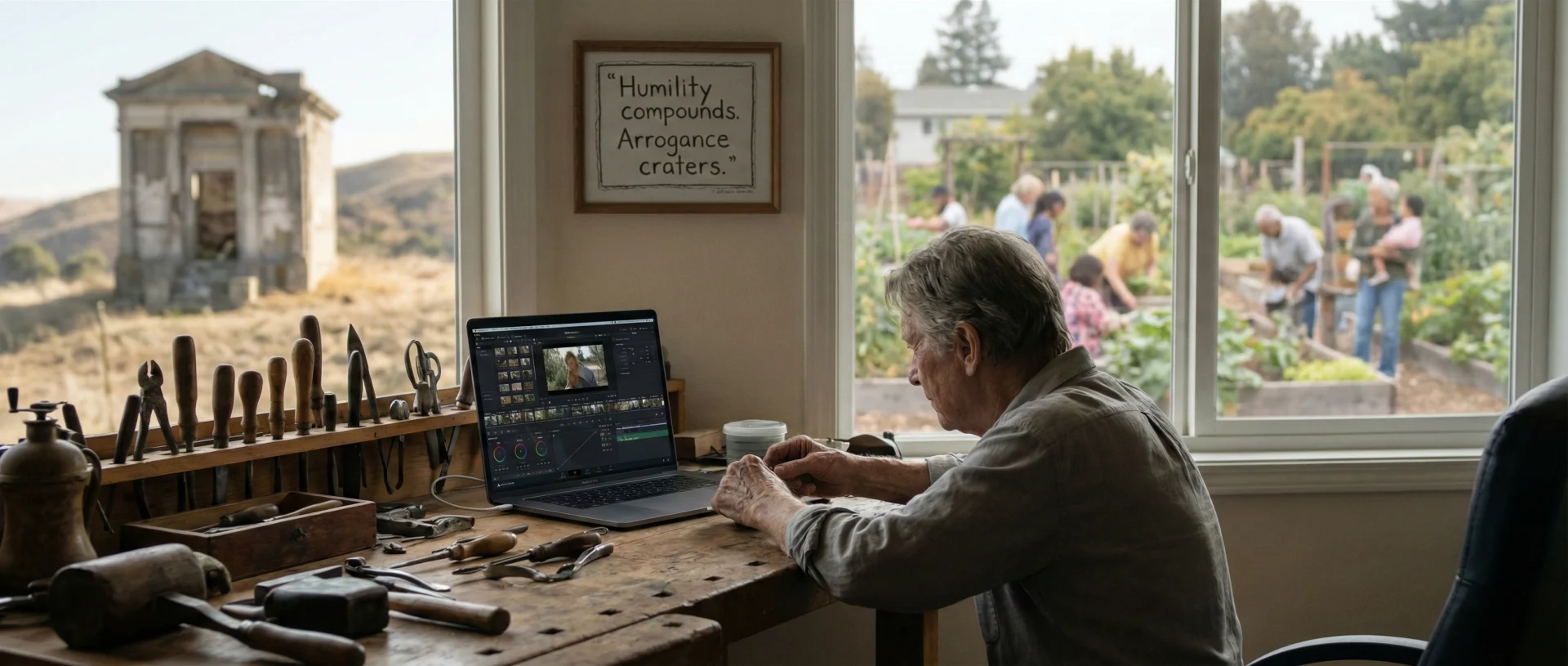
I’m writing this down because I want to remember it when the auditors arrive, as they always do. When someone files the door as faulty. When the 1-star reviews come in for whatever improbable thing we’re trying to build.
I want to remember that the extras are the story. That the paper outlasts the headline. That there is always an Outlaw King in the part of the story that hasn’t been written yet — and that the act of believing in that, before the outcome is certain, is not delusion.
It’s the oldest and most durable form of human intelligence there is.
Enjoyed this? The Creative’s Applause explores the question of authenticity and AI-assisted art in more depth — and who, exactly, gets to claim credit for human expression. The full creative pipeline behind pieces like this one lives at the KindredSoulSearch How-To Guide, if you’re curious how a Friday-night Notes app ramble becomes something like this.
P.S. A final grace note, and I mean it: thank you to the auditors! Without the contrast you provide — the clipboard, the skepticism, the one-star certainty — it’s genuinely less clear that greatness would bother to announce itself so loudly. Resistance has always been part of the kiln. The Outlaw King needs the establishment he’s outlawing. The fire that forges is the same fire that threatens. So yes — it’s a two-way street, and I’d rather walk it honestly than pretend the friction wasn’t part of what made the journey worth taking.

