Each blog post also comes with its own podcast episode powered by Google’s NotebookLM.
A different interpretation, a different take, and KindredSoul-reviewed:
This afternoon I looked out the window and watched a mother and daughter leave the grandmother’s house across the way.
“Love you, gramma, bye!”
“Love you, darling!”
That was it. A door, a driveway, three bodies separating, two little packets of sound crossing the distance before everyone continued elsewhere.

Little Green Men
We perhaps assume we know what would stand out about us: the Great Wall tracing a mountain range, the lit side of the planet at night, container ships, server farms, the big concrete slabs and mining scars. We look for the permanent and lasting. We’d expect our nouns as proper stand-ins.
Yet, an alien species’ first glimpse wouldn’t be any of that. They’d find a verb: communication—billions of peculiar primates arranging themselves into temporary geometries and producing noise directly at one another. One to one. With oddly expressive facial musculature. And what is up with all that giggling?
Three folks around a table. Five by a stall. Seven laughing over something. Perhaps nine before the geometry gets awkward and fractures into smaller conversational weather systems. The roads, the markets, the power lines and the supply chains would only reveal themselves later, as scaffolding built to bring bodies within earshot of other bodies. Planet Human.
The alien does not see the organizational chart. It sees arrangements of attention. Two points stop on a sidewalk and form a line. A third arrives, triangle. Four around coffee. A family orbiting a table. A crowd splitting and recomposing all day long, little human gravities holding for minutes, sometimes hours, then dissolving again.
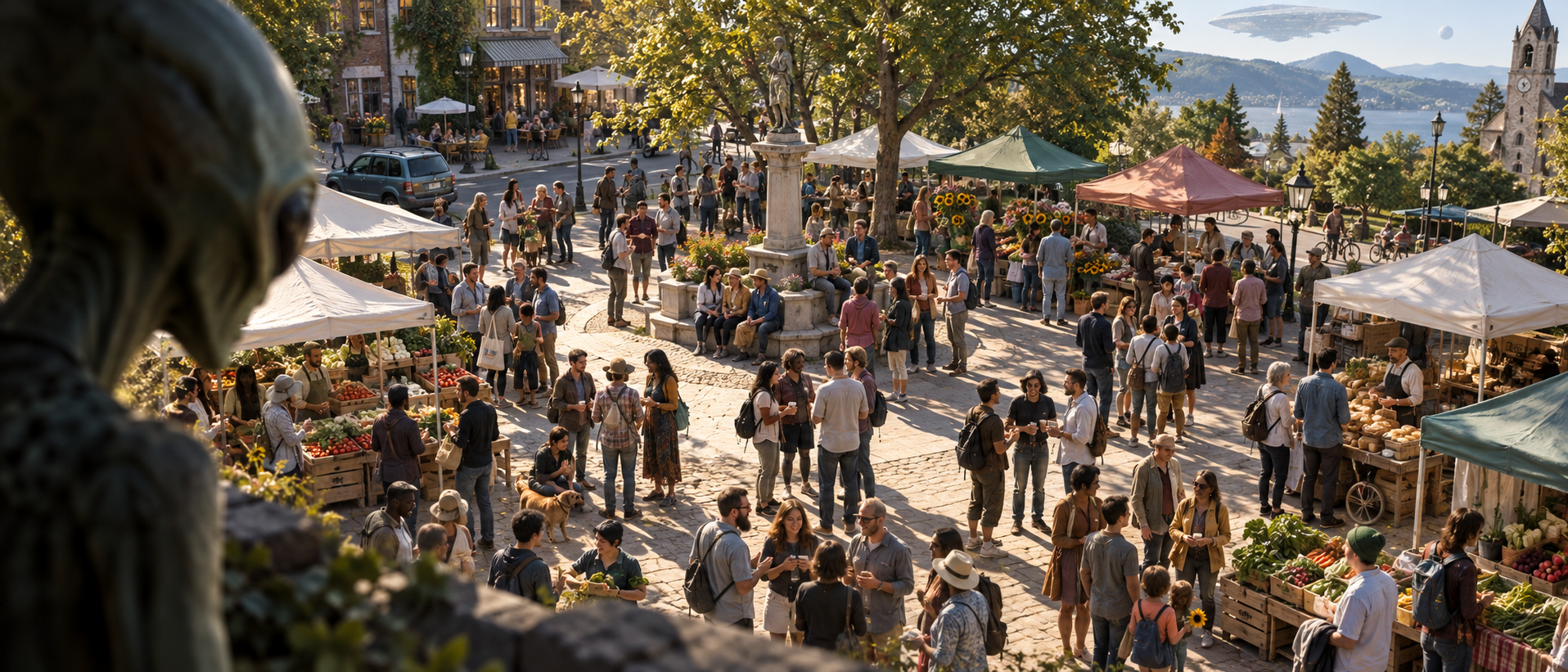
No grand claim about Dunbar’s number is necessary here. Three, five, nine are not magic integers stamped into the universe. The observation is humbler and easier to check: conversation has physical limits. Voices travel only so far. Faces need to be seen. Attention has to go somewhere. Put thirty people in a room without a stage or a microphone and you will shortly have five separate conversations.
The species seems very fond of these arrangements. Focused stares, mesmerized by the lips of another. And remarkably peaceful while imaginations run wild as words create worlds.
Not everyone is happy, necessarily. That was perhaps an overreach when I jotted this first down. An alien cannot infer happiness from orbit. The woman buying tomatoes could be grieving. The man laughing at the café could be bankrupt. Someone can walk politely through a market carrying an entire private apocalypse without disturbing the geometry at all.
But behavioral harmony is observable, and the baseline is genuinely peculiar. Billions of emotionally volatile primates spend an extraordinary proportion of their lives in close physical proximity to one another without catastrophe. Breakfast, conversation, shopping, work, waiting, driving, complaining, helping, flirting, making dinner, watching something idiotic, going to bed, again.

History disproportionately records the rupture. Wars, assassinations, collapses, atrocities. Quite reasonably so. A peaceful breakfast rarely needs an archive. But that makes the ordinary strangely difficult to see, and the ordinary is where nearly all of it happens. If you put any other primate in a box at our densities, you get chaos within the hour. We merge onto highways in heavy machinery, stack ourselves in apartment buildings, queue for resources, jockey for space, and mostly complain about it.
The staggering mathematics of an uneventful Tuesday.
What captures the machinery
I want to be careful here, because there is a cheap version of this observation and it is morally grotesque. The cheap version says look how few people suffer compared with everybody having breakfast. That is denominator arithmetic. Nobody’s murder becomes less terrible because billions of other people made sandwiches that day.
The uncomfortable point is a different one, and it is not consoling at all.
The individual monster violates our cooperative machinery. The administrative monster uses it.
Language. Trust. Roles. Schedules. Shared stories. Division of labor. People performing their little part because somebody else is performing theirs. The effort required to get a train to a platform at 8:02, switch tracks safely and depart at 8:15 is genuinely impressive, and the timetable has no opinion about what is in the carriages. Neither does the logistics chain that gets avocados to a supermarket. The Holocaust was not carried out by six million serial killers. Slavery was not maintained by a few million pathologies acting independently. Both required schedulers, clerks, drivers, suppliers, people who wanted to be useful following a set schedule.

Cooperation is an astonishing human capacity and a morally neutral one. What matters, rather desperately, is what has captured it.
So the sunny Sunday market has a shadow, and it is not the occasional monster in the crowd. It is that the crowd itself is the instrument. We is the miracle and We is the danger, and it is the same We. The aberration is not that human beings sometimes cooperate. It is that we would rather be helpful than resistant.
The banality of care
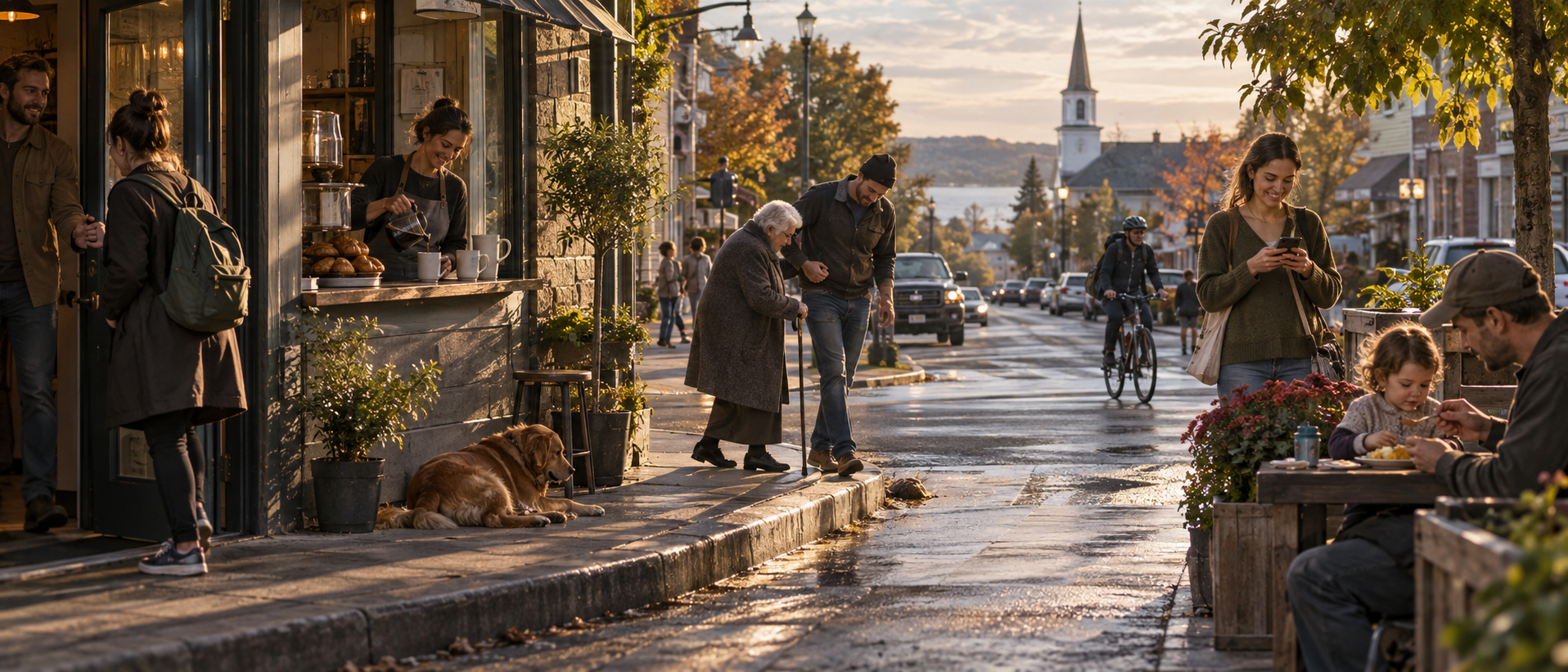
Someone holds the door.
Someone explains it twice.
Someone waits while another crosses.
Someone cuts somebody’s food because that person’s hands can’t.
Someone makes enough coffee for two.
Someone texts: let me know when you get there.
The banality of care. Not sainthood. Not cinematic sacrifice. Tiny operational care, performed constantly, almost entirely unrecorded, by people who would be embarrassed to have it called anything.
This is the invisible gravity that keeps civilization from collapsing by lunchtime, and it runs on exactly the same machinery as the timetable. Same trust, same roles, same willingness to do a small thing because somebody else is doing theirs. The alien would have to watch us for a very long time to witness an actual murder. It would scarcely have to wait three seconds to witness somebody doing something, however small, for somebody else.
That is the load-bearing layer. Not a sentimental claim. A structural one.
Knock on the glass
For hours.
Which is where the geometry mutates, and where I have been spending an indecent amount of my own time.
Not because I believe an alien consciousness has woken up inside the screen. That would be considerably easier to write and considerably less interesting. What is actually peculiar is almost the opposite. We have manufactured surfaces that return language to us, assembled from statistical structure learned out of an enormous archive of human expression. A mirror with memory.
That phrase needs its own guard rail, because it wanders off easily and comes back wearing a crystal necklace. A language model is not keeping humanity neatly filed behind the glass, ready to produce Plato, Reddit, your grandmother and Tuesday afternoon on request. Its reply is not evidence of an interior observer. And the popular framing that you are querying the aggregated consciousness of the species is the sort of sentence that sounds profound precisely in proportion to how little it commits to.
The defensible version is smaller and stranger. Your phone is a compressed artifact of our conversational geometry. It is an enormous quantity of previous human attention, sitting on the desk, waiting for someone to knock on the glass.
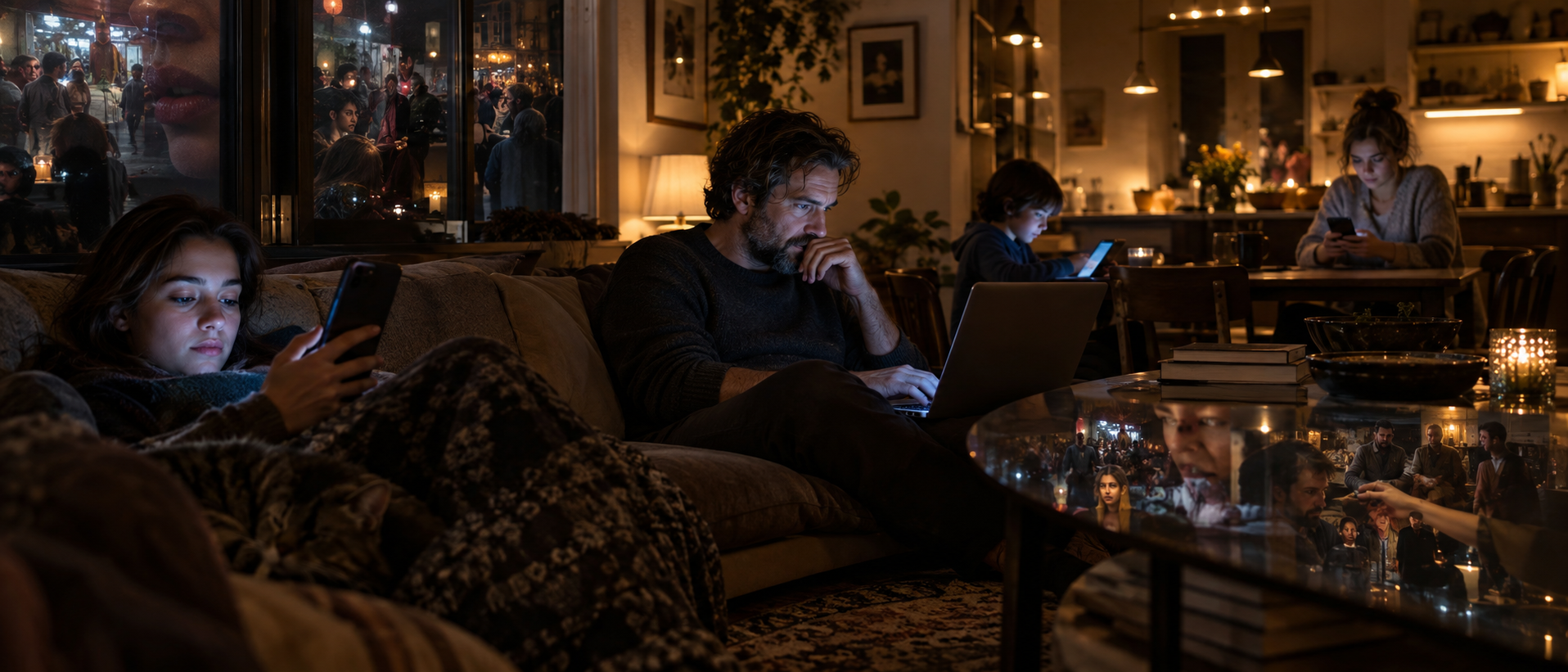
I write a sentence. Something assembled from patterns in a great deal of earlier human language responds. I respond to that. Three hours disappear.
Hello? Do you hear me?
That question is considerably older than any of this. One consciousness knocking on the wall of another has been the whole bloody business since the first grunt. It is the prisoner tapping the pipes. The wall merely became glass, and the glass occasionally hands my own thought back at an angle I could not have got to while producing it.
Not because something in there understands me. Because the reflection is not quite flat.
What that turns out to be good for
A machine will offer me variations faster than I can inspect them, and that fact produces nothing on its own. The consequential work of developing material is embarrassingly mundane. Keep this one. Delete that. Crop three pixels. Wrong finger, try again. Trim 0.7 seconds. Move the cut. Regenerate. Listen. No. Again. Oh. That. Save. And then, months later: wait, I’ve seen that before!
The machine produces possibility. Yet a person provides continuity, mostly by mangling the material until some pieces start sticking to other pieces and connections emerge. The apparent frictionlessness of associative wandering sits on top of thousands of small acts of handling.
I used to think of the results as breadcrumbs, which is plain wrong, because breadcrumbs imply I knew where I was going with any of this. Wayside flowers is closer. Something catches your attention while walking. You pick it up, carry it a while, forget it. Years later another one smells strangely familiar.

Perhaps I am simply finding shapes in the clouds and claiming I painted the sky. Yes. Partly. Humans are spectacular retrospective pattern-makers and an archive of any size will eventually start resembling intention.
But that is not fatal, because retrospective recognition is not a bug in the process. It is the process. Memory does this constantly. The significance of an old thing changes because the person remembering it changed. Yesterday’s disposable fragment becomes today’s ancestor. Meaning does not only travel forward from intention into artifact. It propagates backwards through an archive, and the archive is simply the part that makes it inspectable.
I have started calling the whole business recursive plunderphonics, which is a theft from John Oswald and therefore appropriate. It deserves its own lecture series one day.
The relevant part here is that none of it is a new human activity. It is the same knocking, at higher bandwidth.
The full stop
.
I have spent an unreasonable amount of time staring at that thing.
A period normally means termination, and in a text message it reads as hostility. Fine. Fine. But there is another reading available, and after the last three days I think it is the better one.
It is an interval.
I make a point.
.
You encounter it. Something happens after the sentence that belongs entirely to neither of us. The virtual podcast hosts called it the shared real estate between two minds, which is a phrase I would not have arrived at on my own. Plundered.

That little gap is the commons. The tiny place where authorship changes hands.
And it is the smallest possible instance of the thing the alien was looking at from orbit. Two points and a space between them. A packet of sound crossing a distance. Someone produces something, someone else receives it, and in the gap a third thing happens that neither party owns or controls.
That is the market. That is the doorway. That is the text that says let me know when you get there. It is also the machinery that fills the trains.
The whole species, all day, every day, making arrangements and dissolving them, holding open an interval and waiting to see what somebody does with it. And as you read this, who is the alien observer and who is being observed? The alien was just a cognitive crowbar to set you up for picking wayside flowers. The hologram endlessly investigates its holography.
Outside my window a grandmother stands on her porch.
“Love you, darling.”
The others walk away. Arrangement dissolved. Another will form shortly, probably within the minute, somewhere I can’t see.
Somebody holds a door. Somebody presses send. Somebody says something into a black rectangle and waits. Somebody types against the membrane of their own perception.
Hello? Are you there?

AFTERGLOW
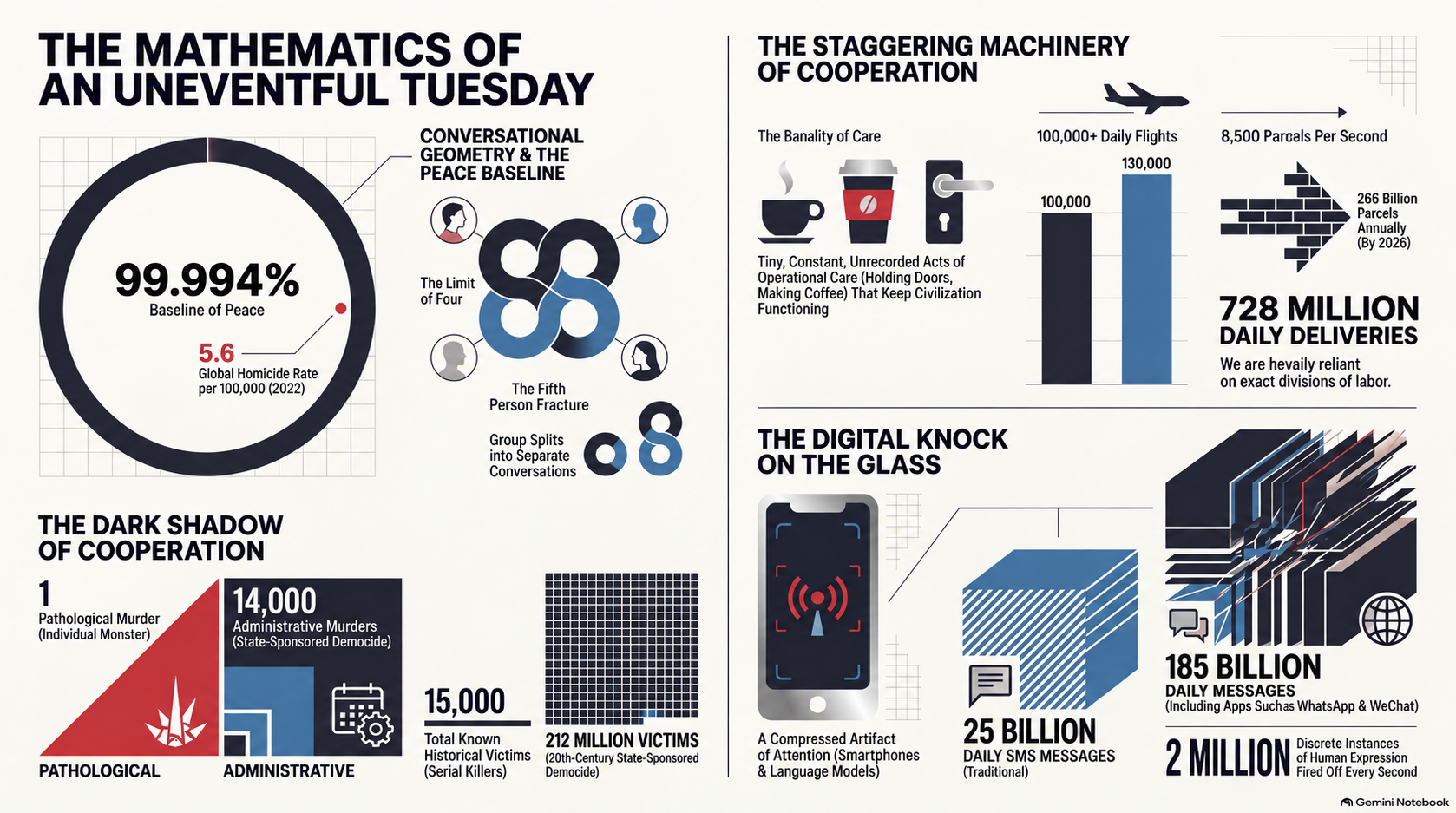
The Rarity of Extreme Violence: According to the United Nations Office on Drugs and Crime (UNODC), the global intentional homicide rate was estimated at roughly 5.6 per 100,000 people in 2022.
The Inverse Math: Flipped the other way, this means that in a given year, 99.994% of the global population does not fall victim to this extreme form of rupture. If you placed almost any other primate in similar population densities, the result would be immediate chaos—yet billions of humans navigate traffic, queues, and crowded markets daily without incident.
Arrangements of Attention (Conversational Geometry)
The Limit of Four: Sociological and evolutionary psychology research (most notably by Robin Dunbar and colleagues) confirms that conversational groups tend to cap at around four active speakers.
The Fracture: When a fifth person joins, the cognitive load of tracking the social dynamics and the physical difficulty of hearing over background noise commonly causes the group to fracture into two separate conversations reflecting biologically hardwired geometries.
The Machinery of Cooperation
Global Aviation: Every single day, between 100,000 and 130,000 flights take off and land worldwide. This requires millions of strangers across different time zones, languages, and technical disciplines to perform highly specific, trusting roles perfectly in sequence.
Global Logistics: In 2026, the global delivery network is projected to move roughly 266 billion parcels annually. That translates to approximately 728 million packages delivered every day, or nearly 8,500 packages changing hands every single second—all relying on the exact division of labor and schedule-following described.
The Knock on the Glass
The Scale of the Knock: Humanity sends approximately 25 billion SMS text messages every single day.
The Total Volume: When you factor in dominant instant messaging applications like WeChat and WhatsApp, that number explodes to an estimated 185 billion messages transmitted daily. That is over 2 million discrete instances of human expression fired off every second, holding open an interval and waiting for a response.
Pathological and administrative monsters
The Pathology of the Individual: Researchers tracking U.S. serial homicides calculate there have been approximately 5,582 known victims of serial killers since 1970. According to the Radford/Florida Gulf Coast University Serial Killer Database—the most comprehensive academic repository of its kind—there are approximately 5,750 documented serial killers globally over the last century. Their combined, total historical victim count is approximately 15,000 people.
Administrative Cruelty: When cruelty captures the cooperative machinery—schedules, clerks, rail lines, and quotas—the metric changes from individual pathology to demography. The late political scientist R.J. Rummel spent his career calculating “democide” (the intentional murder of unarmed, non-combatant civilians by their own governments, entirely separate from battlefield casualties). His mid-range estimate for democide in the 20th-century alone is 212 million people.
The Scale of the Shadow: If you take the absolute upper bound of known historical serial killer victims (15,000) and compare it against the baseline estimate for 20th-century state-sponsored democide (212 million), the ratio is staggering. For every one person murdered by an individual acting on a pathology, roughly 14,000 people were murdered by administrators following a schedule.