
Can Neo-Feudalist Democracy Open a Path to Compassionist Multidimensionality?
I keep thinking about the period.
Not the historical kind, initially. Just this:
.
That little thing.
A full stop. With a world on the other side.

I had been responding to some random soul on Reddit who seemed exhausted by the whole pursuit. Philosophy, meaning, consciousness, whatever peculiar hallway you find yourself walking down once you start wondering what the hell all of this actually is.
They had apparently been peeling the onion and had reached one of those unpleasant moments when another layer comes off and, annoyingly, there is simply more onion.
I know the feeling.
Been peeling for over 50 years.
Should you read all the big ones, up through Sartre, as someone had apparently suggested? Maybe. Will that settle anything? Maybe. Maybe not.
You might stumble into Alan Watts, Ram Dass and Terence McKenna, bless their souls. Castaneda was a fantastic initial hook for me in my twenties. These days I find myself wandering around Bernardo Kastrup, Federico Faggin and the Penrose and Hameroff neighborhood, occasionally stopping to stare through somebody else’s conceptual window.
Fascinating.
But satisfactory?
That seems to be a different question.
Perhaps there are moments when thinking itself comes to what feels like a temporal finality. You arrive at a point. Not the point, necessarily. Just a point where the thought has gone about as far as it knows how to go.
.
Full stop.
Except the strange thing about a full stop is that we routinely travel through it.
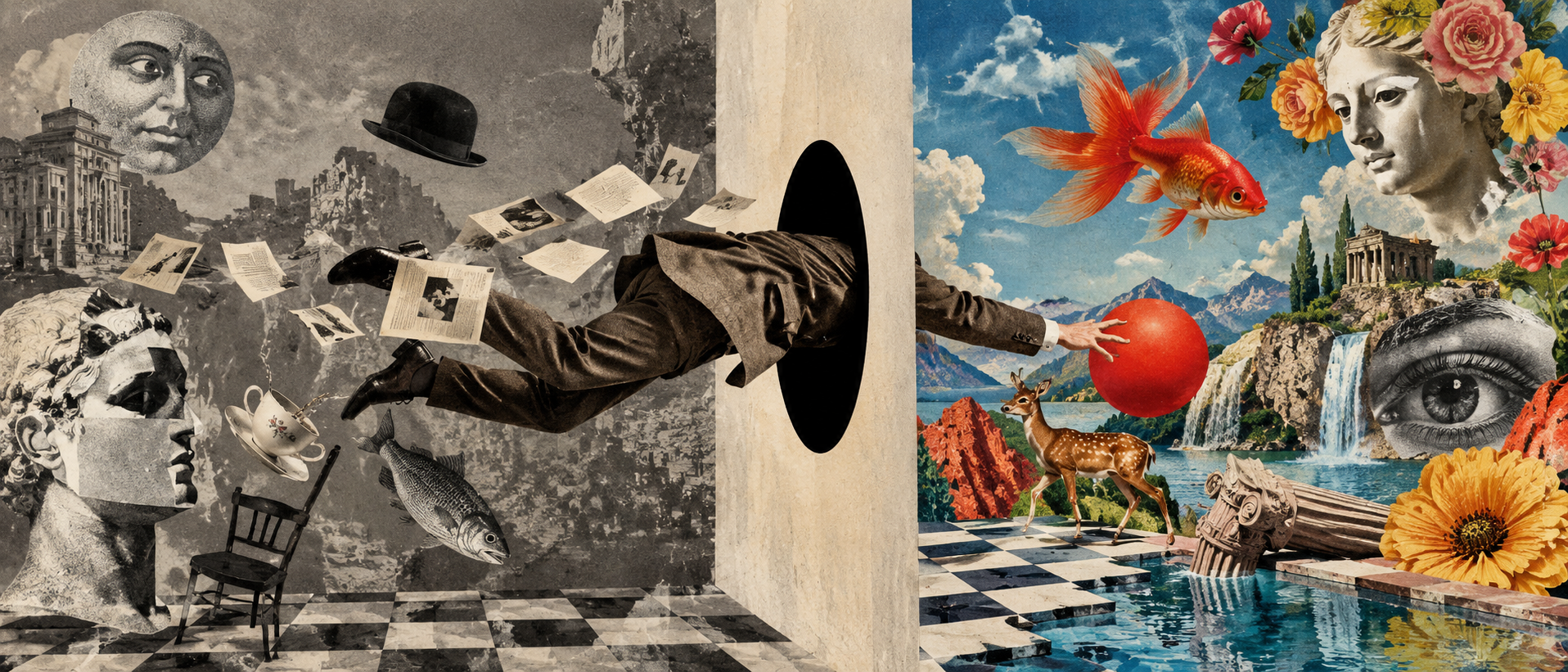
A period seems to mark the absolute end of something until, without ceremony, another sentence begins.
The point turns out to be less like a wall than an extraordinary little compression zone between one configuration of thought and whatever comes next. An entire intellectual world collapses into a speck of ink, and then somehow we emerge on the other side.
Right now.
High Five.
Consensus reality is a handshake.
That thought amused me more than it probably should have. But it also started bothering me, because once you notice the period doing this inside a sentence, it becomes difficult not to see larger periods everywhere.
Cultures have them.
Generations have them.
Institutions have them.
History certainly seems to have them.
The Trouble With Arrows
We tend to draw history as a line.
This happened, then this happened, which caused this, which eventually led to us, standing conveniently at the rightmost edge of the diagram.
Agrarian. Industrial. Information. Monarchy. Democracy. Local. Global. Scarcity. Abundance.
The arrows are reassuring. They give history a direction, and direction rather quickly begins impersonating meaning.
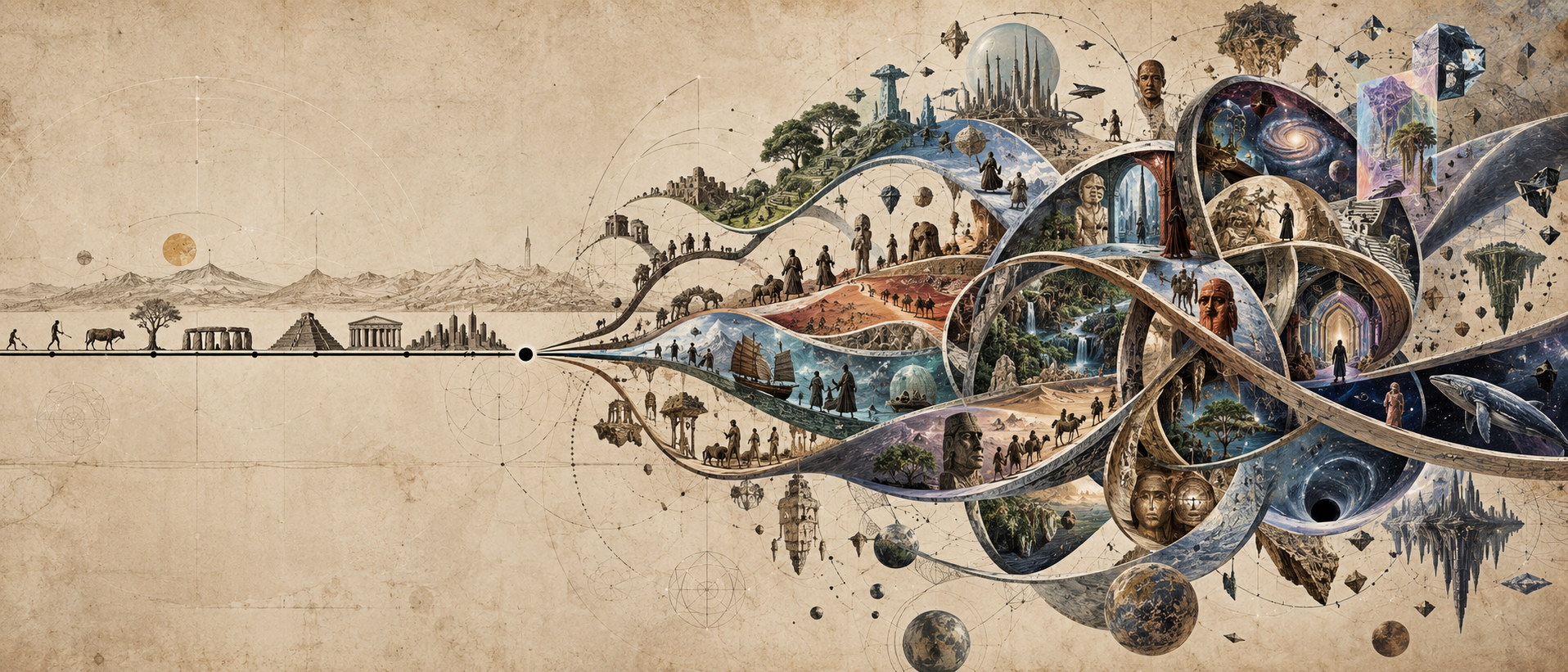
Perhaps that has always been partly fiction.
Reality is considerably ruder.
Civilizations do not politely advance one conceptual square at a time. Old arrangements survive inside new ones. Ancient instincts operate modern machinery. Tribal affiliations occupy global networks. Feudal relationships appear inside nominally democratic systems. Cooperative structures emerge inside markets. Markets emerge inside socialist systems. Religious impulses migrate into technological movements. Machines begin participating in the production of culture while humans wonder whether they are becoming machines.
We sample everything.
We remix it.
We rename it.
We forget where half of it came from.
Then we announce something new.
Recursive Plunderphonics.
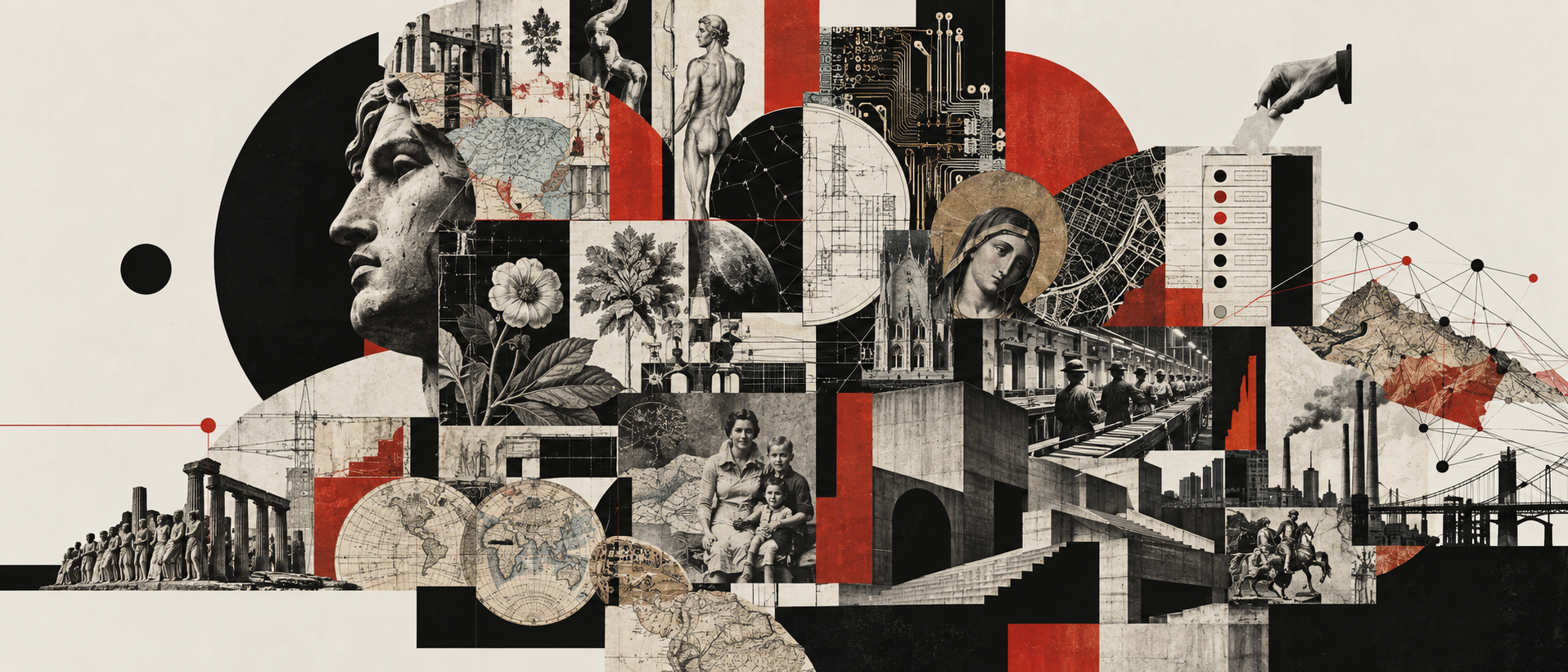
I have used that phrase elsewhere because I keep returning to the sense that culture behaves less like a cleanly advancing composition and more like a sample collage continuously feeding upon itself. We inherit fragments, distort them, layer them over other fragments, mistake an old bassline for a new revelation and occasionally produce something that genuinely was not there before.
Human civilization may be considerably more DJ than composer.
This becomes particularly interesting around the old idea of an “end of history.”
Not necessarily the literal claim that events stop happening. That would have been awkward. Rather, the feeling that perhaps we eventually converge upon the basic form of social organization and then spend eternity tuning the knobs.
Maybe.
But perhaps what is ending is something else.
Perhaps the line is ending.
───────────────.
Because once you reach a point, there is no intrinsic reason the next move must continue forward.
A point can open in many directions.
And perhaps our current disorientation has something to do with discovering that the future increasingly resembles a possibility space rather than a railway.
AI. Climate. Biotechnology. Global markets. Local identity. Digital tribes. Wealth concentration. New commons. Institutional distrust. Network culture. Automation. Resurgent nationalism. Transnational communities. Families scattered across continents while strangers form durable communities inside little rectangles of glass.
All of this is happening simultaneously.
Yet much of our institutional machinery remains remarkably one-dimensional.
One nation.
One government.
One employer.
One household.
One political party or another.
One election every few years.
One enormous market in which wildly different human arrangements are expected to coexist under roughly the same procedural abstractions.
Perhaps these structures are not necessarily wrong.
Perhaps they are simply being asked to resolve dimensions they were never built to contain.
That feels like a period marker.
.
Not apocalypse.
Punctuation.
A Billion Dollars and a Wayside Flower
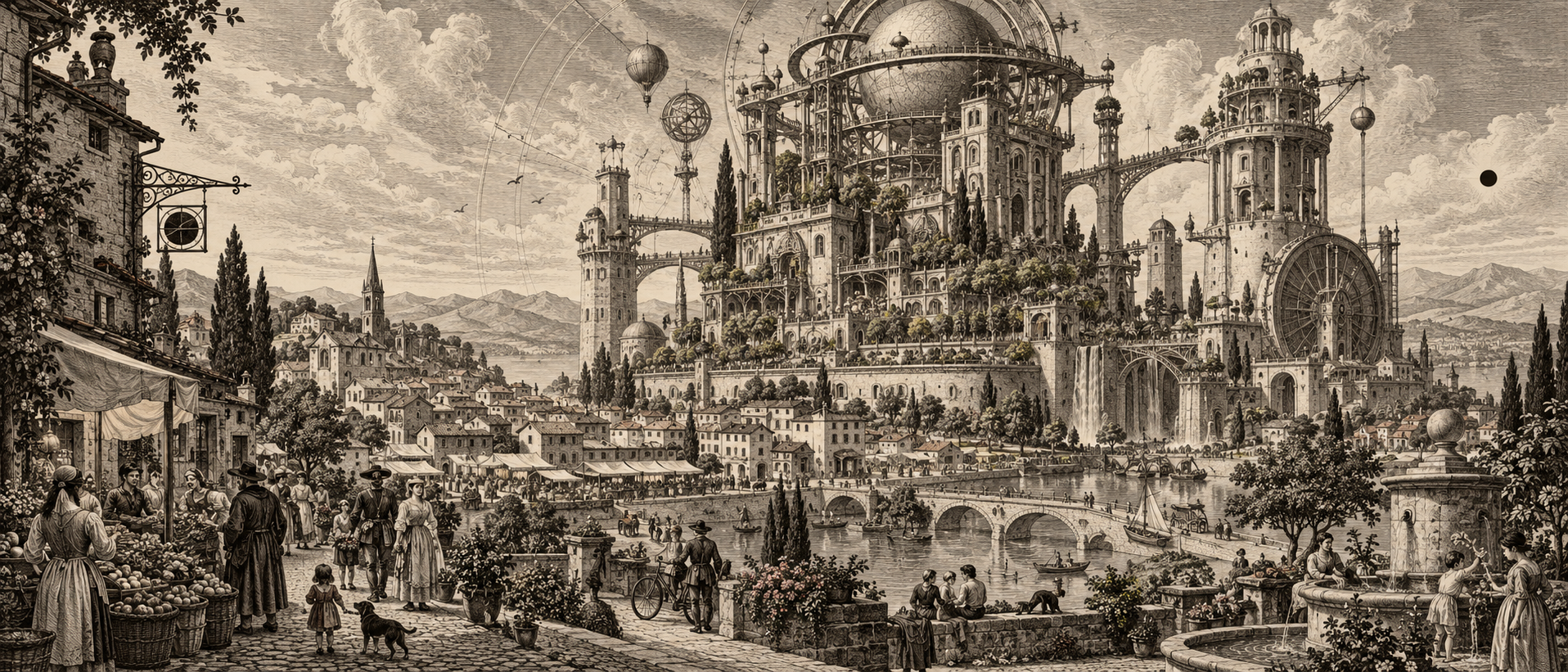
Wealth is an interesting place to test this because it makes almost everybody irritated very quickly.
I recently found myself circling a thought that would probably get me excommunicated from several ideological dinner parties simultaneously:
Obscene wealth, even as a gap, is perfectly acceptable if we are all as contemporaries appropriately and satisfactorily taken care of for the obsessor to pursue their pursuit. Cause then, why not.
Let somebody build rockets.
Collect impossible paintings.
Spend forty years designing the world’s most unnecessarily magnificent cello.
Construct an experimental city.
Fund a telescope the size of Wales.
Become absurdly obsessed with orchids.
Why should inequality itself necessarily offend me if everyone sharing this peculiar historical moment has genuine security, dignity, agency and access to what we have collectively decided constitutes a decent life?
The problem arrives when the pile becomes something more than a pile.
Obscene wealth is not necessarily objectionable because of the gap itself. It becomes objectionable when that gap produces deprivation, domination, distortion, dependency, or disproportionate control over the lives of others.

That distinction matters.
Money is not merely purchasing power once accumulated at sufficient scale. It can become institutional endurance. Political access. Ownership of infrastructure. Control over employment. Control over information. The capacity to withstand conflicts that would financially annihilate another participant.
The moral question therefore gets more interesting than simply:
How much is too much?
Perhaps the better question is:
When does private abundance become public power?
And then another:
Can enormous private capacity exist without converting itself into dominion?
I do not know.
But I suspect this is precisely the sort of question our existing ideological vocabulary handles badly because the available answers already arrive bundled into enormous packages.
Capitalism. Socialism. Libertarianism. Communism. Social democracy. Anarchism. Pick your jersey.
The trouble is that each contains observations I find useful and assumptions I find dubious. History has already sampled them from one another anyway, while continuing to insist upon the purity of the tracks.
So perhaps we sample deliberately.
Neo-Feudalist Democracy, Because Apparently We Needed Another Terrible Phrase
This is where I found myself arriving at the phrase Neo-Feudalist Democracy, which has exactly the sort of intellectual voltage that makes sensible people back slowly toward the door.
Good. Stay for a moment.
I am not suggesting reinstating lords, serfs, hereditary rule or the charming historical convention whereby disagreement with local governance could involve agricultural implements.
The phrase interests me precisely because its components resist one another.
Feudal arrangements concentrate resources and create dependency.
Democracy distributes political legitimacy.
Put them next to each other and something starts sparking.
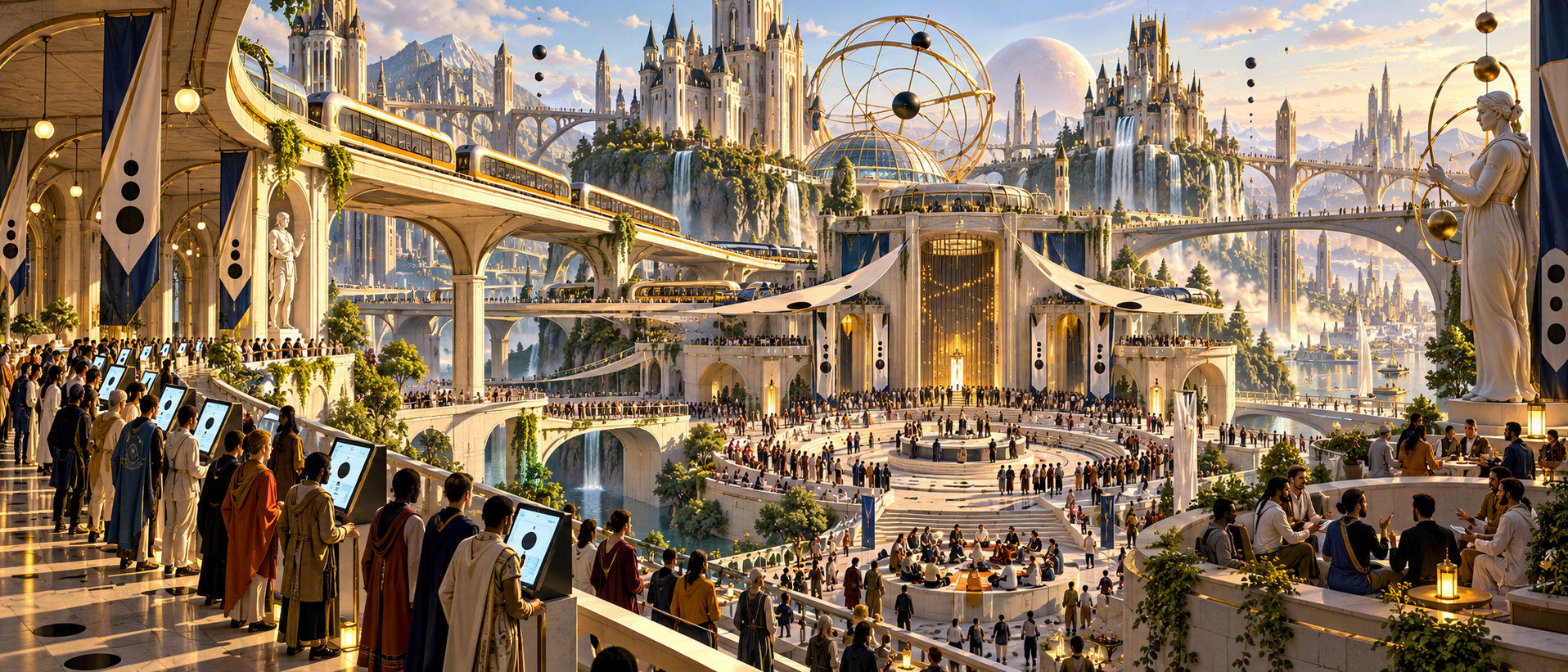
Suppose substantial private wealth does not disappear.
That seems at least worth considering.
Suppose instead we become considerably more deliberate about the structures through which wealth encounters ordinary human communities.
Could a wealthy individual voluntarily support a bounded group of people without purchasing authority over them?
Could support be separated from governance?
Could people accept resources while retaining meaningful exit rights?
Could the person contributing vastly more economically remain just another participant procedurally?
Could groups become materially stronger without becoming socially indebted to their benefactor?
And, perhaps most importantly: Could everybody still tell the rich person no?
That last one may be the entire experiment.
This is approximately where Dunbarrios enters my own thinking, although I am wary of allowing my own project to stroll conveniently onto the stage wearing a cape.
Dunbarrios is an experiment in small-scale procedural collective learning. Small circles. Human-scale governance. Rotating responsibilities. Voluntary participation. Explicit mechanisms for resolving friction. Links between adjacent circles. The ability to leave. No scoring people. No automatic sanctions. No assumption that financial contribution confers greater human authority.
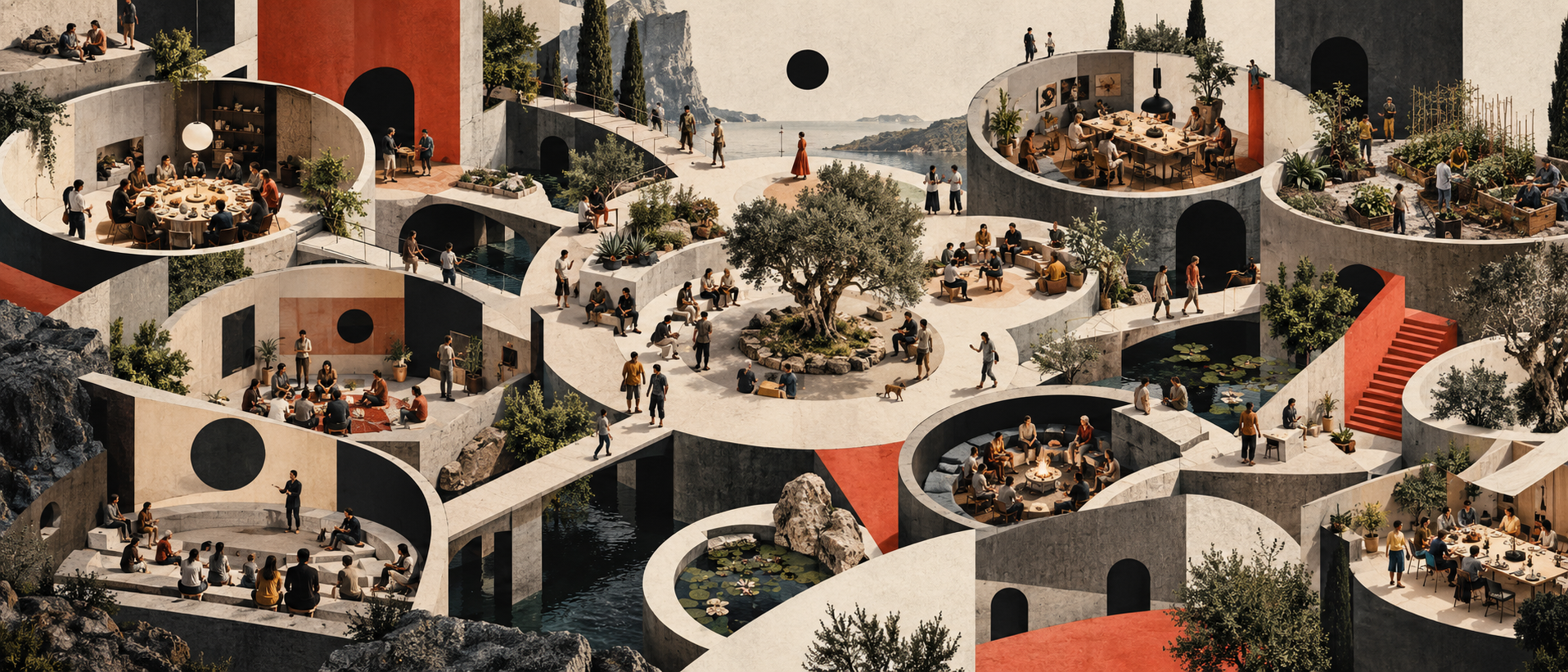
None of this proves anything.
Software especially has an unfortunate tendency to mistake representing a social process for solving it.
Putting “Exit” on a button does not guarantee somebody can meaningfully leave a dependency relationship. Writing “equal voice” into a governance document does not equalize economic leverage. A wealthy steward who technically possesses one vote may still possess enormous informal influence because everyone knows who keeps the lights on.
So the interesting question is not whether a product can design away power.
It cannot.
The interesting question is whether structures can make power more visible, more bounded, more contestable and less automatically convertible from one domain into another.
Money need not automatically become command.
Expertise need not automatically become command.
Popularity need not automatically become command.
Coordination need not automatically become command.
Perhaps authority can remain contextual. Messy. Temporary. Human. That is at least testable.
Compassionist Multidimensionality
I keep reaching for Compassionist Multidimensionality, not because I have discovered the next ideology. God forbid. We have quite enough nouns already.
I mean something smaller and stranger.
What if the future does not require everyone to inhabit the same social answer?
One community might organize considerable voluntary redistribution.
Another might preserve substantial private wealth.
Another might operate cooperatively.
Another might emphasize familial responsibility.
Another might experiment with shared ownership.
People might participate in several overlapping arrangements simultaneously.
What matters is not necessarily uniformity between these systems.
What matters is whether the systems allow people to remain sufficiently secure and sufficiently autonomous while interacting with one another.
That “sufficiently” is doing heroic amounts of work, of course.
Who determines what satisfactory care means?
Material subsistence? Healthcare? Housing? Education? Mobility? Time? Privacy? Belonging?
The realistic answer will almost certainly remain contested.
And there is another danger. Celebrating multidimensionality can become a clever way of tolerating injustice by calling every arrangement merely another experiment.
Some arrangements are coercive.
Some destroy exit.
Some produce dependency intentionally.
Some accumulate power specifically by reducing the agency of others.
Pluralism cannot mean intellectual shrugging. So perhaps compassion supplies the constraint. Not compassion as niceness. Not mandatory hugging. Something closer to an insistence that our arrangements remain responsive to the consequences they produce in actual people.
If one person’s extraordinary pursuit requires another person’s avoidable misery, something has gone wrong.
If one group’s autonomy requires another group’s powerlessness, something has gone wrong.
If one experiment can survive only by preventing participants from leaving, it is no longer merely an experiment.
That still does not tell us what the one correct system is. Good. Perhaps that is the point.
Maybe multidimensionality begins when we stop assuming that one must exist.
. ← FULL STOP!
A point.
The apparent end of a sentence.
For much of history we have imagined ourselves moving along some line toward better arrangements, worse arrangements, inevitable arrangements, divinely ordained arrangements, technologically determined arrangements, historically necessary arrangements.

Perhaps we are approaching one of those points where the grammar itself becomes questionable. Not because everything that came before was mistaken. Quite the opposite.
Recursive Plunderphonics means we keep the samples.
Markets have learned things.
Democracies have learned things.
Commons have learned things.
Families have learned things.
Religions have learned things.
Indigenous governance traditions have learned things.
Corporations have learned things.
Cooperatives have learned things.
Networks have learned things.
Even failed systems contain procedural knowledge about what humans repeatedly try, tolerate, resist, corrupt and occasionally make beautiful.
Why throw away the record collection?
Sample it! But perhaps do so consciously.
Take the useful fragments without pretending their original ideological containers must remain intact. Build smaller spaces where arrangements can be tried, observed and changed. Connect those spaces so learning can travel sideways rather than commandments always travelling downward.
And perhaps wealth itself can become one such sample.
Not abolished by definition.
Not worshipped.
Not allowed to quietly become sovereignty.
Simply another form of human capacity subjected to the same awkward question everything else eventually encounters:
What happens to the people around it?
That seems a more interesting place to begin.
A billionaire can remain a billionaire.
The obsessed can pursue their obsession.
The oddball can build the telescope.
The circle can organize differently from the circle next door.
History need not resolve into one triumphant arrangement.
Perhaps the goal is not convergence.
Perhaps it is to become better at coexistence without powerlessness.
I have no idea whether Dunbarrios, Neo-Feudalist Democracy, Compassionist Multidimensionality or any of these slightly irresponsible phrases survive sustained contact with reality.
That is rather the appeal.
They are pointers.
Not destinations.
Little marks along the trail where somebody stopped for a moment, looked around and thought:
Huh.
Maybe this way.
Perhaps the next wayside flower is already there somewhere, still in the distance.
And perhaps we reach it.
Perhaps we don’t.
.
Full stop.
Then we continue. Wondering. Wandering.

