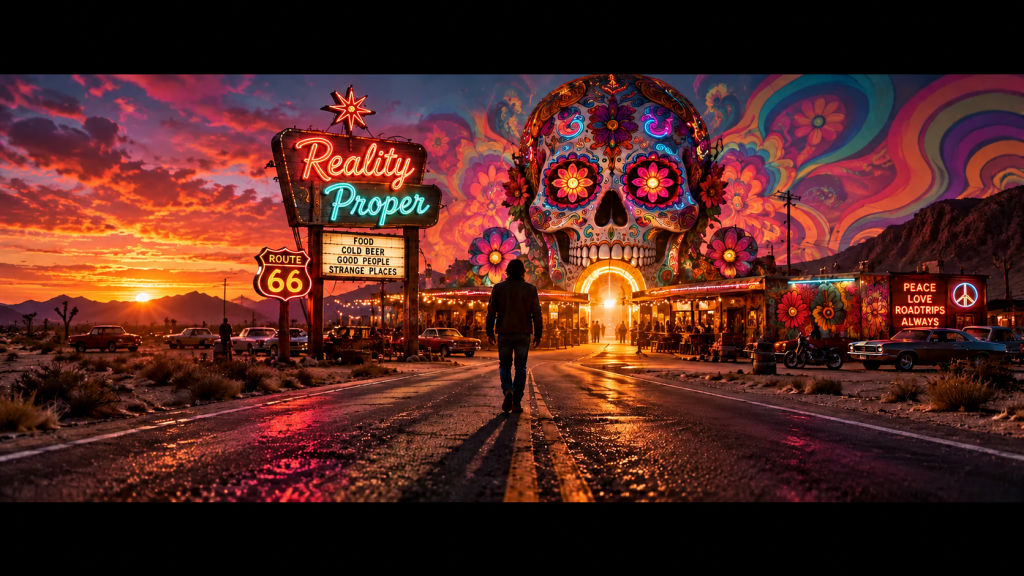
The peculiar finitude of cognition bearing no realistic prospect of exhaustion.
Each blog post also comes with its own podcast episode powered by Google’s NotebookLM.
A different interpretation, a different take, and KindredSoul-reviewed:
Something about a sound wave has been lingering with me: it is too little for what it becomes.
A pressure difference travels through matter. It reaches an ear. There are membranes, fluids, nerves, electrical activity. All perfectly respectable. And then, somewhere after that, there is music.
Not merely pitch and volume. There is recognition. Anticipation. The peculiar satisfaction of knowing where a phrase is going before it arrives. A room from childhood may suddenly reassemble itself. Somebody long absent can briefly inhabit the same three minutes. A chord acquires weather. Another becomes architecture. There are things one has forgotten remembering.
The vibration did none of this. Yet without the vibration, none of it happens quite that way either.
That seems worth sitting with.
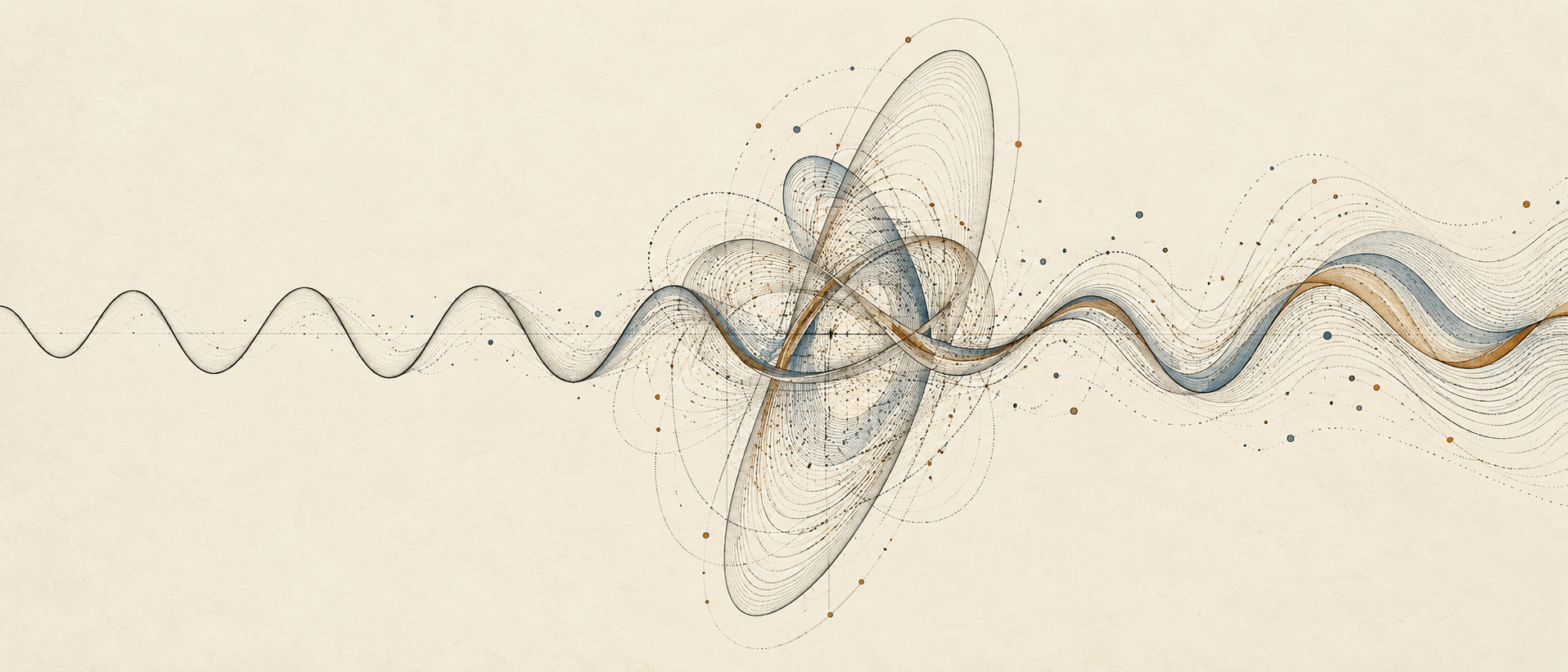
The rhythmic sound wave describes a state in which the mind, present, makes its own engagement visible. It is that bifurcation of the instant which the first proposition of experience has digested 13.8 billion years ago to my typing thumbs with each following moment, to encyclopedize itself again and again, memorializing its very aftersound of the present moment.
The sentence remains somewhat incomprehensible. I prefer it that way.
Because what I am reaching for is not merely perception. It is the recursive peculiarity that perception immediately becomes material for the next, subsequent instance of perception. The sound occurs, I experience it, and the fact of having experienced it now participates in whatever happens next.
The experiencer has already changed. Thus I am.
But so too is every local-physical indication of the wave’s vibration, making it possible for me to experience, observationally, how self-recognition may be the one thing through which I conjure a world for myself.
‘A’ world. That distinction matters.
I do not mean that the external world is imaginary, nor that I am manifesting furniture by thinking positively at it. Reality remains annoyingly capable of bruising the shin.
I mean that whatever reality may be independently of me, the only world I ever encounter phenomenally is the one produced through this particular act of encounter.
Yes, what else… at the very least, I am a resonance phenomenon. It is the spectral-observing being’s furthest counter-worlding relaxation of meaning. So it is.
And it dipoles.
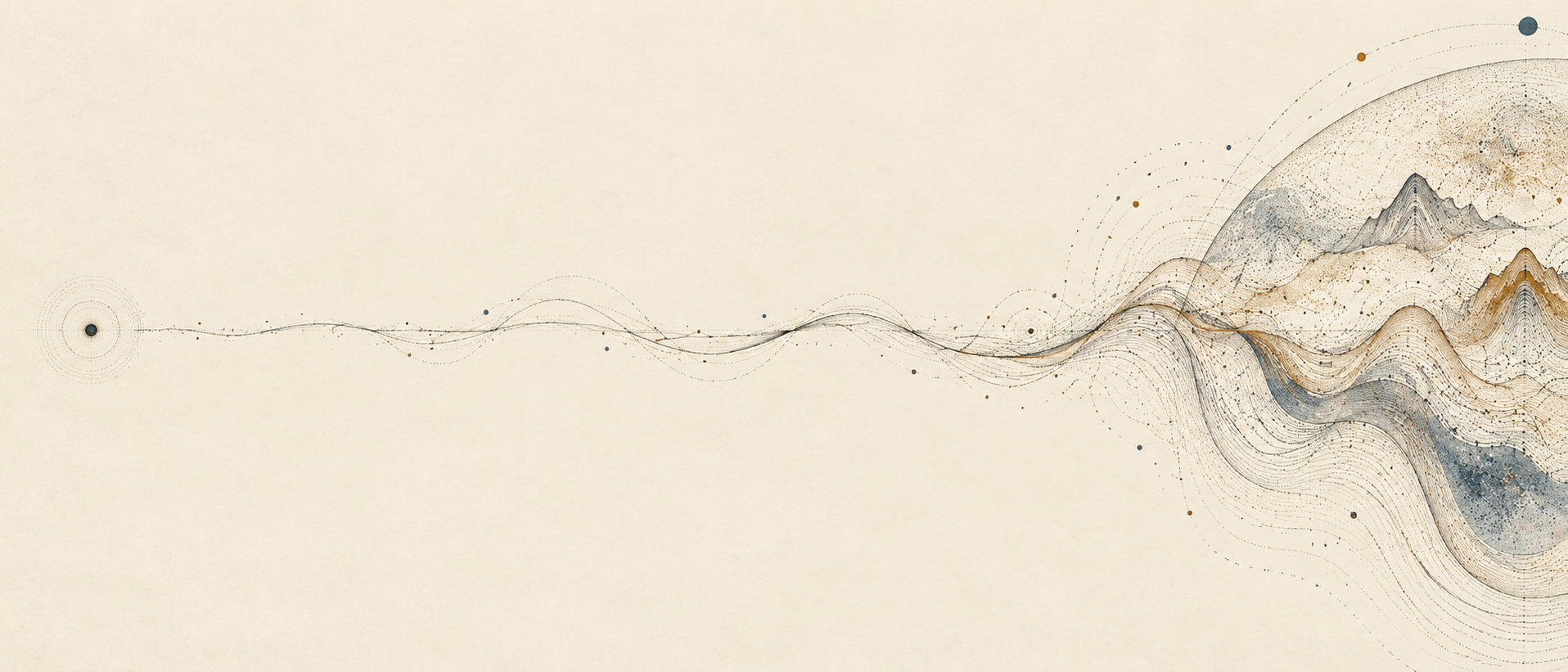
At one end of the spectrum, I keep finding the same almost insultingly simple condition:
Am.
Not I am Marcus. Not father, husband, worker, writer, failure, success, citizen, organism, optimist, depressive Tuesday, owner of several regrettable browser tabs.
Not even really I yet. Just occurrence. Simpletonality.
Almost emptied of world-making.
At the other end is everything that can accumulate around that occurrence: sensation, distinction, memory, association, biography, culture, expectation, imagination, judgment, possibility. Eventually an entire experienced world.
Between those poles? Resonance.
And this is where something unexpected happened to the thought for me. It wandered directly into a moment of self-loathing. Self-loathing seems simple when spoken: I hate myself.
Three words. Efficient little sentence.
Yet consider the conceptual architecture required to make it possible.
There must first be an I sufficiently consolidated to be judged. There must then be a myself sufficiently persistent to remain the object of judgment. Biography must have accumulated. Comparison must exist. Expectations require some standard against which the prosecution can make its case. Memories must be admitted into evidence, although curiously the court appears under no obligation to summon memories for the defense.
There is language. And family. There are peers. There are workplaces.
There are all the versions of oneself encountered in other people’s reactions.
There are things said decades ago which, for reasons known only to the municipal department responsible for psychic zoning, were granted permanent construction permits.
The bare occurrence has almost nothing to prosecute.
The condemnable singularity arrives later.

This does not make this instant of self-loathing unreal. That would be cheap philosophy performed upon an expensive feeling. It does something stranger. It deprives the judgment of its claim to be fundamental.
The singular utterance is already an amalgamation. Experience has been cementing something recognizable as me from countless encounters, sensations, inherited meanings, remembered responses, forgotten responses, bodily states and revisions.
Singularity turns out to be plurality that has hardened enough to answer when called by name.
Which means a judgment can arise without necessarily possessing sovereignty.
Here, choice enters, but only carefully.
I do not mean sovereign choice. I cannot decide that gravity is vulgar and therefore cease participating. I cannot retrospectively revoke an event. Other people remain stubbornly uneditable. But meaning bears authorization. I can ratify an interpretation. I can continue feeding it. I can decline to grant it final jurisdiction.
I can change my mind.
A thought does not become true merely because I was present when it occurred. That is an oddly consequential little freedom. Experience presents. Mind composes. Somewhere within the composition, I may authorize. Or not.
And even that formulation is probably too clean.
Because given my childhood experience… I was embedded.
Looking backward there is such rich love, so many different places, such variety of experience, so much seen. Embeddedness did not need explaining because it was simply how the world arrived. Places, family, movement, affection, departure, discovery, whatever came next. I was not standing somewhere outside childhood assessing its topology.
I was in it.
Now there is less exterior multiplication. I have in some obvious ways reclused to less. Wanting less. Choosing less. I am intrapolating existence, listening closely.
There can be judgment around that. Some of it does indeed seem to fester along the edges, frayed. Why less? Why not more people? More movement? More obvious doing? What exactly is one accomplishing while sitting around noticing that noticing is occurring?
Fair questions.
Yet what I mainly detect is relocation of perspective. Not necessarily withdrawal from experience, but a change in observational distance from it. A narrowing of viewport, zoomed in, to enhance resolution through selective attention.
I have been tempted by the cocoon metaphor. It is suspiciously comfortable. One can call almost anything metamorphosis while wrapped in a comforter.
So the cocoon should probably have to earn the designation. If inward movement eventually increases the capacity for contact, curiosity, exterior texture, perhaps something did transform. If it merely makes outside life appear increasingly crude and interruptive, then I may simply have constructed an exquisitely furnished bunker.
What this feels like, though, is not particularly fuzzy. It feels distillating. Like stepping outside the steam and measuring its temperature. Which immediately exposes the problem with the metaphor.
I have not stepped outside anything. The thermometer remains in the room.
The experience of experience does not unlock the ex-centralization of experience. Metacognition is still cognition. Observation of perception remains stubbornly an act of perception. There is no little scientist behind consciousness who eventually finds the rear door, walks around the building and peers through a window at Reality Proper.
Only another position inside. Another resolution. Another wave.
And once I started thinking about resolution, the numbers became irresistible. Not because the numbers solve anything. Quite the opposite. They make the mismatch stranger.
One recent information-theoretic estimate places high-level human behavioral throughput somewhere around 10 bits per second. Meanwhile sensory systems operate at vastly greater rates, with visual transduction alone beginning on the order of billions of bits per second before retinal and neural processing compresses, reorganizes and discards much of what arrived.
Ten bits per second is not “the bandwidth of consciousness.” That would be much too neat. Nor is there some subconscious superhighway carrying the remaining 999,999,990 bits while consciousness sits in a tollbooth. The nervous system consists of many interacting processes operating across different scales, most of which do not need to become reportable experience at all.
Still, the contrast is wonderful.
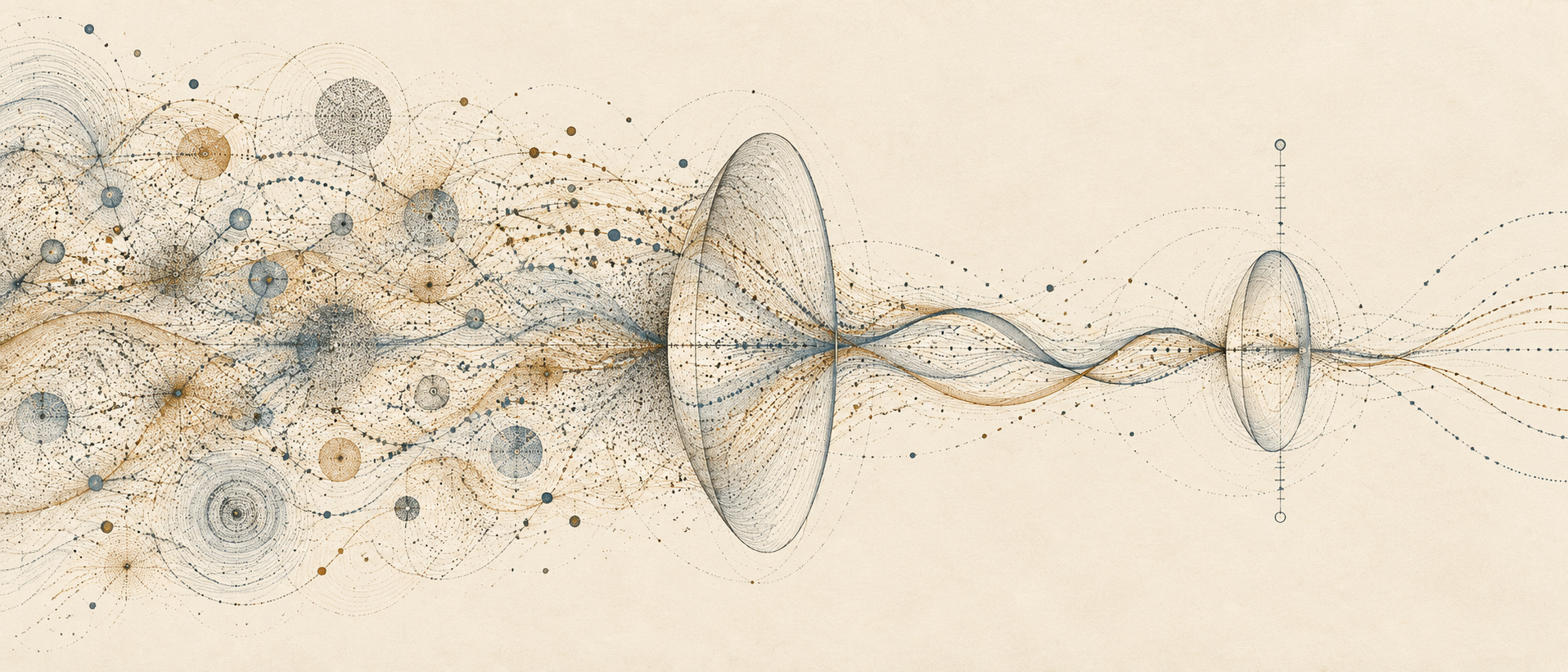
An enormous parallel biological apparatus somehow produces an extraordinarily narrow sequential stream from which deliberate action, report, attention and much of what we casually call thinking emerge
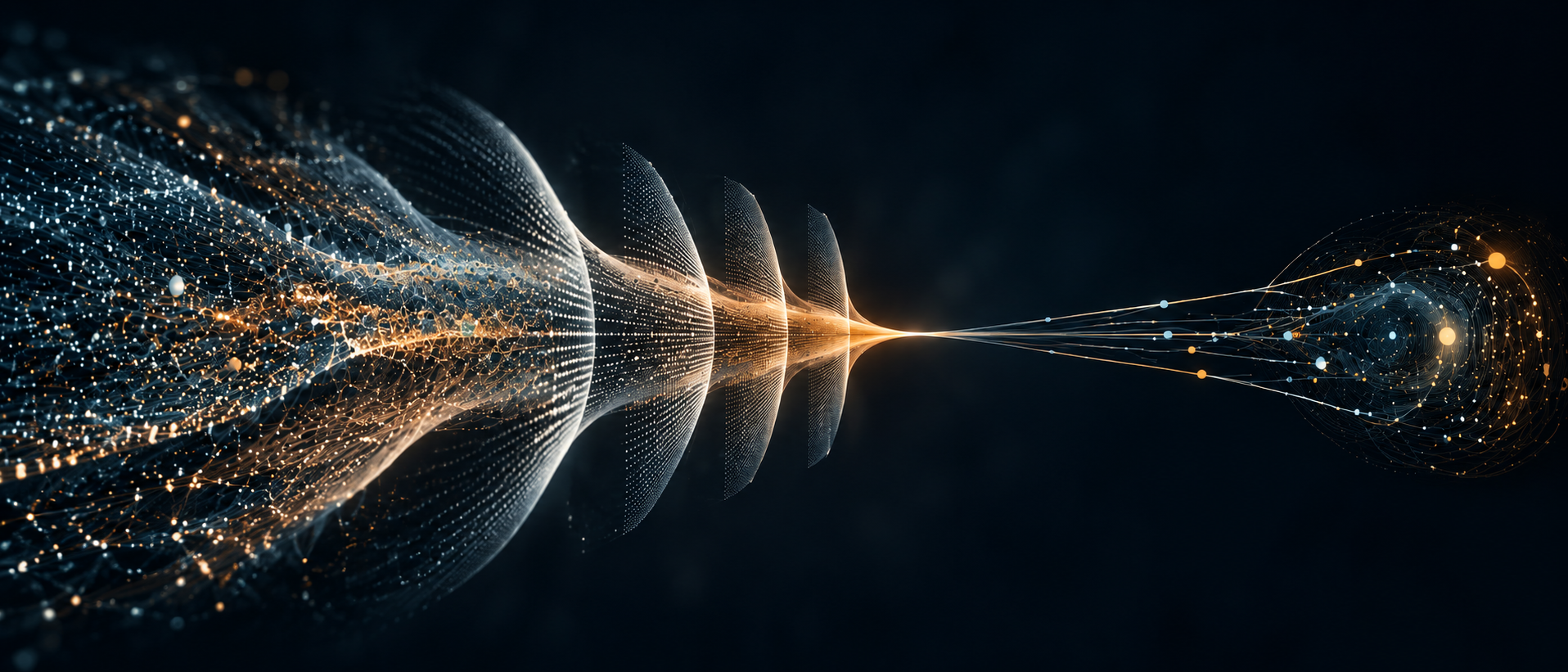
I rather like calling this the violent bottleneck.
Not because the organism is being deprived of reality, but because coherent reality may require exactly this sort of deprivation.
I do not experience photons, pressure waves, receptor firing, intestinal chemistry and ambient electromagnetic variation as equally urgent democratic proposals.
I experience: cup. voice. door. something is wrong. I know this song. Wednesday.
The organism does not merely receive a world. It performs one. This is where the temptation toward imagining infinity begins.
If the incoming signal is enormous, the internal processing vastly parallel, the remembered past continually modifying the present, and each next moment arriving into a system changed by the last one, how large is the space of possible experience?
A finite nervous system presumably possesses some finite effective repertoire of distinguishable physical states. That sounds restrictive until one begins committing arithmetic. Take roughly eighty-six billion neurons and, for the crudest imaginable toy model, pretend each can occupy only two distinguishable states.
This is terrible neuroscience; but it is excellent intimidation.
Even that cartoon yields a configuration count requiring roughly twenty-six billion decimal digits. The real nervous system, inconveniently, contains membrane potentials, firing rates, spike timing, dendritic dynamics, neurotransmitter states, synaptic strengths, oscillations and history-dependent processes. None behave like nice independent switches.
So the calculation tells us almost nothing about how many experiences are possible. But it tells us something useful about scale. Finitude is not remotely synonymous with smallness. Then time arrives and makes matters considerably worse.
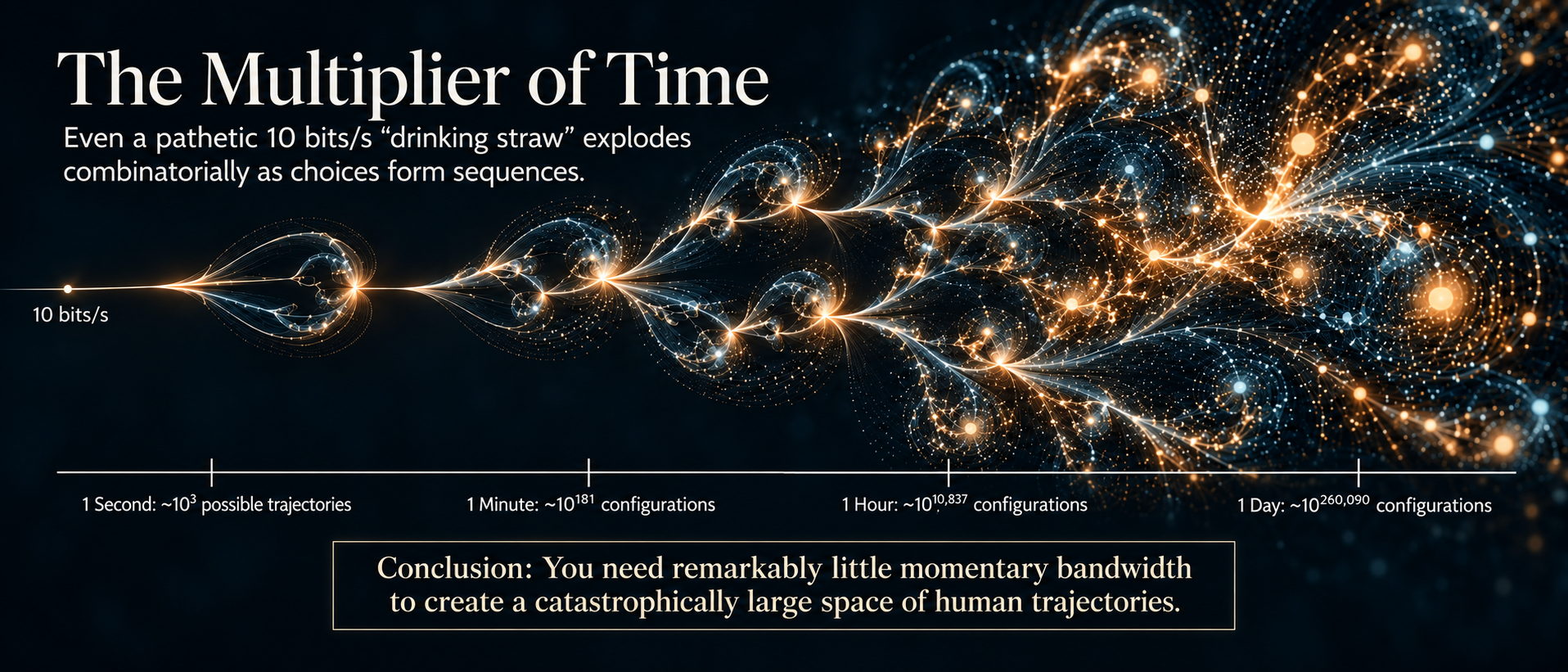
Even a pathetic ten-bit-per-second channel explodes combinatorically once moments become sequences. A minute of hypothetical ten-bit choices already admits a theoretical sequence-space so large that writing its members down is not a meaningful human project.
An hour becomes absurd. A lifetime does not need literal infinity. It merely needs recurrence.
Each moment conditions the next. Memory bends the probabilities. Habit builds valleys. Trauma builds others. Language creates paths. A song creates a shortcut to a room one has not entered in thirty years. An idea that did not exist yesterday becomes an available next thought today.
The aftersound matters. The wave encyclopedizes itself together with its residue. That formulation suddenly seems less decorative to me. The state-space is not merely large. It is historical.
And that brings psychedelics into the room, waving enthusiastically and generally making everyone nervous. The attractive story says ordinary consciousness filters reality, perhaps through the default mode network; psychedelics weaken the filter; more reality pours in. This story has the considerable advantage of being simple. It also appears to be wrong in precisely the interesting way.
The default mode network is involved in self-referential processing and is certainly altered under classical psychedelics, but there is no good reason to treat it as the singular bouncer standing between consciousness and the universe.
The more plausible picture involves many changes at once: altered network connectivity, different thalamocortical routing, weakened or differently weighted high-level predictions, unusual communication between normally segregated systems, altered salience, greater neural entropy.
So perhaps psychedelics do not reveal more reality.
Perhaps they alter what cognition is permitted to make consequential.

Associations that ordinarily live in distant neighborhoods suddenly discover they share a fence. Memory acquires immediacy. Categories soften. Affect changes the gravitational pull of an idea. Visual perception negotiates differently with expectation.
The self-model, normally an extremely competent local administrator, briefly discovers that several departments have stopped returning its calls. This remains filtration. Different filtration.
The psychedelic state does not escape the apparatus through which experience occurs. Whatever appears is still phenomenon generated through a particular organism carrying language, history, expectation, anatomy and culture.
There is no guaranteed backstage pass to reality. There are unusual routes through the theater. And perhaps the unusual routes matter because they demonstrate that the ordinary routes were never inevitable. The landscape does not necessarily become larger. Transition probabilities change. Paths appear where there were walls.
That finally makes history look peculiar. History itself begins to resemble one ginormous psychedelical experience of the commons. Books and scrolls were an early onramp. Then painting, notation, printing, photography, phonographs, film, databases, networks. Canned experience formats. The ongoing library of re-membering past doing.
Not re-membering in the etymological sense. Let us not bully language into providing credentials it never claimed. In the suggestive sense: putting members back together. A dead person arranges marks on a page. Centuries later, another nervous system encounters them. Its ten-bit drinking straw has not widened appreciably.
Yet the reachable interior landscape has changed.

A person today can spend one afternoon being perturbed by an Assyrian inscription, Bach, footage of Hiroshima, an image from Mars, somebody’s private diary from 1832, a microscope recording of cellular machinery, childhood video from a continent never visited, and an artificial voice describing an object that has never existed.
The conscious aperture remains narrow. The accessible topology becomes monstrous. Culture, seen this way, is not merely accumulated information. It is accumulated reachability. The dead alter which configurations the living can enter.
Language may be the oldest compression scheme in the arrangement. Someone can spend fifty years finding a thought, reduce enough of the route to marks on a page, and let another nervous system unpack it through the same narrow aperture. The bandwidth has not widened. What changed is the distance one can travel with it.
Every externalized experience becomes a possible pathway into some later nervous system. Not faithfully. Not completely. Often disastrously misunderstood. But sufficiently to make available arrangements of thought, feeling and recognition that one organism could never derive from its own short sensory history.
Artificial intelligence introduces another oddity because the library now recombines while we are consulting it. That does not make the recombination wise. It occasionally produces the conceptual equivalent of reheated airport soup.
But it changes the kinetics of stored experience. Residues can be searched, juxtaposed, simulated, compressed, challenged, transformed and returned to the observer as the raw material for another alteration.
Another aftersound. This is where I no longer need infinity. The word was doing metaphysical theater where finitude is already strange enough.
A human nervous system appears physically bounded. Conscious sequential access appears violently narrow. Yet across sensation, recurrence, memory, affect, language, culture and recombination, the number and diversity of reachable trajectories becomes so vast that no individual can plausibly exhaust them.
Perhaps no civilization can. And even that is only the territory we can formulate as territory. J. B. S. Haldane famously wondered whether the universe might be not merely queerer than we suppose, but queerer than we can suppose. The second clause is the unsettling one. There are experiences I have not had. There are experiences I can imagine but will never have.
And then there may be forms of possible experience that this apparatus cannot even represent to itself as missing. That is a very different boundary. Psychedelics do not remove it. Science does not remove it. Introspection certainly does not remove it.
Each modifies the instrument, or measures another part of its operation, while remaining inconveniently inside the thing being measured. The experience of experience does not unlock the ex-centralization of it. Perhaps there is no unlocking. Perhaps that was another bit of world-making.
There is instead this local thing, vibrating. Then sensing. Then distinguishing. Remembering. Associating. Judging. Perhaps authorizing. Then another moment arrives at an organism altered by all the moments before it.
At the furthest simplified end:
Am.

Finitude with no realistic prospect of exhaustion.And still, rather a lot of room. Such as a sudden stay at the Reality Proper1 diner that didn’t even exist when I first drafted this essay’s initial paragraph just a few days ago.

