I had McLuhan’s thermometer upside down.
Direct conversation, I figured, must be the hottest medium of them all. Two people facing each other, entire lifetimes attempting to squeeze themselves through the remarkably narrow passage of speech, gesture, and the occasional raised eyebrow. What could possibly be hotter than that? Marshall McLuhan, inconveniently, had classified conversation as cool. His hot and cool media weren’t concerned with emotional temperature but with the degree of participation demanded of an audience. Hot media deliver comparatively high-definition information. Cool media leave considerably more to be supplied by the participant.

A photograph (hot), for instance, offers far more visual detail than a cartoon (cool). A lecture largely delivers its contents; a conversation demands something more of the listener, whose brain runs decidedly hot, mesmerized, filling in vividly what the speaker could never adequately transmit. A raised eyebrow, a pause, a handful of words that, written down, draw from a mere 26 letters of the English alphabet. And somehow, from such meager ingredients, entire worlds take shape. Two worlds connect or collide.
Terence McKenna had a particular fondness for McLuhan, whose work he treated as something approaching a psychoanalysis of humanity through its instruments of communication. McLuhan’s point was rather simple, though its implications were anything but.
The tools we use to communicate also influence how we think.
A book asks us to imagine the scenes described on its pages. Television supplies the moving pictures. A smartphone delivers messages from half the planet while we’re trying to have breakfast. Each medium invites a different kind of attention, and over time those habits can change how we experience the world.
The peculiar thing is that we invent these technologies to serve us, only to discover that we’ve begun adapting ourselves to them. McKenna took this observation into considerably more psychedelic territory, and brave are those that followed him far enough to appreciate the irony.
If our technologies can shape how we receive and interpret information, what actually makes that information meaningful to us? Why might the very same words leave one person indifferent and profoundly affect another?
Which brought me, somewhat circuitously, to Federico Faggin.
Faggin helped bring Intel’s 4004 microprocessor into existence, making him a particularly interesting figure to encounter questioning the philosophical reduction of human beings to biological machines. He understands the machinery rather intimately, which lends an agreeable weight to his objection, even if it doesn’t settle the argument.
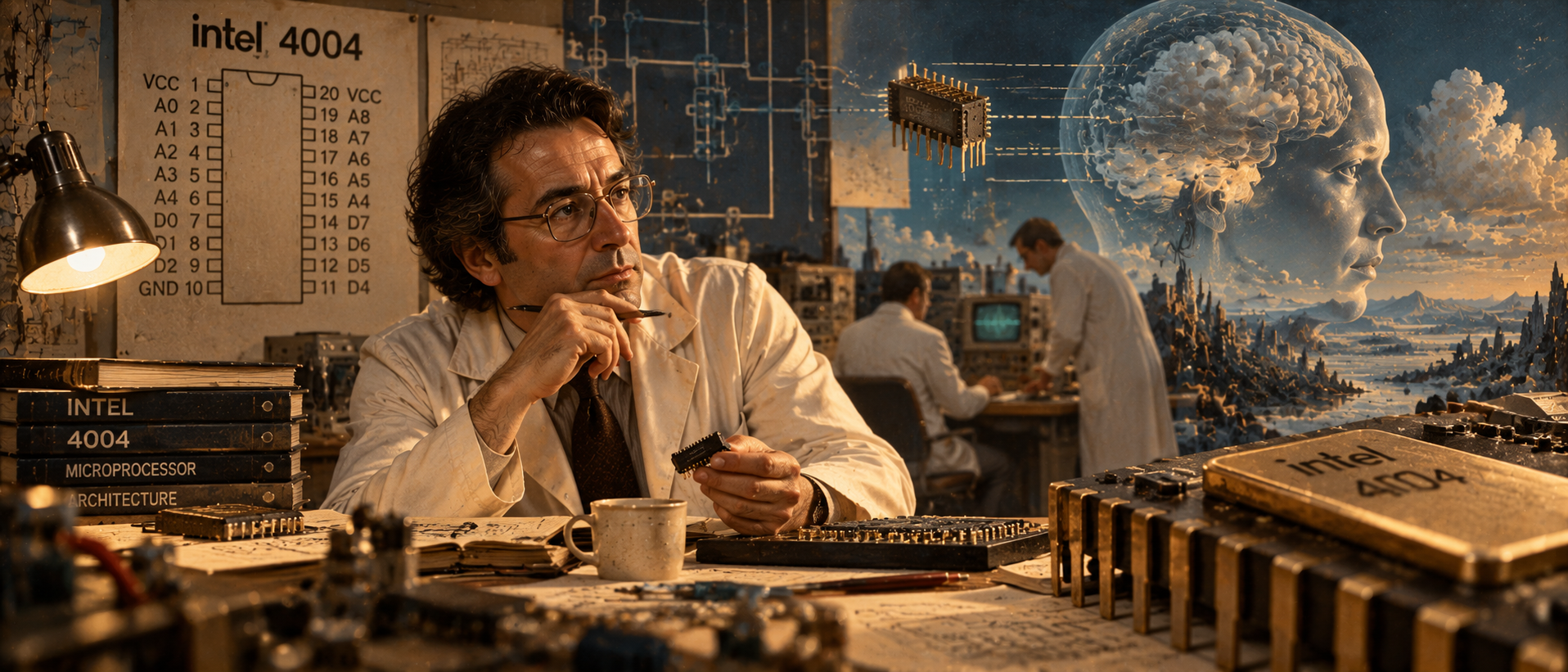
His distinction concerns information itself. In information theory, information can be described mathematically without accounting for what a symbol means to anybody. The statistical properties of a message can be calculated without anyone understanding its contents. Faggin argues that this formal treatment leaves something fundamental unexplained:
The subjective experience through which significance arises.
A word isn’t merely recognized. It is experienced as meaningful by somebody, like that somebody just reading this line, and that somebody has an entire life to filter their direct experience through.
Faggin carries this into a consciousness-first account of reality, proposing that experience is fundamental rather than a secondary product of physical machinery. He hopes that AI might eventually help expose the limitations of scientism, the conviction that the methods and descriptions of physical science exhaust everything worth knowing about existence.
I’m firmly in Faggin’s camp here. There is something wonderfully ironic about a man who helped invent the machinery now asking why on earth we insist on describing ourselves as though we were merely another version of it. Science has given us astonishing insights into the workings of our bodies and brains, and I wouldn’t trade any of that knowledge for a comforting mystery. But when we start treating a description of the machinery as a complete account of the life experiencing it, I think we’ve smuggled a philosophical conviction into the laboratory and dressed it up as scientific certainty.
That’s scientism, not science. Faggin’s own account of consciousness, including its quantum foundations, still has plenty to demonstrate. Fair enough. But so does the proposition that our lived experience can ultimately be explained away as the workings of an elaborate biological machine. You could map every electrical impulse in my brain and still have no idea what this morning meant to me. And frankly, I’d rather science remain curious about that distinction than declare the mystery solved simply because we’ve become extraordinarily good at measuring its surroundings.
Consider what we’ve built with AI. You can ask it to translate a poem, untangle a complicated argument, or help put into words something you’ve been struggling to express. Sometimes its answers are genuinely insightful. Sometimes they surprise you. Behind that little exchange sits a machine trained on more writing than any person, or population even, could hope to read in a lifetime. That’s quite an accomplishment, and dismissing it as merely shuffling words around seems rather ignorant. But just because a machine can hold a convincing conversation doesn’t mean there’s somebody experiencing that conversation on the other end. Whether it experiences anything at all is an entirely different question.

Perhaps future investigations will alter our understanding of machine consciousness. For now, the more interesting question to me is why we have become so comfortable treating our own subjective experience as something sufficiently accounted for by the machinery associated with it.
This is where I keep returning to a rather ordinary scene: two conversationalists. Two coffee cups resting on a table between them. A little exchange, perhaps about nothing particularly consequential, and an almost comically small amount of informational bandwidth carried by mere spoken words creating worlds… so seemingly mundane, considering everything that is happening.
A voice crosses the table. Some sound waves, facial expressions, fragments of language. The participants share enough history, or perhaps discover just enough curiosity, to begin assembling an understanding of what the other intends. Neither has access to the other’s experience. Each interprets from within a private accumulation of memories, expectations, disappointments, sympathies, and convictions.
Even the silence between sentences carries a particular significance, and sometimes a different significance for each participant.
One person may remember the conversation for years. The other might scarcely recall it by evening. The coffee cups, meanwhile, remain innocent of the whole affair, mostly.

An algorithm examining the exchange could identify the words, analyze vocal inflections, infer emotional states, and perhaps provide a useful reconstruction of the conversation. With sufficient contextual information, it might recognize implications the participants themselves overlooked. There is no reason to diminish those capabilities. But the reconstruction would still leave open the question of what it was like for either person to be there, and why a particular ordinary sentence happened to matter.
Because the words themselves are never the whole story.
A sentence encountered yesterday may carry an altogether different significance today. Nothing has changed in its spelling, grammar, or statistical properties. Yet the person reading it has lived another day, perhaps learned something, lost something, fallen in love, or merely arrived at a different understanding of an old conviction.
The difference a day makes. Literally.
We all perform this peculiar labor of interpretation continuously, often without noticing. We make significance from glances, silences, gestures, and words. We love through it, misunderstand through it, occasionally construct entire private catastrophes from something somebody else considered an innocent remark. The capacity for meaning-making doesn’t guarantee the accuracy of our interpretations, nor does it make us particularly agreeable creatures. It does, however, remain stubbornly individual.
And that individuality brings me to a more troublesome concern than the consciousness of machines.
We have confused the volume of information with the experience of significance.
The enormous aggregate of modern institutional life depends upon abstraction. We classify people as workers, patients, consumers, voters, applicants, accounts, demographic cohorts, and whatever additional categories an administrative imagination might require before lunch. We turn lives into manageable information because the alternative, attempting to personally comprehend millions of individuals in all their particularity, is plainly impossible.
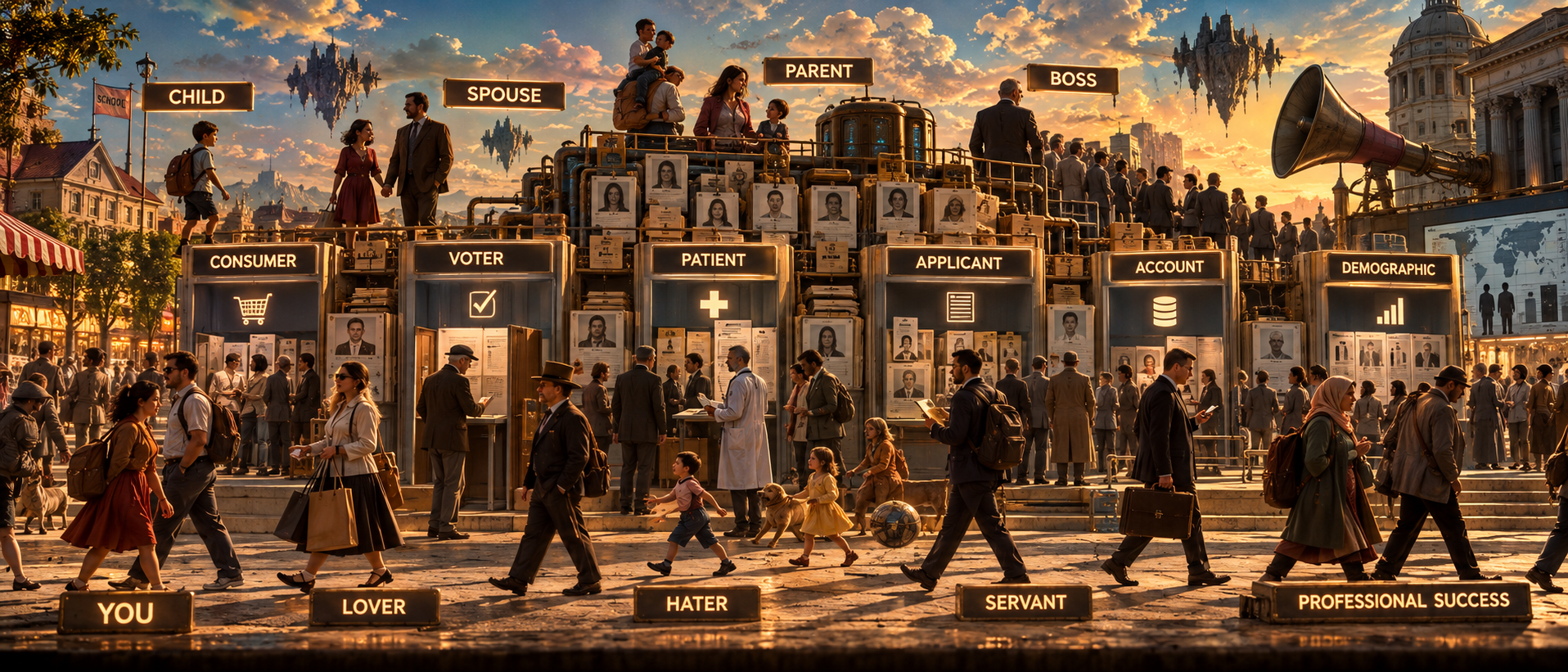
There is nothing inherently pathological about this. Abstraction is necessary, and sometimes merciful. A hospital needs records. Public institutions require consistent procedures. Fair treatment can depend upon refusing to privilege the person we happen to know over the stranger whose circumstances deserve equal consideration.
At scale, the problem is not reduction itself. It is our institution’s tendency to forget that a reduction has taken place as human dignity becomes secondary consideration to throughput. The person becomes a number. The worker becomes a resource. The patient becomes a case. The citizen becomes a data point in a model of public sentiment. The classification, originally constructed to help us coordinate our affairs, acquires an authority over the life it only partially represents.
Eventually, we begin accepting our cog-status-quo as though the arrangement were a natural consequence of being human rather than a choice embedded in the machinery of our institutions. This is what I mean by institutional overreach in its perhaps least theatrical, but most pervasive form. It need not involve an authoritarian edict or even malicious intentions. It can emerge from an entirely reasonable system becoming so efficient at processing its own representation of reality that it loses the capacity to be corrected by reality’s participants.
And the human being, conveniently simplified for administrative purposes, is left trying to squeeze an actual life through the allotted form fields. Dignity becomes an operational problem, then. Not because its existence depends upon the institution granting it, but because preserving dignity requires arrangements capable of acknowledging what their own categories leave out. The represented must retain some means of correcting their representation.
Otherwise we risk masquerading incompetence at managing a civilization virtuous, whilst its inhabitants are increasingly difficult to encounter. We have become extraordinarily proficient at broadcasting ourselves to the many, while the capacity to recur meaningfully with the few appears almost quaint. A civilization organized for continuous reach has relatively little structural interest in the modest, repetitive encounters through which people actually come to know one another.
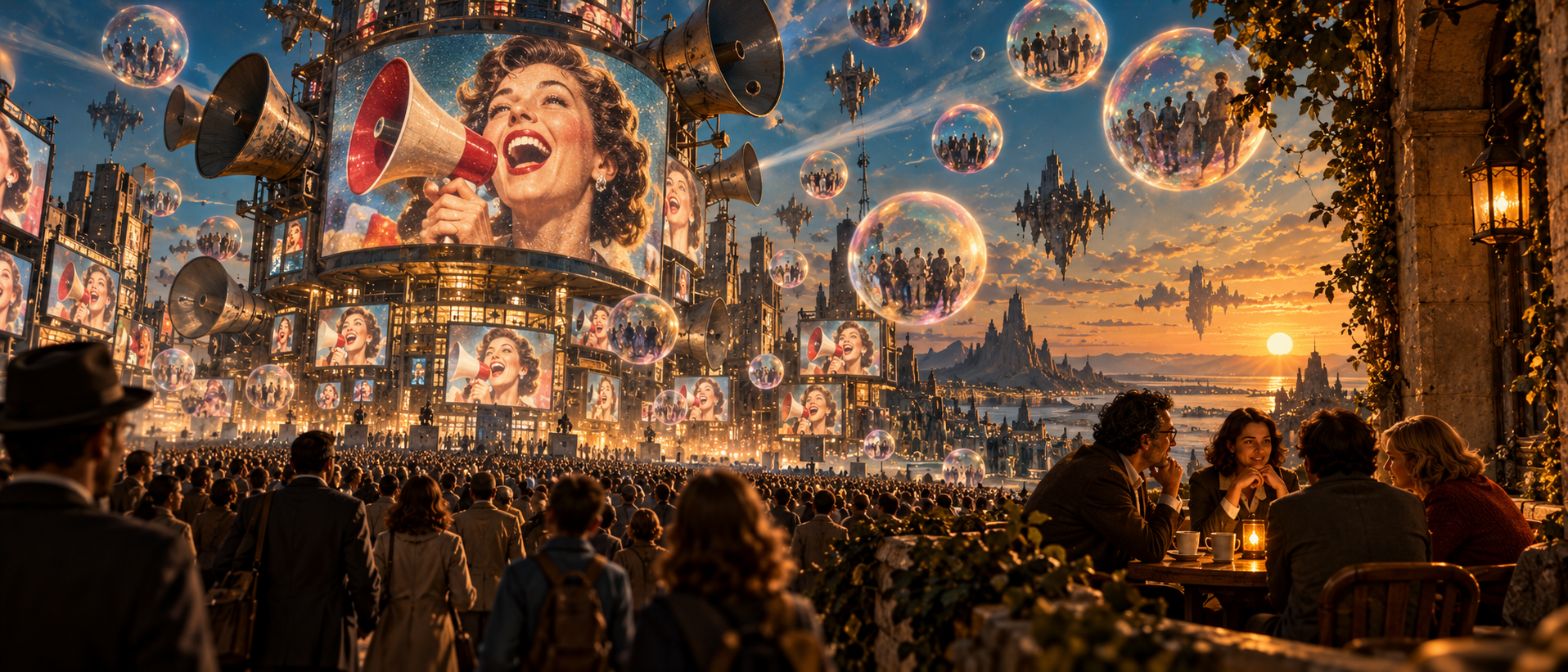
What interests me is whether we can create arrangements in which people remain close enough to recognize one another’s particularity, while retaining enough freedom, reciprocity, and procedural clarity to correct their shared assumptions. The opportunity for collective learning resides in that continual adjustment. We don’t merely coordinate what we do; we become capable of improving how we decide, participate, and carry responsibility together.
A small circle of people, returning to one another with a measure of regularity, might offer a practical unit for this. Not a replacement for larger institutions, but somewhere the abstractions can be challenged by the lives they are supposed to serve.
Which brings me back to the coffee cups, and to a slightly uncomfortable proposition: perhaps the central discipline of re-lating is intentional attention reduction.
I don’t mean reducing the quality or duration of attention, as though humanity could use another productivity technique for becoming more efficiently absent. Rather, I mean deliberately reducing the number of competing claims upon our attention. Narrowing the field sufficiently to permit another person’s complexity to become perceptible.
Modern communications technology has provided us with an almost miraculous capacity to encounter expressions from people everywhere. Yet our attention remains stubbornly finite. Every additional voice enters an environment in which thousands of others are already demanding recognition, and the temptation is to resolve the resulting overload by summarizing, ranking, compressing, or disregarding.
A natural response, certainly. But the habit begins to resemble our institutional abstractions. We become proficient at recognizing the category, the position, the argument, the familiar caricature. The other person barely has time to arrive before we have assigned them their place. The encounter disappears into recognition.
I became curious, then, about three words we use almost indiscriminately in describing this entire process: information, intelligence, and relation.
Their etymologies offer a rather delightful little excursion.
Information reaches back to the Latin informare, to give form, shape, or instruct. Intelligence descends from intelligere, to understand or discern, with roots suggesting selection or picking out from among things. And relation carries an especially lovely inheritance from referre, to bring or bear back, originally associated with reporting and recounting.
One ought not mistake etymology for a secret philosophical instruction manual. Words accumulate meanings and wander off in directions their ancestors could hardly have anticipated. Still, these particular ancestors seem unusually willing to participate in the conversation.
To give form. To discern. To bear back.
Could relation be understood, at least poetically, as a continuous attempt at re-bearing together? The phrasing is awkward, which is partly why I like it. To bear something is to carry it, perhaps endure it, perhaps bring something new into being. We also have our bearings, that sense of orientation by which we recognize where we are in relation to everything else.

A mutual conversation performs a little of all this. We bring experiences into an encounter, attempt to communicate what they have made of us, receive an interpretation shaped by somebody else’s life, and carry something back. Sometimes only a minor correction. Sometimes a revelation. Occasionally a reassurance that neither participant had known they needed.
And sometimes, of course, nothing of the sort. We misunderstand, become defensive, talk past one another, or simply run out of coffee.
But even that failure belongs to the possibility of relation. Another encounter might reveal what the first could not.
I wonder whether this is an important part of the peculiar phenomenon I’ve been calling Blue Noise Earth – and adventure currently still in the making.
Consider the sheer volume of humanity, billions of lives proceeding simultaneously, each generating perceptions, recollections, relationships, conversations, and small acts of meaning-making. An enormous, overlapping cacophony of lived experience whose aggregate exceeds anything an individual could hope to comprehend. We can measure populations, map communications, count interactions, and increasingly model the informational patterns produced by all this activity.
The macro cosmos of physical scale is almost irresistibly available to measurement. The micro cosmos of lived experience proceeds within it, no less real to its inhabitants for being so difficult to represent from the outside.
Language does something extraordinary between those two scales. It compresses the accumulated experience of one life into something another might receive in a few seconds. A sentence can carry decades of history, yet arrive as a handful of symbols on a screen. Whether those symbols find any resonance depends upon the encountering mind at the keyboard.
And this returns me to Federico Faggin’s distinction, to McLuhan’s cool conversation, and finally to the rather unremarkable table supporting our two cups of coffee.
A machine may examine the corpus of humanity’s recorded expressions in quantities no individual could ever absorb at scales even civilizations eventually forget. It may help us distinguish patterns, recover misplaced insights, and compose possibilities that surprise even their human authors. I find this astonishing and creatively useful. The apparatus has become capable of extending our intelligence into territories previously inaccessible to us. Yet an entire corpus doesn’t eliminate the particular life of the person encountering its expressions.
Here, reading these symbols, somebody supplies what the medium cannot: the contingencies of a lived day, the private relevance of a memory, the possibility of encountering an idea that unsettles something previously considered settled. Even if the words were generated algorithmically, whatever significance emerges in the encounter becomes part of that reader’s experience.