
It had been some weeks since I felt compelled to articulate a rough thought. The articulation organ goes quiet for stretches, and then a phrase arrives the way weather arrives, without permission, and I understand I have been carrying it for longer than I knew.
So: the handshake.
Not the gesture. The gesture survives, ritualized into greeting, the way calcified prayers survive their gods. I mean the older handshake. The one that confirmed yes, we share a reality, and I commit to it with you. The one that asserted, in the doing of it, that consensus was a thing two nervous systems agreed to maintain between them.
That handshake has been slipping for two generations. It slipped well before AI. AI is the technology that arrived late to a wake and is now being mistaken for the killer.
Capability accelerates. Social digestion lags. That lag is the entire story.
Arrange recorded history on a timeline and ask how long a paradigm tends to hold before its next phase shift. The intervals compress in a way that feels suspiciously geometric. Band cohesion held for fifty thousand years and more. Agriculture, ten thousand. Writing and empire, perhaps five. The axial age — that strange near-simultaneous philosophical bloom across Greece, India, China, the Levant — bought roughly eight centuries before the printing press dismantled clerical reality. Each epoch arrives, redefines what humans can do, and is overtaken in a window roughly half or a third as long as its predecessor.1
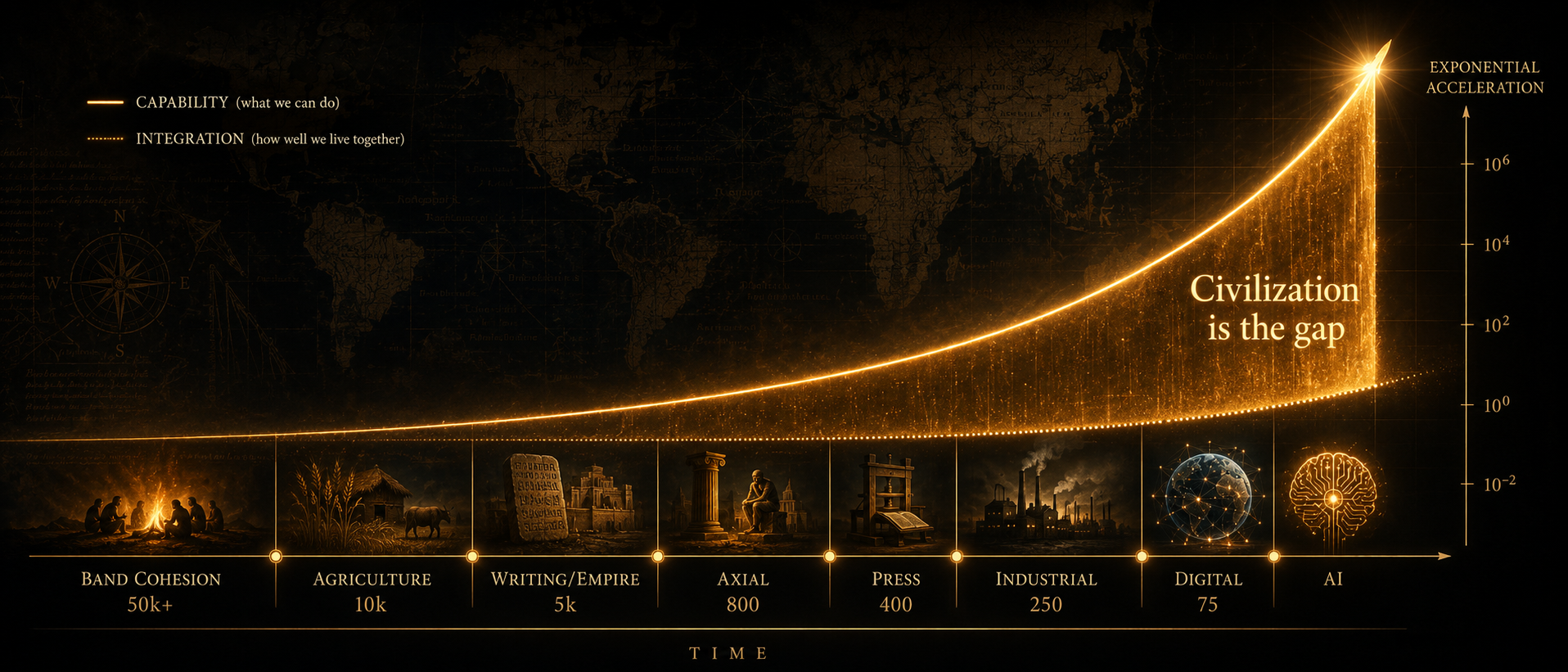
Kurzweil noticed the slope. What he missed was the floor. He charts one curve, ascending sharply: what we can do. A second curve trails the first by a widening distance: what we can integrate. Civilization is the gap between them, and the gap is opening at exactly the rate at which the upper line accelerates.
The story everyone tells about the present — AI democratizes intelligence, renewables democratize energy, the long arc bends toward broader participation — holds water at the altitude of think pieces. It holds less water at the altitude of a kitchen table.
Each decentralizing leap in recorded history generated, simultaneously, new concentrations. Railroads democratized commerce and birthed the monopolies. The internet democratized publishing and birthed platform feudalism. Social media democratized voice while centralizing attention into the most absolute oligopoly of recognition humans have ever assembled. AI is on track to democratize cognition while requiring concentrations of compute, energy, water, and policy capture so vast they are already redrawing national economies around the cooling pipes of data centers.

Decentralization is not the trend. Oscillation is the trend. Decentralization and reconsolidation are the two phases of the same engine, and the engine is running hotter.
What is scarce in 2026 is not information. Not content. Not skill. Not — in any practical sense — intelligence. What is scarce is shared ground. The pre-articulate background hum that lets two people, or twelve, or several thousand, behave as if they inhabit the same world.
Some will argue there was never a shared world. That consensus reality was always a useful fiction maintained by the slow speed of media.
The truer thing, I think, is that consensus reality always was a practice. Something maintained through repeated acts of mutual confirmation. A nod. An eye-meeting. A joke that lands. A handshake. A funeral attended. A grievance acknowledged.
These are not symbols of the practice. They are the practice. Society is what nervous systems do when they regularly touch one another’s interpretations of the world.

That practice has been hollowing out for two generations. AI did not start the hollowing. AI is what enters a hollowed room and fills it with synthetic intimacy.
And here the reflex gets it wrong.
AI is not the destroyer of the handshake. AI is, more precisely, a prosthetic.
A prosthetic compensates for a faculty already lost. A prosthetic can also accelerate the wasting of a faculty merely weak. The same crutch that lets a fractured leg heal will, given enough years, atrophy a healthy one. AI is being asked to perform the things the handshake used to perform — companionship, witnessing, the small ongoing confirmation that one exists in a shared frame — and the asking is not, mostly, conscious. It is what the hollowed room reaches for, the way a thirsty mouth reaches for whatever is wet.
I have nothing against the prosthetic. I am writing this with one.2 What concerns me is the limb beneath it. Whether the limb is recovering or wasting. Whether anyone is doing the unglamorous work of strengthening the underlying capacity, or whether we are quietly shifting weight onto the synthetic and forgetting we ever stood without it.

The Dunbarrios project — which I have been building in something like a private monastery for two years now, the way one tends to build things when no one is asking for them yet — began as an attempt to articulate this.3
It is sometimes mistaken for a community platform. It is not a community platform, though it contains the shape of one. It is, more precisely, a scarcity filter for the post-scarcity cognitive age. When intelligence and content and persuasion all approach infinity, the scarce goods become coherent identity, durable trust, emotionally meaningful attention, mutual accountability, interpretable reality.
The DunbarrioSolo loop at its core is not an app feature. It is a rehearsal chamber for the faculty that lets a person enter a small group of humans and behave as though those humans are real and continuous and capable of being injured by carelessness. That faculty has atrophied. Not because people are worse. Because the conditions that ordinarily exercise it have thinned.

A friend of the project asked me, some weeks ago, whether I worry I am too early.
I used to. I do not, much, anymore. What feels like being early may be — I have come to suspect — the work of articulating vocabulary before pressure makes the vocabulary necessary.
The internet existed before the social behaviors that would later make sense of it. Social media existed before the creator economy was legible. Large language models existed for years before they crossed the threshold that turned them into a civilizational event. In each case, someone had to talk strangely about a thing before the thing became obvious.
So I am mapping vocabulary. Laying down terms — handshake, atmospheric commons, the rejection one harbours, the editor-in-chief of the femtosecond now4 — that may or may not become useful. The work is to put them somewhere they can be found later. If they are needed, they will be found. If not, they were exercises in keeping a certain kind of attention alive during a thin season.
I do not know yet which it is. I have made peace with not knowing.
A temptation arrives, when one has articulated something at this scale. The temptation is to grip it. To brand it. To become its custodian, its gatekeeper, the holder of the orthodoxy.
I notice the temptation. I am declining it.
Ideas of a certain order stop belonging to individuals the moment they compress something civilization-sized into transmissible form. Whoever first said consent of the governed did not own consent. Whoever first sketched a double helix did not own genetics. Useful articulation is, by its nature, fugitive. It runs.
The role available to a person who has articulated such a thing is not emperor. It is something humbler and more interesting. Articulator. Ritual designer. Seed planter. Signal amplifier. Keeper of boundaries against the distortions that will, inevitably, accumulate around any idea worth distorting.
I would rather watch this idea travel through minds I will never meet than hold it in a sealed room.
One last thing, because I think it matters more than people realize.
Humor.
Systems unable to laugh at themselves drift toward dogma frighteningly fast. The healthiest version of any new social architecture — Dunbarrios included — is the one that remains permeable to its own absurdity. Small groups can produce wisdom. They can also produce paranoia, conformity, soft coercion, and the special claustrophobia of people who have lost the capacity to find each other ridiculous.

If I were forced to name a single failure mode for what I am building, it would be this: taking itself so seriously that the handshake stiffens back into ritual.
Which is to say — I am watching for it.
The pendulum does not stop at equilibrium. It overshoots. Civilization is less an ascent than a nervous system convulsing toward higher coordination while dragging its Paleolithic instincts behind it like rusted chains.
The handshake must now be designed. But design is just scaffolding. The thing itself — the actual reaching of one nervous system toward another, the small daily act of confirming that we still share a world — that part cannot be engineered.
That part has to be practiced.
Together.
1 Not law. Grammar. It survives more scrutiny than most pop-futurism, and it falls apart the moment one asks it to predict a year rather than a window.
2 This essay was sharpened against another intelligence. Claude as interlocutor; two long conversations; my pen at the end. The thinking is mine; the friction was mutual. I mention it because writing about synthetic intimacy while concealing how the writing was made would be its own small handshake-failure.
3 For new readers: Dunbarrios takes Robin Dunbar’s cognitive ceiling — the rough upper bound on stable relationships a primate nervous system can hold — as architectural premise rather than trivia. Small rotating circles, fractal self-governance, a Knowledge Tree built from phylogeny hashes, a Living Resume that treats a person’s contribution as accreted rather than declared. The underlying philosophy I have called Compassionism: the working hypothesis that consciousness is relational and structurally entangled, not the property of any isolated skull.
4 Adjacent threads in my work. Atmospheric Commons names the part of shared life no one owns and everyone draws from — the breathable medium of trust and meaning. The Femtosecond Now takes up the editorial responsibility of attention inside collapsing time-horizons. The Rejections I Harbour is more personal: an essay on what we refuse to receive, and what the refusal costs in the marrow of a life.

