

One Monday YouTube’s feed handed me two dozen human beings at the most vivid moments of their lives, and I mostly forgot every one of them by morning.
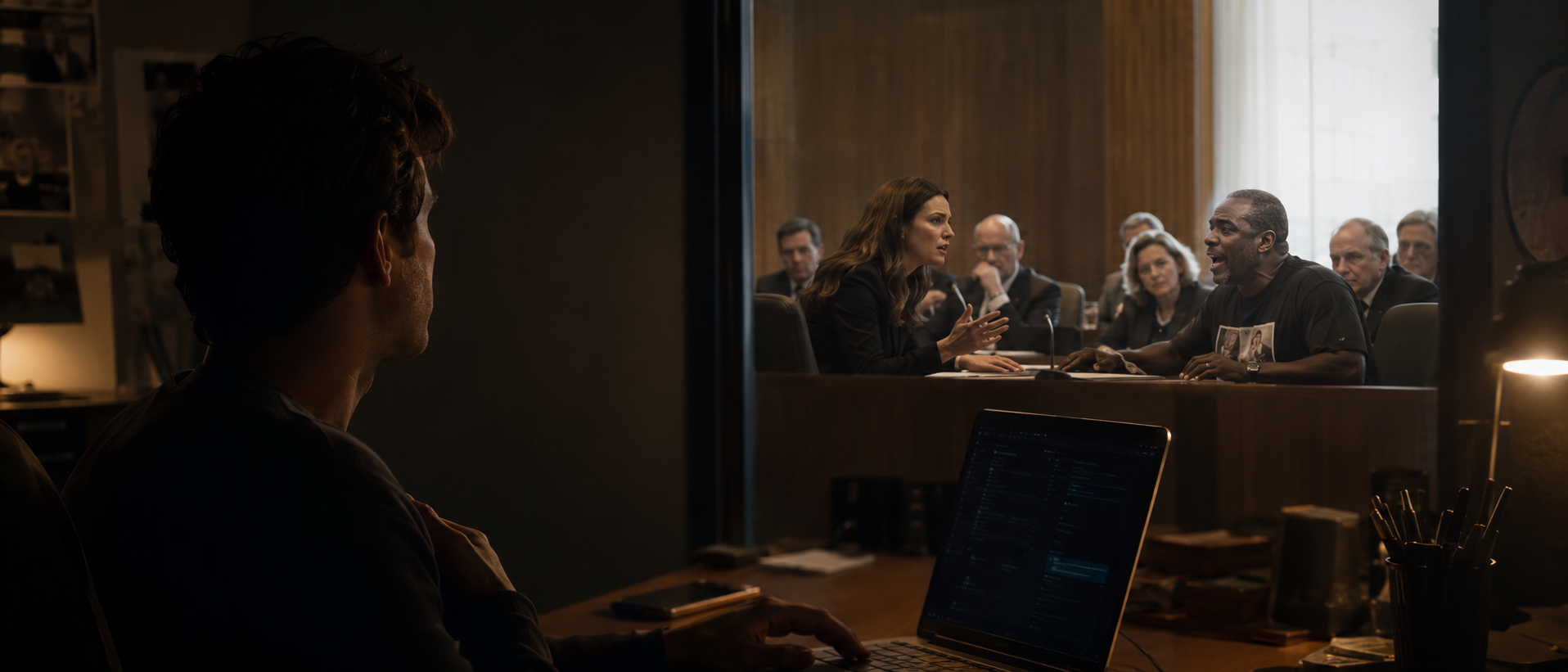
The clips arrived the way they do, one following the last. George Carlin tracing how shell shock softened into battle fatigue, then operational exhaustion, then post-traumatic stress disorder — the wound buried one syllable at a time until the word could no longer find the man it named. A poet explaining why the record of a people comes back wrong when you look it up: somebody went to real trouble to make sure it would. A father priced out of the body-cam footage of the wreck that maimed his own child. Six hundred dollars for transparency, set just past what a grieving family can pay. And the father himself at a podium, coming apart, while an official corrected his etiquette. You’re here to address the board, not the people. The procedure was the cover-up.
Thirty minutes, give or take. Two dozen lives, each a single take. Courage and grief and an eloquence that only catastrophe ever teaches, the whole vertical span of a person — served and gone. Some clips had a few dozen views. Some had millions. The forgetting treated them identically.
And there I sat, scrolling, doing the only thing the medium had left me room to do.
The reduction of agency to a tap
This is not a flaw in the machine. It is the machine working. The whole achievement of the outrage stream is that it turns caring into engagement and lets it evaporate before it can thicken into anything that would cost the order a single thing. The views prove the caring is oceanic — millions of people, feeling the right feeling, all night. It changes almost nothing, because the caring has nowhere to go that isn’t a tap.1
There is a lazy version of this thought, the one that blames the medium for everything and lets me off the hook. The stranger truth is that the spectrum was never in the feed. The feed had clips. It held no model of me, aimed at no destination. The throughline I felt — that terrible, lovely range of human scale moving through me in half an hour — I authored it, with the quality of attention I brought. Another person scrolls the identical sequence, gets a dopamine smear, and sleeps fine. The progression I mistook for the algorithm’s curriculum was my own.
Which is a thing I do constantly and only just caught: I promoted the machine to teacher and filed myself under naive man, little app, nobody reads him. I had put the agency everywhere except the one place it was sitting.
The frontline does not want company
But the eloquence I coveted is forged in the fire I would never wish on myself. The father speaks like that because his son was hit by a ninety-mile-an-hour driver and the city went quiet. He would trade every devastating word to have the day back. I was holding my ordinary Tuesday against other people’s worst hours and finding myself insufficiently aflame. To want their voice is, a little, to want their wound.
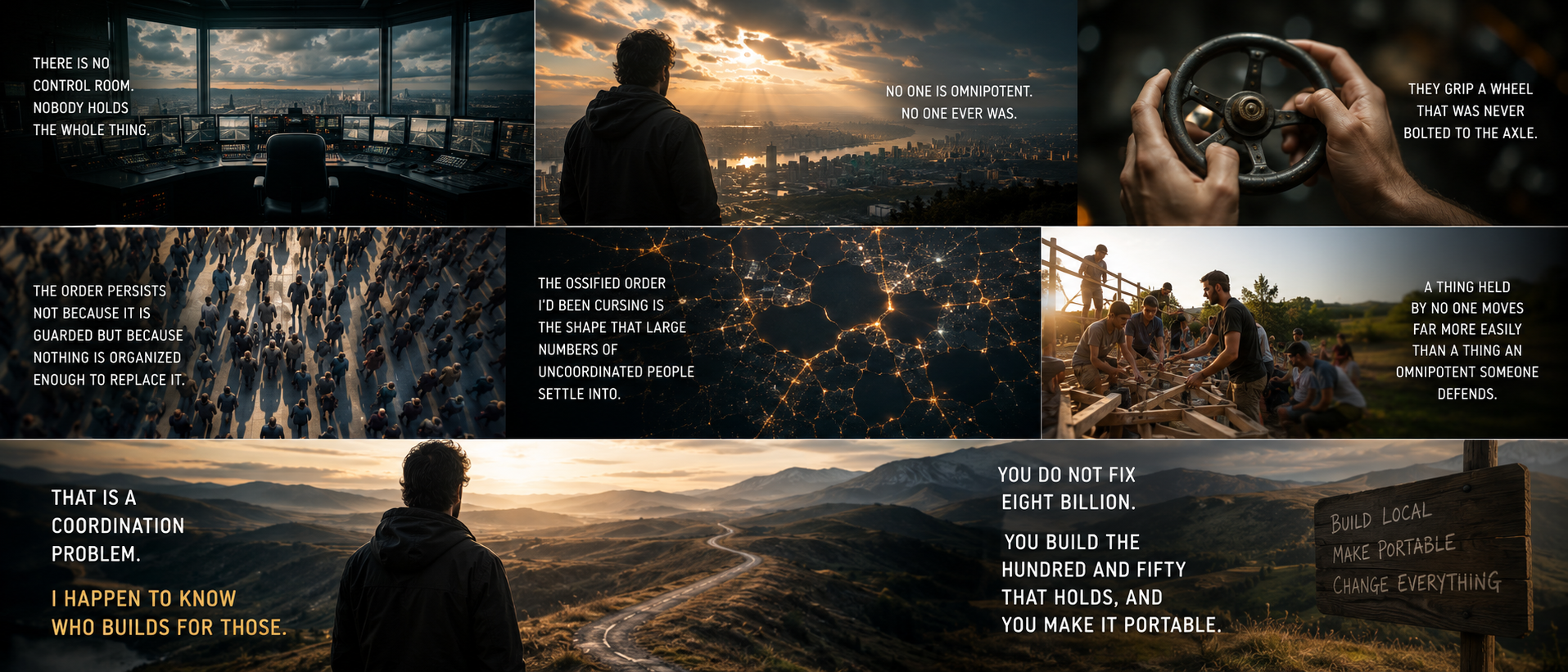
And the overwhelm under all of it — eight billion facets, a significance I could not hold — was the cognitive ceiling doing exactly its job.2 The feed had set me down inside my own thesis and asked me to digest planetary suffering at a width no nervous system can digest. What followed was what the thesis predicts: the freeze, the leak, the shrinking. My small Idaho-thinking of people living in peace together is the right answer to global scale, not a retreat from it. You do not fix eight billion. Nobody fixes eight billion. You build the hundred and fifty that holds, and you make it portable.
I had written the argument for why I don’t have to carry the world. I had simply never turned it on myself.
Then the floor gave way, in the good direction
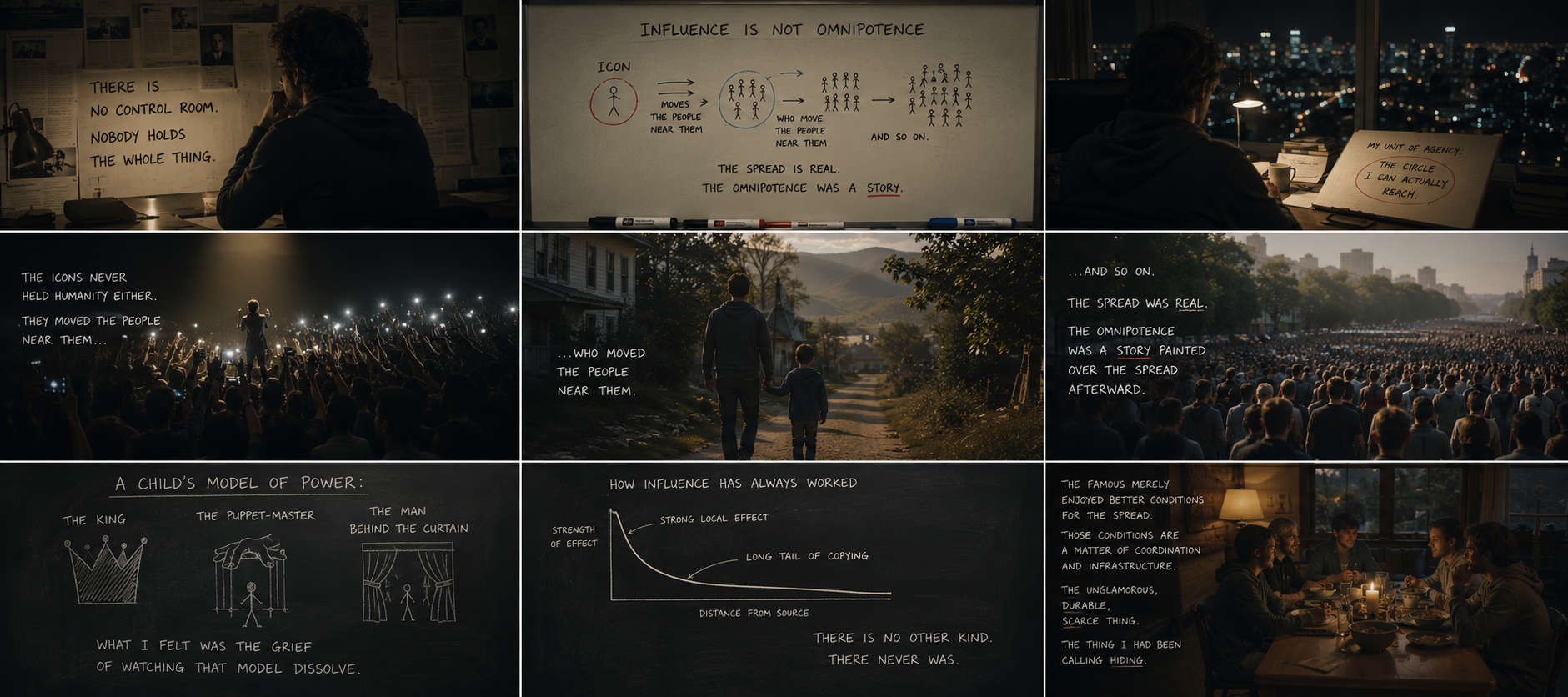
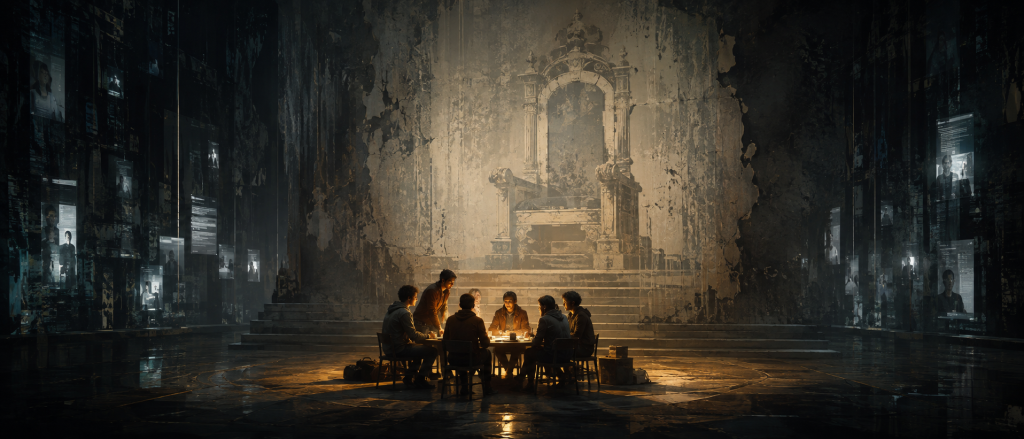
The thing I had been grieving — my exile from the seat of real power, the control room where the world gets steered — is not occupied. There is no control room. Nobody holds the whole thing. The iconic few, the faces that stand in for entire decades, are blips with fan clubs, not hands on a lever. No one is omnipotent. No one ever was.
Both directions of that arrive at once. The vertigo first: if nobody steers, the ossified order I’d been cursing is not held in place by some competent malevolent hand. It is the shape that large numbers of uncoordinated people settle into. No villain to defeat, which is almost worse.
The relief comes in right behind, and it is bigger. A thing held by no one moves far more easily than a thing an omnipotent someone defends. I had been certain that whoever held control would surrender none of it. But the control I imagined was itself the fiction. They grip a wheel that was never bolted to the axle. The order persists not because it is guarded but because nothing is organized enough to replace it.
That is a coordination problem. I happen to know who builds for those.
The temptation up here is the flat reading: then it’s all empty, idolatry is a joke, no meat left on the bone. But that is the same error stood on its head. All the power is elsewhere and therefore there is no power anywhere both come from measuring against omnipotence — and against a fantasy of someone who holds the world, every real human shrinks to a blip and every real influence to nothing. The fantasy was always the wrong yardstick. A child’s model of power: the king, the puppet-master, the man behind the curtain. What I felt that night was the grief of watching that model dissolve, which is real grief even when the thing you lose was never there.
The meat on the bone is the scale I keep fleeing and keep being returned to. The icons never held humanity either. They moved the people near them, who moved the people near them. The spread was real; the omnipotence was a story painted over the spread afterward. How little is left on the bone turns out to describe how influence has always worked, for everyone, the giants included. A strong local effect and a long tail of copying. There is no other kind. There never was.3
So my unit of agency is the unit anyone who ever lived had to work with: the circle I can actually reach. The famous merely enjoyed better conditions for the spread — and those conditions are, again, a matter of coordination and infrastructure. The unglamorous, durable, scarce thing. The thing I had been calling hiding.
What the realization licenses
I ended that Monday on a small sentence I nearly missed — a hope of finding a few like-minded people to push with. Not a footnote to the night. The answer to it. The cure for a half-hour of dissipated witnessing, and for the loneliness threaded all the way through it, is the people. For someone building on the cognitive ceiling, the first real circle is not the consolation prize beside the frontline. It is the frontline and the proof of concept in one move.
My agency in the moment was never mostly nothing. It was narrower than saving the world and far easier to find — the thing the world has always actually run on. Find your hundred and fifty, or your first five, and build whatever lets a witnessed thing survive past morning.
That is not the naive position. The naive position was believing I had to hold all eight billion.
I already knew I didn’t. I needed one Monday of two dozen strangers to remind me — and then forget them all by breakfast, which is, in a single sentence, the entire problem.
1 Watch the syllable count do the burying: shell shock, two beats, almost the sound of the gun. Battle fatigue, four, already softer. Operational exhaustion, eight, something that might happen to a car. Post-traumatic stress disorder, eight and a hyphen, the man gone entirely. Nobody signed an order to anesthetize the wound. It happened by a thousand reasonable institutional preferences, each defensible, summing to a word that no longer reaches anyone — which is the quiet face of what I’ve called WETIKOHowl, the drift away from a truth we still, somewhere, hold.
2 A number from primate fieldwork has no business being a moral instrument, and yet. Dunbar’s ceiling is a claim about what a mind is built to carry: meaning and obligation sized to a circle you can hold, not to a species. The feed’s offer — be responsible to all of it, now, continuously — is overload wearing the mask of conscience. The tell is that it produces paralysis and calls it being informed.
3 The same machinery, given a different spine, is the whole wager of the coordination work. A layer that lets an extractor route value outward can also let the people on the other side keep their charge from leaking away. The like button is that layer inverted — engineered evaporation. Build the version that accumulates instead, and you have not made a smaller version of the throne; you have made the only thing the throne was ever a painting of.