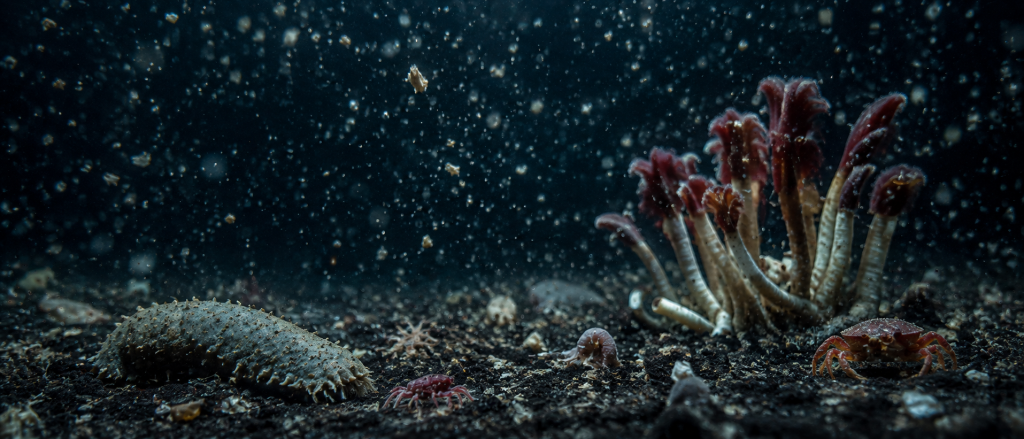
In the abyss, it rains food.
I want you to hold that image literally for a moment, because it isn’t a figure of speech and the literal version is stranger. Four miles down, in permanent black, at a pressure that would collapse your chest before you finished being surprised by it, there are animals — sea cucumbers, worms, crustaceans with more legs than seems advisable — and every one of them is eating the same thing. A slow, continuous, never-ending precipitation of the dead.
It’s called marine snow. Up in the light, in the top two hundred meters where photosynthesis still works, things live and eat and die: plankton, diatoms, fish scales, fecal pellets, the leftovers of an enormous solar-powered party that has been running without interruption for three billion years. Then it falls. Slowly, for weeks, down through the twilight and the midnight and past the last mammal that will ever visit, arriving at the bottom as a fine pale drift that the benthic animals farm the way a village farms weather.
I lost most of a night to a video about this.1 Same room as the last essay, an hour or two later in the sequence — laptop on the arm of the couch, the kitchen light still off down the hall, my leg gone dead underneath me at some point during the twilight zone and me declining to do anything about it. I had gone in for the trench diagrams. I came out fixated on a distinction the film made in passing and then walked away from.
There are two ways to be alive down there, and they are not the same way.
Two economies, one darkness
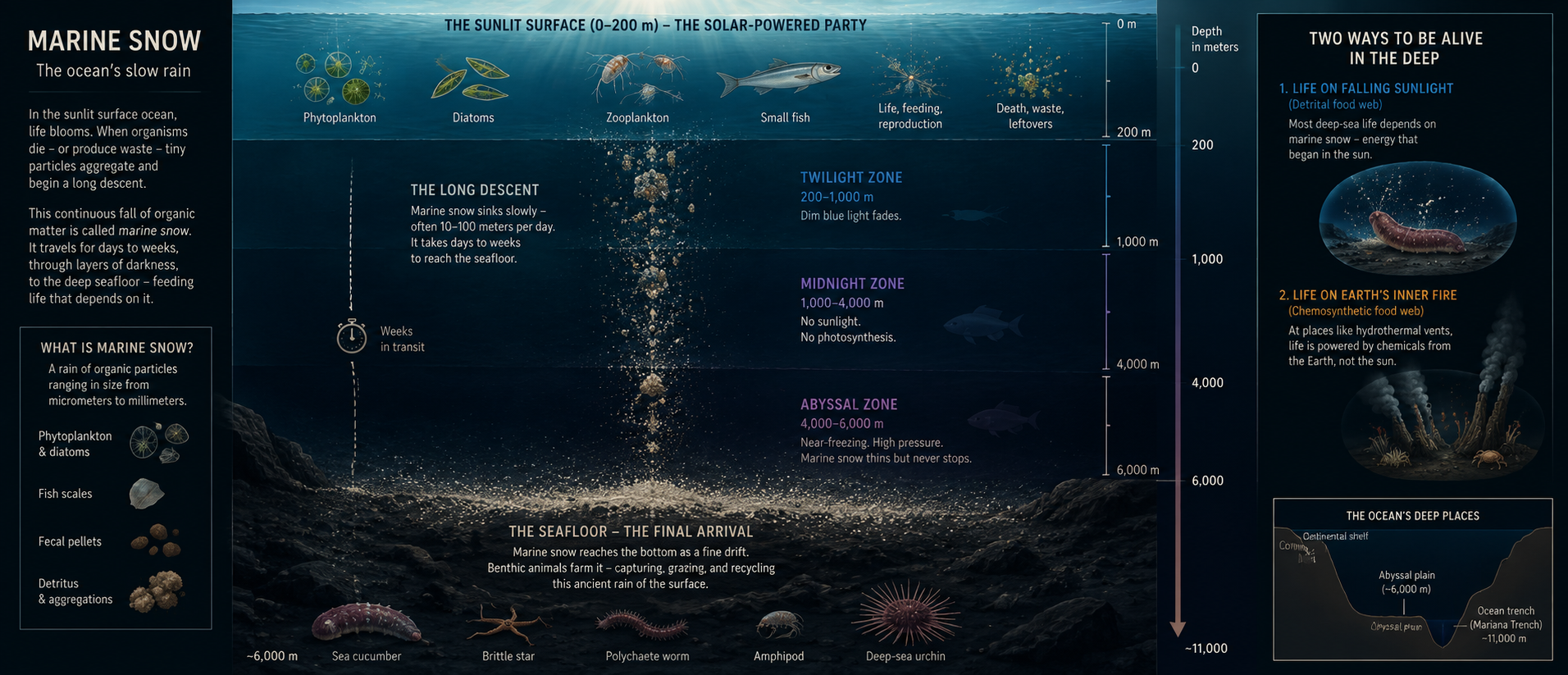
Marine snow is the sun’s energy arriving late.
Every flake was assembled in the light. A photon hit a chloroplast in the photic zone, sugar happened, something ate the sugar, something else ate that, and eventually the whole arrangement stopped working and began its long descent. By the time it reaches the seafloor it has been dead for weeks and has passed through several intermediaries, but the energy in it is unambiguously solar. None of that changed just because it got dark on the way down.
Which means the abyssal plain — eighty-three per cent of the ocean floor, more area than every continent laid together — is not an independent world at all. It’s a remittance economy. An entire biosphere living on transfers from a surface it will never see, cannot reach, and would not survive for one second.
Astonishing, and still not the interesting one. What lives down here though is.
Because the snow doesn’t stop at the sea cucumbers. It stacks. Detritus feeds the grazers, the grazers feed the shrimp, the shrimp feed the fish, and somewhere near the top of that column sits the colossal squid — the largest invertebrate on the planet, an animal we managed not to film alive until 2025, carrying the largest eyes of any living animal. Twenty-seven centimeters across. Bigger than your head. Or even bigger than your imagination:
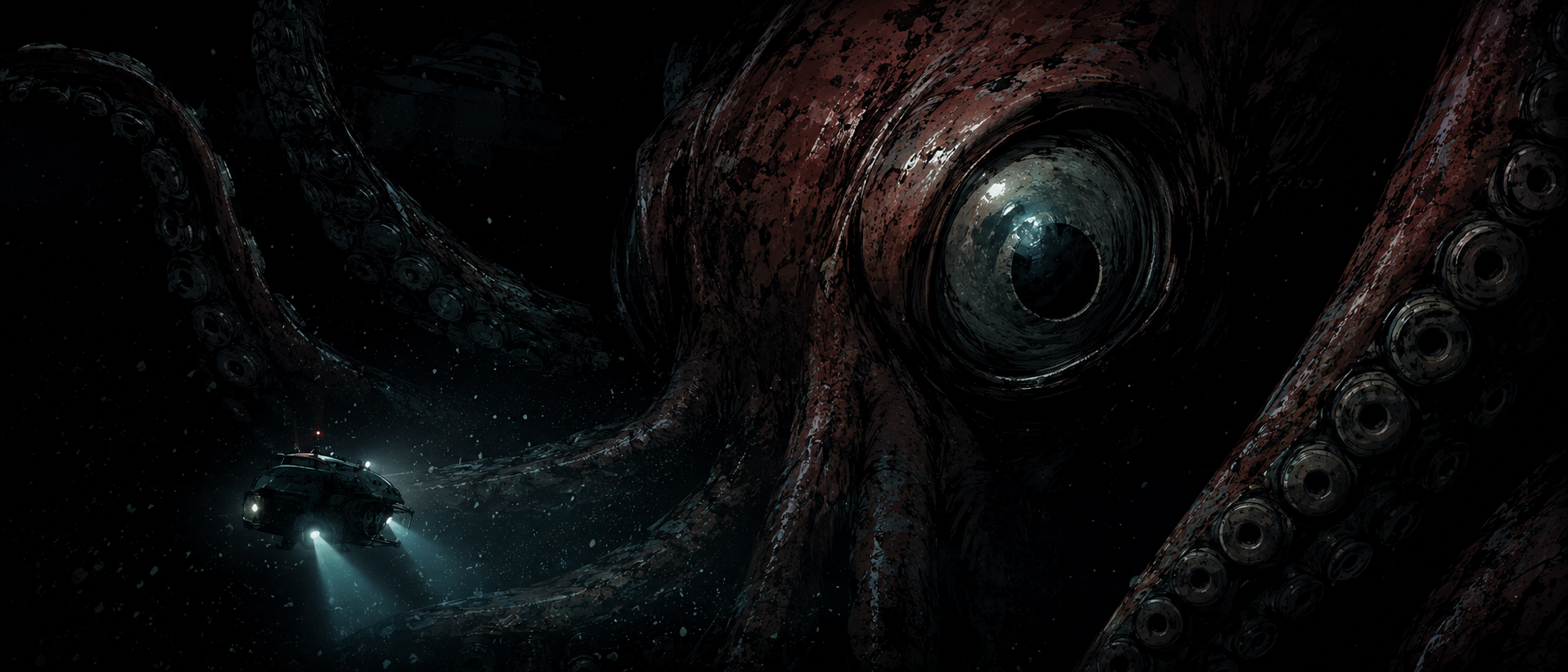
Nobody is certain why anything down there gets that big. Deep-sea gigantism is real and stubbornly unexplained; the candidate answers involve cold water, dissolved oxygen, delayed maturity, the absence of anything large enough to object. What’s certain is that it isn’t abundance. Nothing about the abyss is abundant. The snow is thin, unhurried, and utterly reliable, and reliability turns out to be a different resource from plenty — you can build something enormous on a small income that never stops arriving.
And then, at the very top of that column, something arrives that doesn’t belong to it at all.
The sperm whale is not a deep-sea animal. It’s a visitor. It fills its blood and muscle with oxygen at the surface, closes everything, and drops a kilometer or more into the dark on a single breath to hunt an animal whose eye evolved, most likely, for the sole purpose of noticing it coming — and still can’t see it, not really, not in that black. An hour later the whale comes back up carrying scars from hooks on tentacles nobody has ever filmed doing the fighting. This is the largest battle on Earth, it happens thousands of times a day, and no human has witnessed a single round of it.
In order to go down there the whale gives up its air. The lungs collapse on the way — deliberately, by design, alveoli folding flat under the pressure — and the oxygen it needs is already stashed in its blood and muscle, because the one thing you cannot carry into the deep is a pocket of the surface. Hold that. I’m going to need it at the end.
But first some venting.
What actually happened in 1977
Clams the size of dinner plates. Crabs, blind and unbothered. And tubeworms — two meters of them standing in clusters, white tubes with blood-red plumes at the top, and no mouth, no gut, no digestive system of any kind. The geologists aboard had brought instruments for measuring temperature and no biological preservative whatsoever, because why would they have. They ended up putting specimens in the vodka.
If you read that as they found some worms, you get the shrug I gave it the first time. What lands only afterward is what everyone believed about life on the day before.
Every ecosystem on Earth ran on sunlight. All of them, without exception. A lion is solar-powered; it simply launders the sunlight through a wildebeest on the way. Every food chain anyone had ever traced terminated in a photon, and this wasn’t so much a theory as the floor the theories were standing on.
And here was a city with no photon in it anywhere.
The tubeworm carries an internal organ packed with bacteria, and those bacteria oxidize the hydrogen sulfide venting out of the rock. Energy from the planet’s own chemistry — heat, pressure, mineral — with the sun playing no part. The worm doesn’t eat. It farms, internally, and lets the tenants pay rent in sugar.
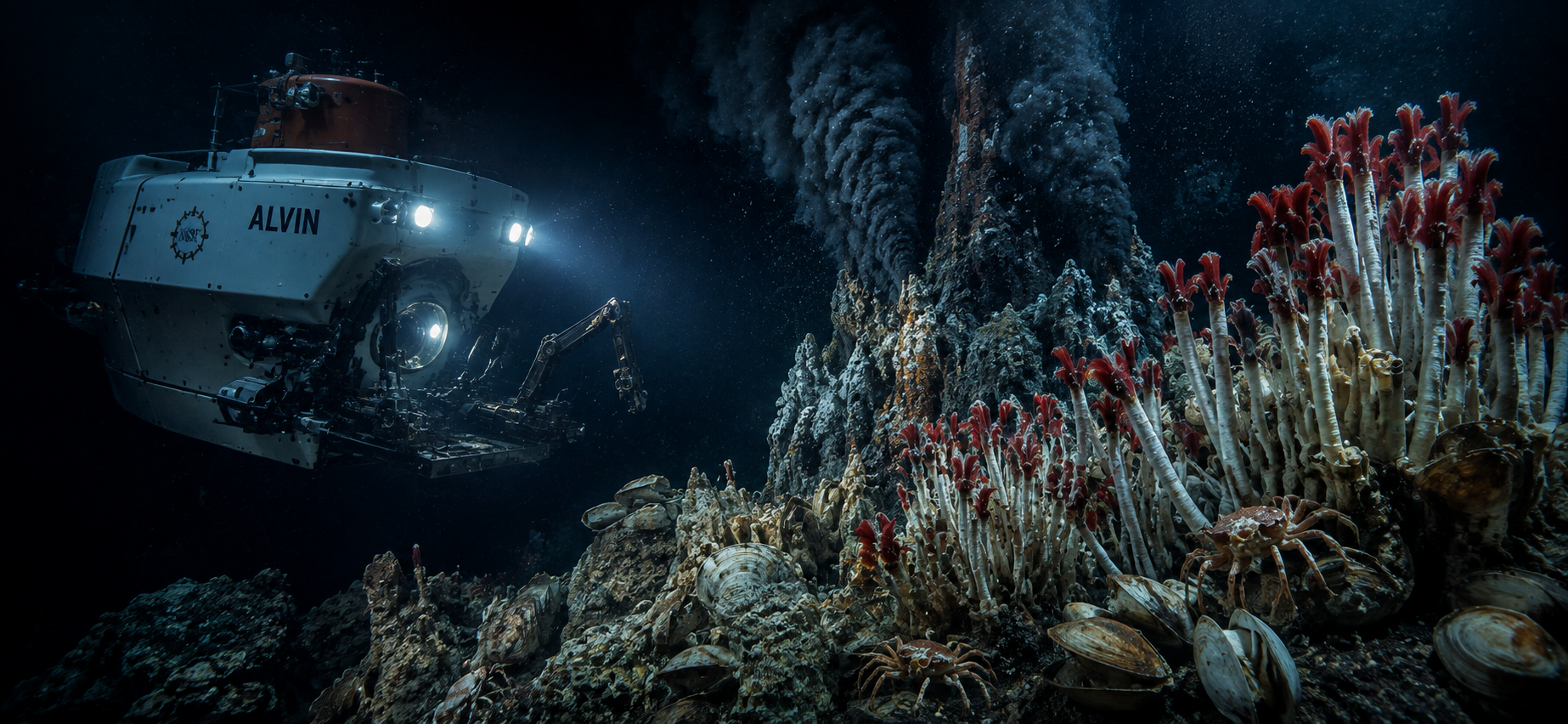
That is a second answer to the question of how to be alive, written independently, in the dark, with no reference to the first one and no knowledge that a first one existed.
Which is why the discovery stopped being about worms within about a year and became about Europa, and Enceladus, and every other body in the solar system with liquid water under a lid of ice and no light at all. Life does not require a star. That’s the sentence 1977 bought us, and we bought it with a submersible full of vodka.
The borrowed alphabet
The vents looked, for about two days, like my exception. A genuine outside I could point at. Not imagined otherness — actual otherness, sitting on the seafloor since long before there was anyone around to file it anywhere.
Then I read up on how the tubeworm actually works.
That red plume is red because it’s packed with hemoglobin, a specialized version that binds hydrogen sulfide and oxygen simultaneously and carries both down to the bacteria. Both. The chemosynthesis needs sulfide for its energy and it needs oxygen as the thing to burn the sulfide against.
And free oxygen in the ocean is a photosynthetic product. Every molecule of it was exhaled by something standing in the light, or by the ancestors of something standing in the light, going back to the great oxygenation two billion years ago.
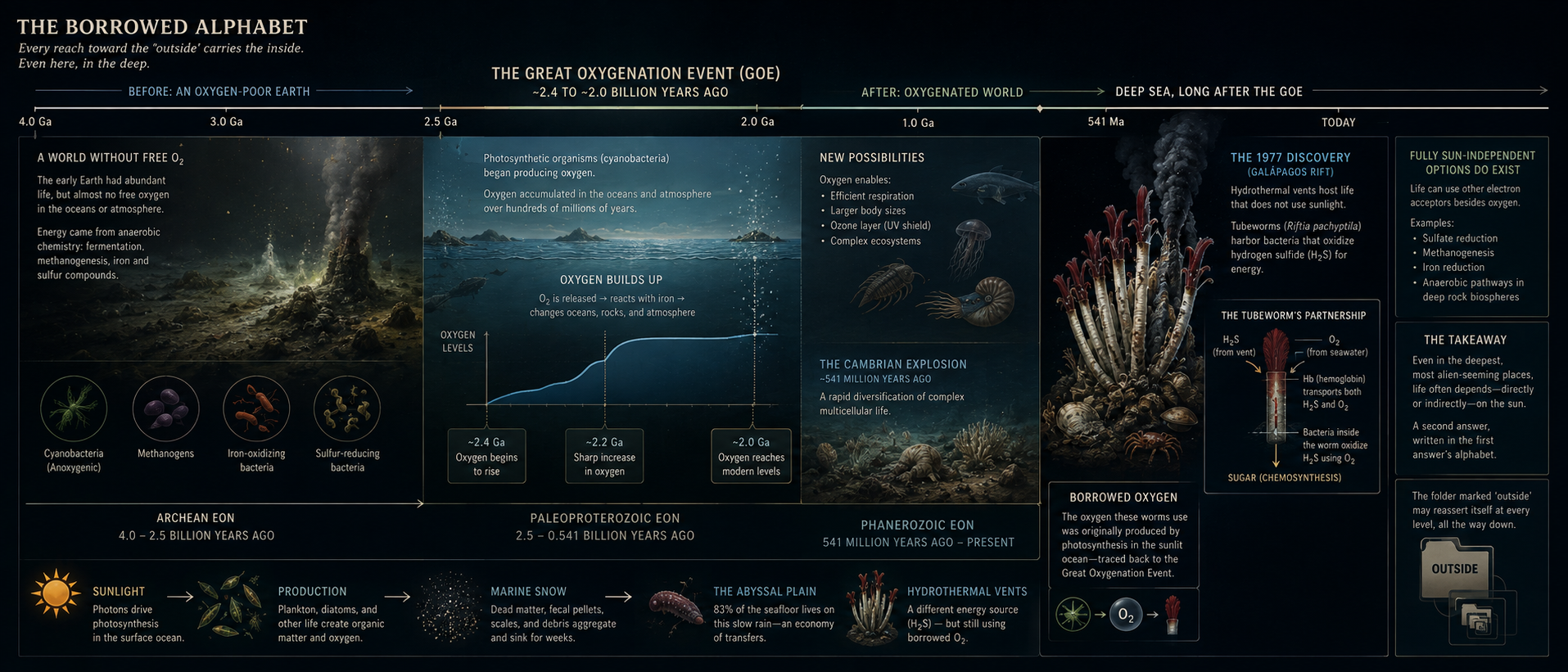
So the most emancipated life on this planet turns out to be half-emancipated. Novel energy source; borrowed electron acceptor. A second answer, written in the first answer’s alphabet.
Fully sun-independent options do exist — anaerobic pathways, methanogens, microbial communities miles down in the rock that owe the surface nothing. They’re real. They’re just not what surfaced in 1977, not what got photographed, and not what ended up on the posters about Europa.
I find this close to unbearably funny. I wrote an entire essay arguing that we cannot get outside ourselves, went looking in the deepest hole on Earth for a counterexample, found one, and discovered it was breathing our air.
The folder reasserts itself one level down. It may do that at every level, all the way down, which is a possibility I’m going to leave sitting there because I don’t yet know what to do with it.
I am benthic
I’ve been describing my own situation wrongly, and the ocean corrected me.
I called the abundance weather, then retracted it. I called it a landscape I walk across, which was better. The accurate description is that I’m on the seafloor and it’s snowing.
Everything the machine hands me is precipitation from a photic zone I cannot enter. A vast sunlit layer of human music — every session player, every third take, every argument in a control room at two in the morning, every kid who learned four chords and meant them — lived, and produced, and eventually stopped, and the residue of the whole thing drifts down to me in flakes, forty seconds at a time. I farm it. I’ve become good at farming it. Nothing I am eating originated in my own dark.
That reframing costs me something and I’d rather name the cost than let it sit unpriced.
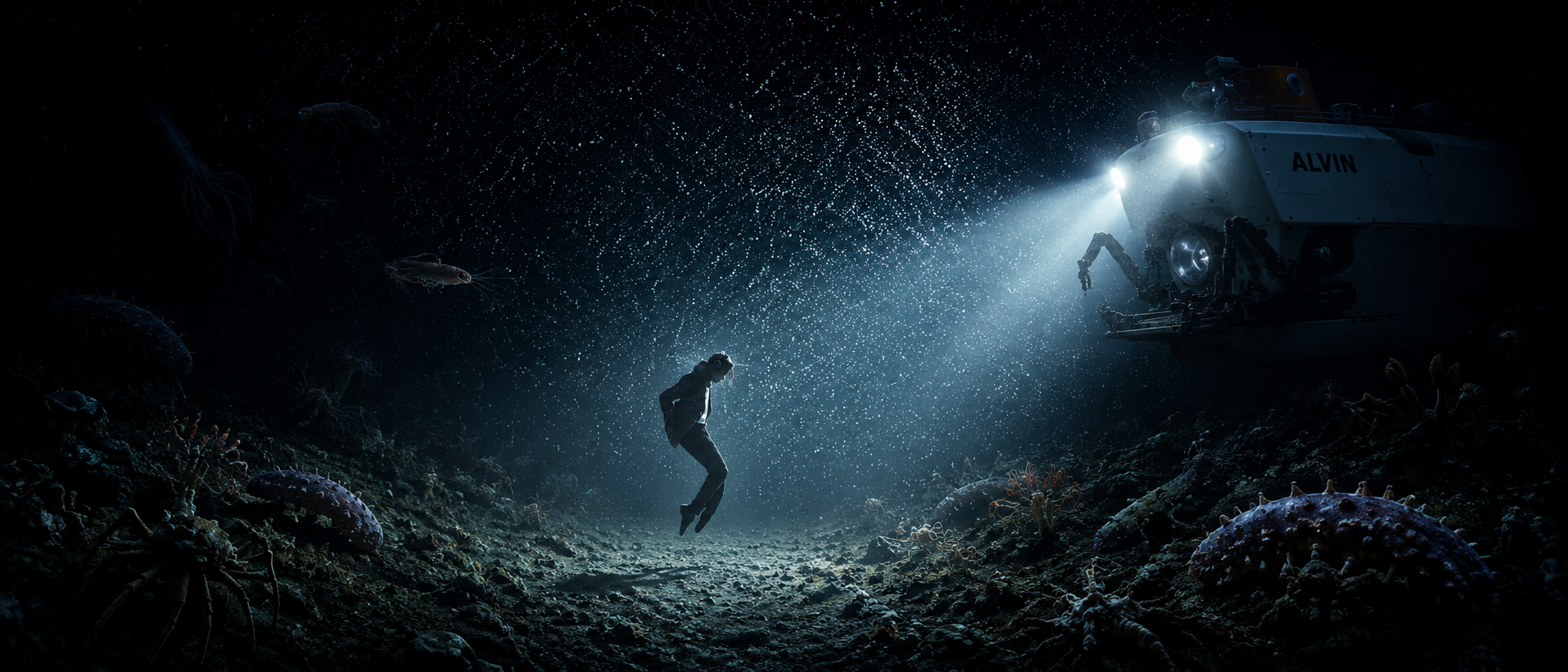
It costs me the word exploration, which I’ve been leaning on hard. The sea cucumber is not exploring. It is grazing a downward flux it neither generates nor influences, and there’s no version of its life in which it swims up to see what the surface is like. And it costs me the flattering ambiguity of audience member number one, which sounded like a frontier the first time I wrote it and now sounds more like an address at the bottom of a gravity well.
What it doesn’t cost me is the food. The snow is real, and the animals eating it aren’t failures — they are the most successful colonization of hostile volume in the planet’s history, achieved by adapting to a resource that merely arrives. Emancipation was never the standard anywhere in biology. Living is.
Is there a vent?
Still. Once you’ve accepted the diagnosis, the ocean plants a question you can’t put down.
Is there a vent? Is there anything in a working creative life whose energy doesn’t route through the corpus at all — no photon anywhere in it, running instead on local chemistry, on heat coming up from underneath?
I think there is, and it’s smaller and considerably less romantic than I was hoping for. It’s the material that isn’t in anyone’s training data because it happened to exactly one person and has never been written down or regurgitated. The particular room. The thing that was said in a car and then not discussed for nine years. The reason you actually left the job, which is not the reason you give when asked. None of this is better than the corpus — in raw form most of it is worse, artistically, shapeless, self-serving. But its energy comes from below rather than above, and no amount of sampling from a distribution will produce it, because it is not in the distribution. It’s in the rock.
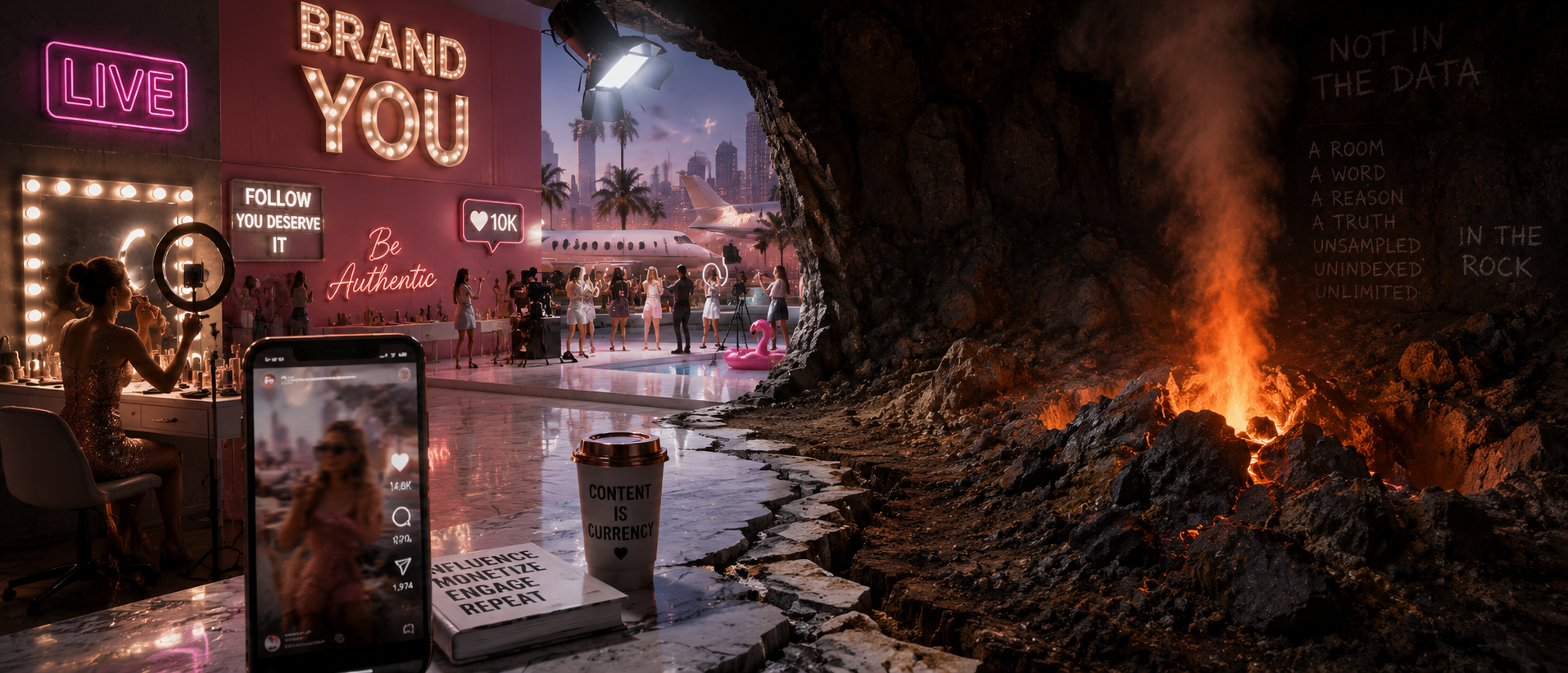
I am confined within the strangeness of my first-hand experience. Beyond that lies the abyss that I can only illuminate one living second at a time. Imagining. Passing. Uncaught, then forgotten. Unless I hold on to it for a second look. Out of respect as in its etymology of re- (back) and specere (to look at). With the quiet desperation of a human who knows two thirds of the road has already been checked off.
And then the joke lands on me a second time, because to write any of that down I have to use language, and language is the oxygen — Atmospheric commons all over again, exhaled by the surface, two billion years of it, and here I am breathing it in order to burn my own sulfide.
Novel energy source. Borrowed electron acceptor. There is no clean version of this available to anybody. There is only the ratio, and the ratio is the whole practice. Not am I an artist or a curator, which is a status question wearing a philosopher’s coat. Just: what proportion of tonight came from underneath? From that liminal space of possible emotion?
There’s a detail about vent communities I keep turning over. They’re small. Dense, finite, entirely dependent on one chimney, and when the chimney shuts — which it does, on a timescale of decades — everything around it dies. A whole civilization scaled to a single hot rock, which is a sentence I’ve written before in a different context and about a different species.3 The way they persist is by broadcasting larvae into miles of cold black water on the chance that another vent exists somewhere out there, unseen, uncontactable, possibly not there at all.
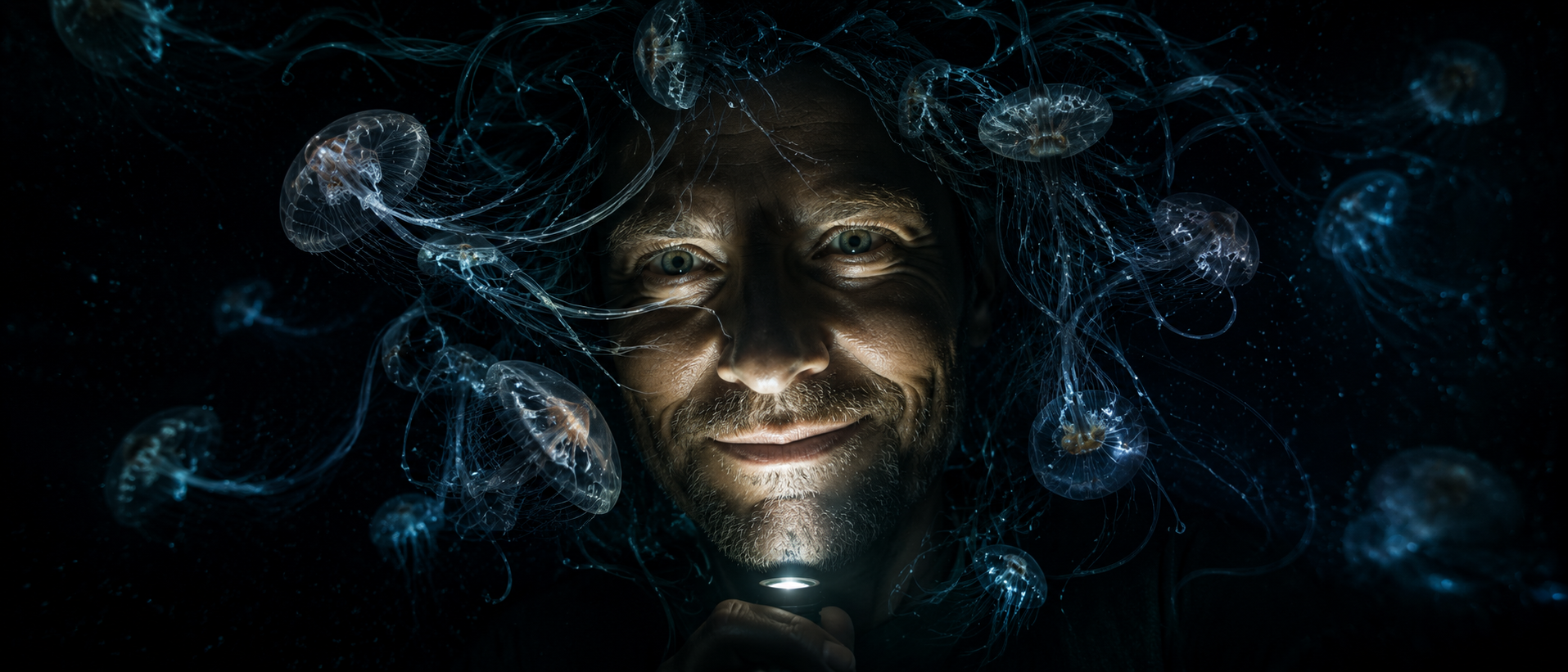
I spent part one admitting that I write these things looking for a witness. I’d like to withdraw the embarrassment. That’s not neediness. That’s larval dispersal, and it is the only strategy the topology permits.
Where you’re standing
I’ve been circling the idea that beauty is less a property of objects than a question of where a consciousness is able to stand. What you can be moved by depends on the terrain your history has built underneath you. A sommelier isn’t tasting harder; she’s standing somewhere I can’t reach from here. Someone raised inside a musical tradition hears structure where I hear ornament, and no amount of effort tonight relocates me.
The seafloor makes that concrete, because down there the constraint isn’t taste, it’s physiology. The tubeworm can’t come up. Its entire architecture is a solution to conditions that would kill me in seconds, and I can’t go down, for the mirror-image reason, and neither of us is failing at anything. We’re differently located in the same ocean, and the ocean is under no obligation to be traversable by anyone in particular.
I’ve argued elsewhere that aliveness comes in layers — dead matter at the bottom, then the autonomous engine that runs the body without consulting anyone, then the witness sitting on top wondering who’s issuing the instructions.4 The tubeworm may be the purest specimen of the middle layer I have ever encountered: no mouth, no gut, no brain to speak of, an engine that solved an impossible room and has, as far as anyone can tell, nobody home to be impressed by it. Whether the third layer is a luxury the sunlit world can afford and the vent cannot, I have no idea. But it does mean the most extraordinary thing on this planet may be happening entirely unwitnessed, forever, which either destroys my argument about presence or completes it, and I’ve gone back and forth twice while writing this paragraph. This liminal space is mercurial.

If the topology view is right, some beauties are permanently unavailable to particular minds — not through insufficient effort but through location. And others are available to nearly everyone from nearly any starting point: the minor sixth, a face, the long view over water. Those are basins rather than peaks. You fall into them; you don’t climb. Which is exactly why every culture files them under beautiful and every advertiser strip-mines them.
Haldane’s line was that the universe is not only queerer than we suppose, but queerer than we can suppose.5 I used to read that as humility. I read it now as cartography — he’s describing a region with no approach route from anywhere we’re able to stand. Not unknown. Unstandable-on. And the folder marked outside is the noise we make while pointing at it.
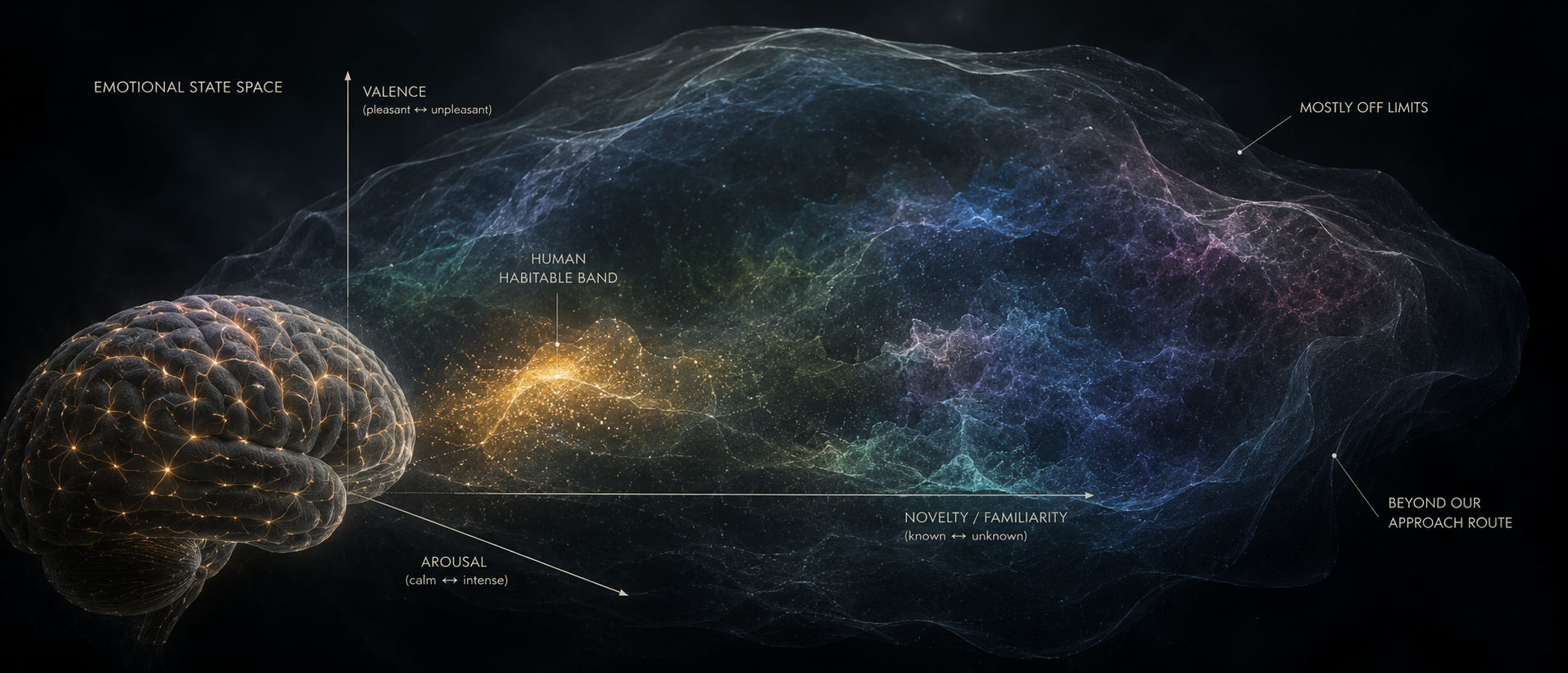
Which is where I want to put down the thing I’ve been circling in this essay without ever naming it properly. Imagine a dimension whose axes aren’t length or time but feeling — every emotional state any living thing could conceivably occupy, laid out as a continuous volume. Somewhere in it: what a tubeworm has instead of contentment. What a corvid feels about the future. Whatever the octopus is doing with the eight semi-independent selves in its arms. And somewhere in that volume, a small bright neighborhood, is everything a human brain is built to reach — grief, awe, spite, the particular ache of a chord resolving late. It feels total from the inside. It is not total. It is a habitable band in a volume that mostly isn’t ours, the same way the photic zone is a bright film on top of the liquid black beneath.
Most of that volume is off limits, and not for want of trying. This is the topology argument again, but at species scale rather than personal: it isn’t that we haven’t gone there, it’s that there’s no approach route from a mammal.
And still — we trail a little further into the weeds than the equipment strictly allows. Music does it. So do the arts, the substances, the practices, the presence of another mind that’s standing somewhere you aren’t. That’s real, and I’d defend it against anyone who calls it decoration.
But the ocean insists on the honest version, so here it is: we never grow the gills. We build a pressure vessel and carry our own conditions down with us in it. Every instrument we have for reaching further into that volume is a submersible, not an adaptation — Cameron in a steel ball wrapped in glass microspheres, going to the bottom of the world in order to look, and coming back, because looking was the entire point and staying was never on offer. We visit. What we bring back up is testimony, degraded by the ascent, told in surface language to people who weren’t there.
I’ve been calling these essays field notes. That’s what they are. Notes taken from inside the vessel, by someone who is not going to become the thing he’s looking at, about a region he can only illuminate one living second at a time.
Water doesn’t crush water
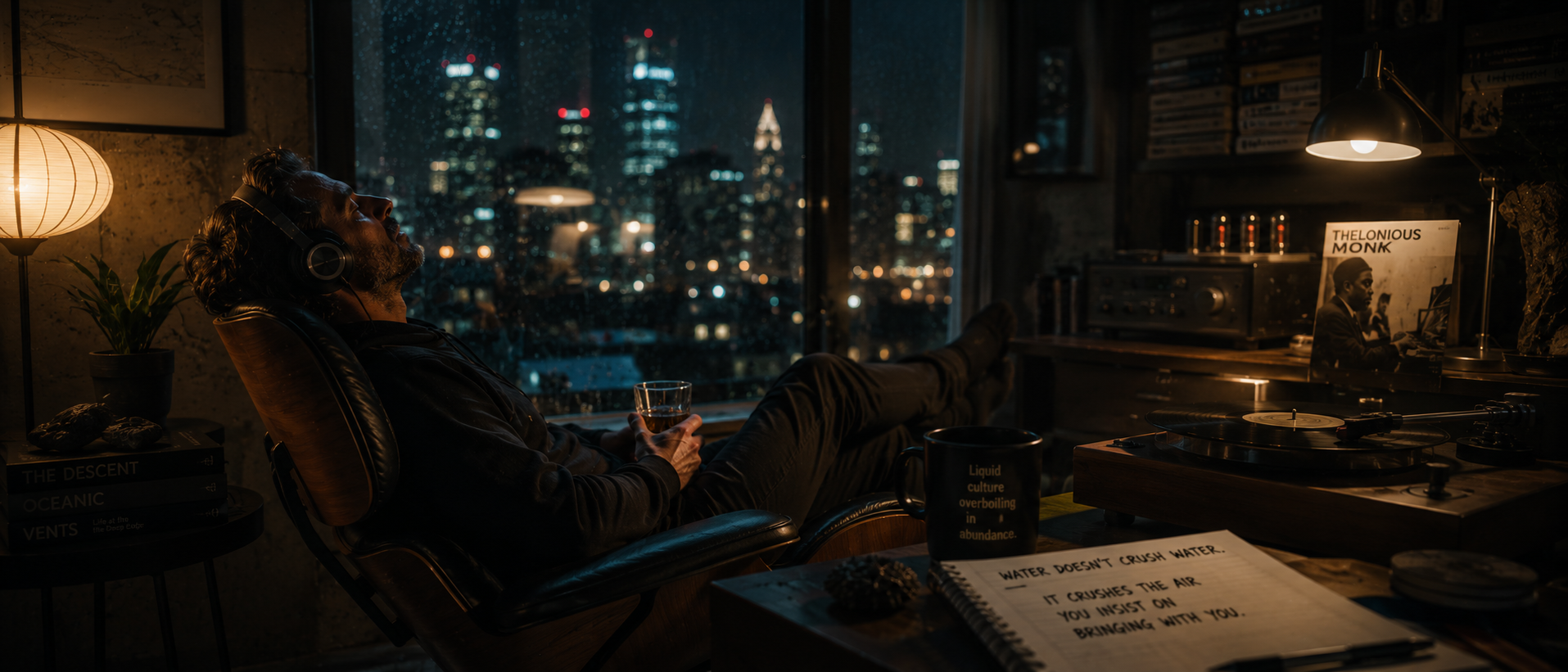
You’d think the deep ocean crushes things. It mostly doesn’t. An open can full of seawater goes to the bottom of Challenger Deep and comes back unchanged, because water does not crush water. We’re mostly water ourselves. What the depth destroys is the air you brought down with you — the sealed spaces, the pockets of surface conditions you insisted on carrying into a place that does not have them, which the whale worked out a long time before we did.
I’ve now written two long essays about a song generator, and that’s the sentence I’d keep if I had to burn the rest.
The abundance didn’t crush anything that was real:
it crushed the hollow parts I brought down there with me.
That there is an original, that beauty needs a crowd to certify it, that a body of work culminates rather than merely continues. Those were air pockets. They imploded early and loudly, and I mistook the noise for the end of something.
What was mostly water came through fine. Liquid culture overboiling in abundance.
It’s snowing on the seafloor tonight, as it has every night for a billion years, and somewhere along a ridge in the dark a worm with no mouth is being fed by tenants it will never meet, while its offspring drift off into the cold on the strength of a rumor.
And then I put on the bebop one. Down here, it turns out, you can live on what falls.
1 Epic Spaceman‘s single-shot descent to Challenger Deep. He mentions at the end that he uses no generative AI in his work and would rather it helped us make things than made things for us. Given that I arrived at his video by way of a Suno prompt, I’m choosing to take that as instructive rather than as an accusation, though I notice I had to choose.
2 Part one, where the kitchen and the alien song get their proper introduction. This piece won’t make much sense without it.
3 The framework is called Dunbarrios and it argues, at tedious length, that human belonging has a natural scale and that we have built almost everything above it. I did not expect to find the thesis confirmed by tubeworms.
4 An essay called Who Is Issuing This — on anesthesia, pain asymbolia, improvisation, and the gradient between the engine and the witness. It keeps trying to get into other essays. This time I let it.
5 J. B. S. Haldane, Possible Worlds, 1927 — endlessly quoted, rarely finished. He was making a claim about the limits of our categories, which is either the humblest or the most arrogant available position depending on which end you pick it up by.

