The Era of Liquid Culture: Marine Snow and the Folder Marked ‘Outside’

Field notes exploring musical liminal spaces, the depths of the oceans, and the human capacity to spell a. w. e. (whether ‘spell’-cast or ‘spell’-bound… remains yours to decide). PART I today.
As you browse this blog, please feel free to watch the narration videos posted on KindredSoulSearch.com’s YouTube channel:
Each blog post also comes with its own podcast episode powered by Google’s NotebookLM—a different interpretation, a different take, and KindredSoul-reviewed.
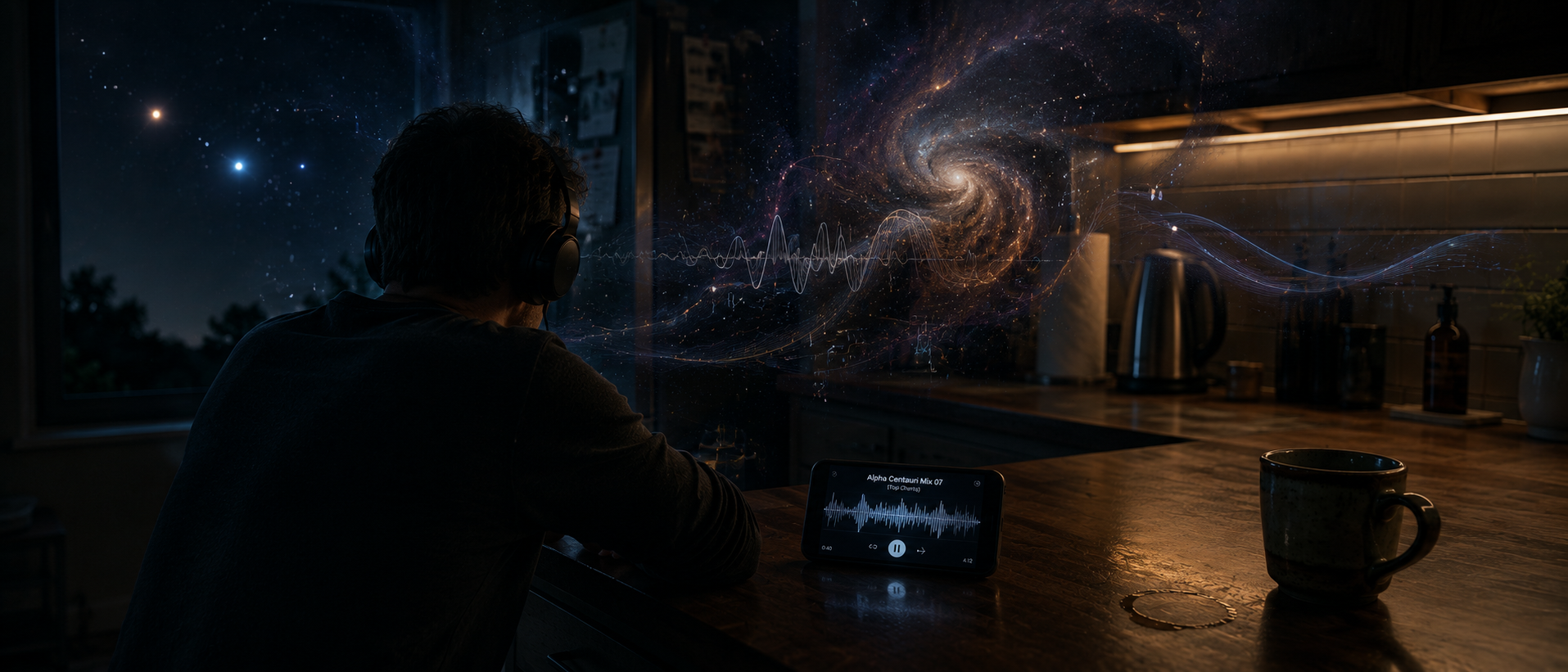
I asked a machine for a version of my song that would top the charts on Alpha Centauri. Something came back. That is the whole problem we’ll explore below.
 

There is no music on Alpha Centauri. I want that established before anything else, because everything after it depends on the fact being flat and boring and certain. Three stars, a rocky candidate or two, no ears, no lungs, no lungs meaning no breath, no breath meaning no phrase length, no phrase length meaning nothing that could possibly be called a chorus. A silence four and a bit light-years deep, and nobody standing in it.

I typed the prompt anyway.

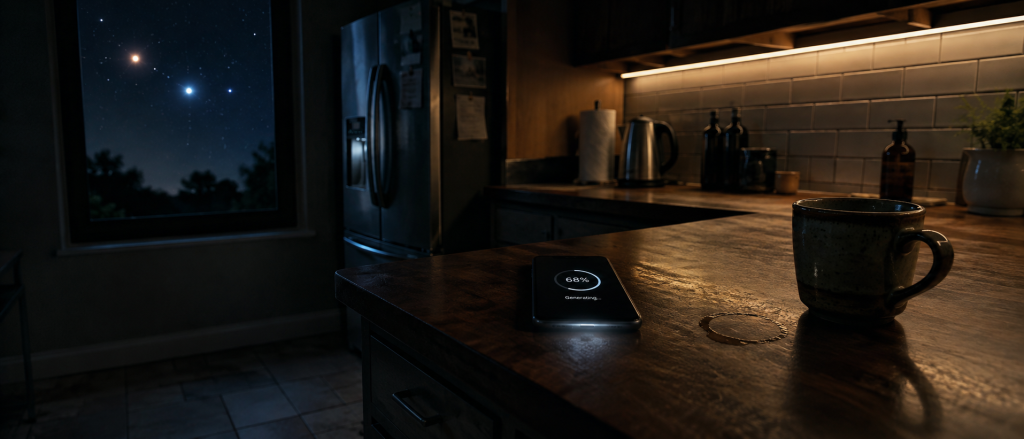
The kitchen at that hour has a particular character. The overhead light stays off because turning it on would be an admission. What’s left is the strip under the cabinets and the pale rectangle of the phone lying face-up on the counter, and the refrigerator doing the thing refrigerators do, which is to hum at a pitch just low enough that you only notice it when it stops. Cold underfoot. A mug from earlier, gone cold too, ring on the wood. I leaned on my forearms and watched a progress indicator, the way you watch a kettle, which is to say uselessly and completely.

Forty seconds.

And then the machine handed me something that sounded — I’m choosing these words carefully — like it came from there. The pulse landed a fraction off from where my body wanted it and stayed there, insisting. The intervals leaned into a place my ear had no map for and kept going. And running underneath all of it, unmistakable, was my own song, the one I’ve been walking in circles around since spring, literally hundreds of variations since, its lyrics still standing in the mix like trail markers on a path whose entire landscape had been swapped out overnight.

I didn’t move for the length of it. When it ended the refrigerator was still going.

What I thought, more or less verbatim, was: how am I supposed to process this.

I have an answer now. It cost me a few weeks, it isn’t the answer I was angling for, and it’s substantially less flattering than the one I’d have written if I got to choose.

First, the ledger

Let me dispose of the obvious objection, because I already ran the experiment and lost.

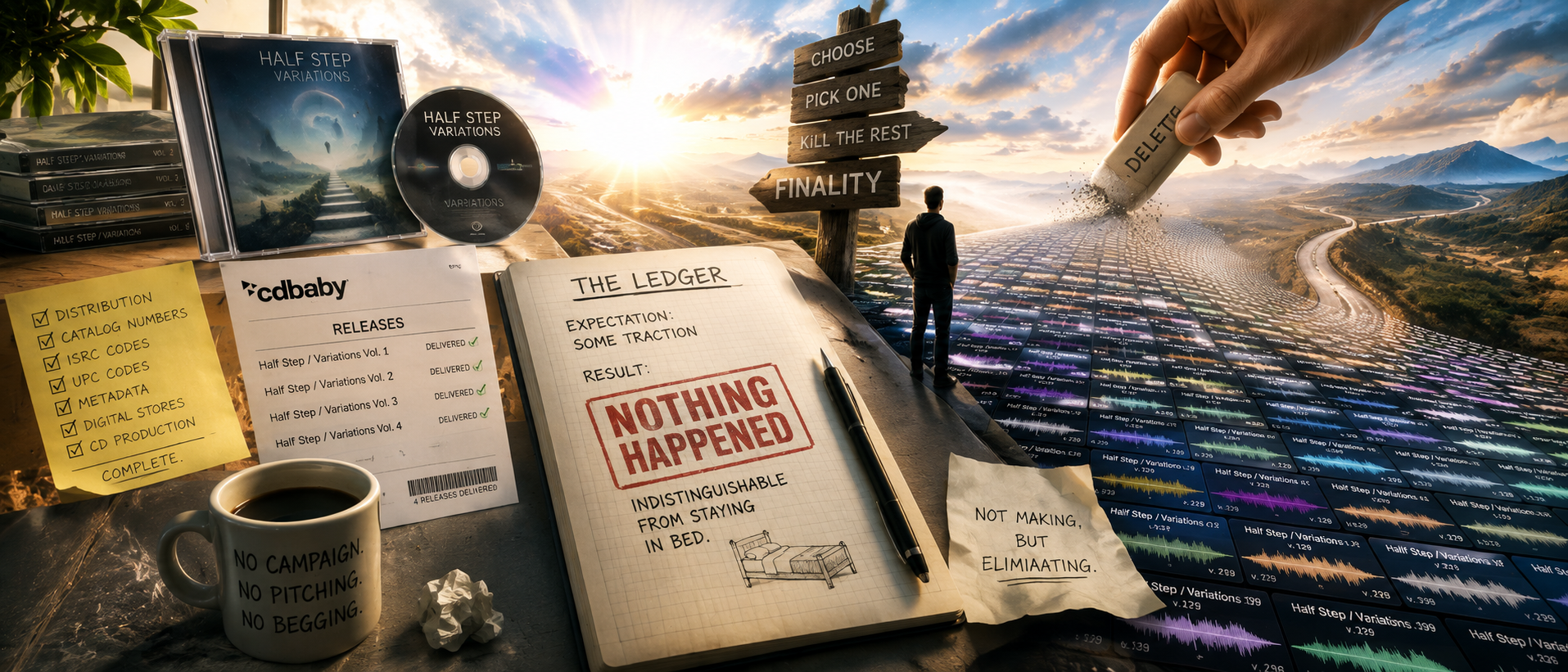
I have released four of these via CD Baby. Real releases — distribution, catalog numbers, the whole apparatus. Unmarketed. No campaign, no playlist pitching, none of the modern begging. And so, predictably, no traction whatsoever: a result statistically indistinguishable from having stayed in bed.

Someone reasonable would say that what I was missing was finality. That the vertigo of endless variation has an obvious cure — choose. Pick one. Kill the other four hundred. Scarcity used to be imposed by cost, and since cost has left the building, impose it by decision instead. Which is correct on paper, and is arguably the only job left to an artist when supply goes bottomless: not making, but eliminating.

I ran it. Nothing happened.

Not because the releases failed to find listeners — I never gave them a chance, so that proves precisely nothing about the market. It failed because finality wasn’t the missing ingredient. Declaring a version final changed the metadata and left the experience exactly where it was. The ending I believed I was lacking turned out to be an ending I did not want, which is useful information, and arrives the way most information about myself arrives: as a failed remedy for a misdiagnosed complaint.1

The precedent I thought didn’t exist

When I first wrote about all this I made a claim that there is no precedent for anything comparable. There is. Like many others, I’ve been the precedent for thirty years.
 

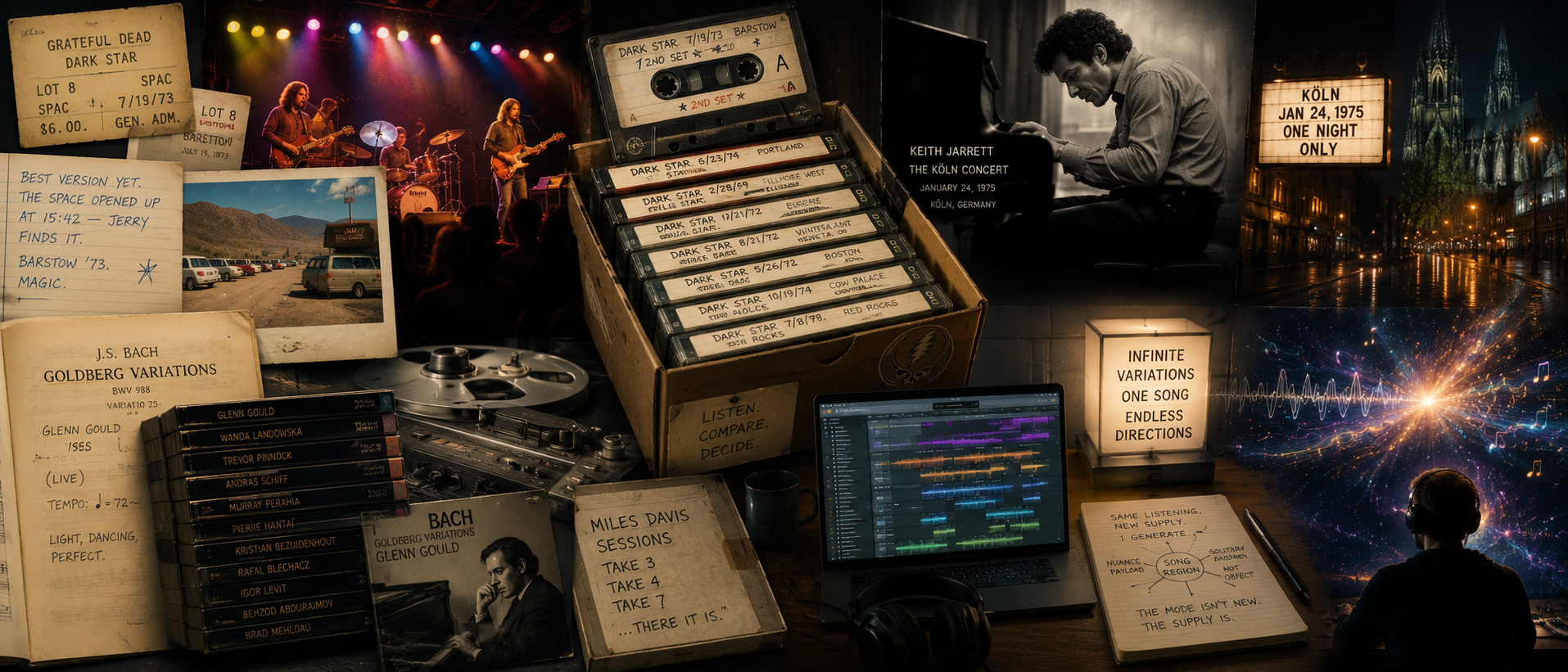
Certain songs prompt me to track down specific live recordings because on that night, in that room, the band or singer does something extraordinary they’ve never done again and never did before. That’s like discovering a gem. Each unique. Similar in behavior as the tape-trading Deadheads who spent decades arguing over which “Dark Star,” from which parking lot, in which state, contained the real thing. So does the collector with eleven Goldberg Variations who can tell you which pianist takes the twenty-fifth at what tempo and why that matters more than anything else that happened to him that week. So does anyone who has ever sat through all seven alternate takes on a reissue, waiting for the moment the horn player finds it.

Same listening. The song as a region rather than an object; the nuance as the payload. And — this is what I missed at first — it was always mostly solitary. Nobody else ever heard the collector’s exact sequence either. The Deadhead with the shoebox of cassettes was already living inside a private mythology; he just had to drive to Barstow for more of it.

Keith Jarrett walked onto a Cologne stage in 1975, hated the piano he’d been given, and spent sixty-six minutes playing around its dead registers. That night can’t recur, and the reverence we hold it in is inseparable from the fact that it can’t.2 What sits on my counter is the photographic negative of Köln: a night that recurs infinitely, in every direction, on demand, forever.

So the mode isn’t new. What’s new is that the supplAi went bottomless and the person generating it is me.

The folder marked ‘outside’

Back to the kitchen, then, and the alien song.

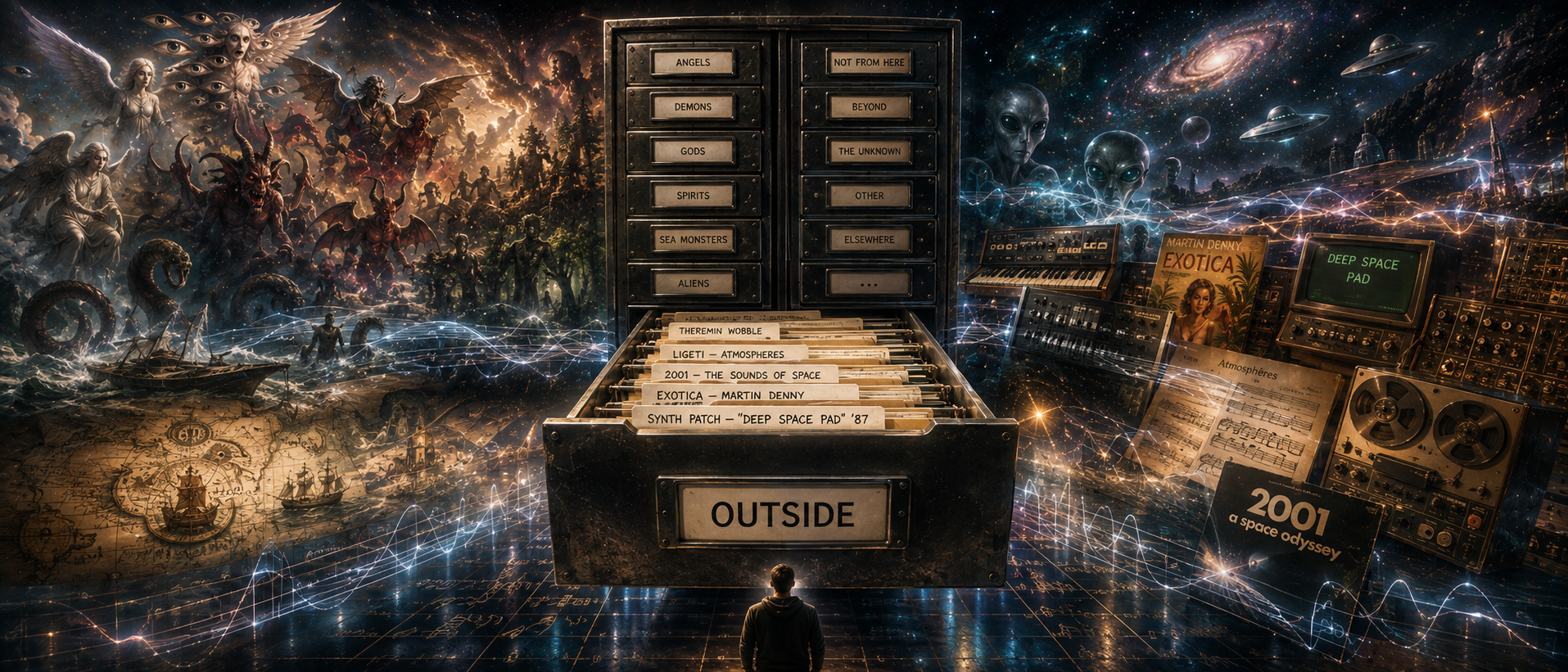
The model has no access to Alpha Centauri. It cannot have any. What it has instead is the complete record of every human attempt to sound alien: the theremin’s wobble, Ligeti’s clouds of voices lifted into 2001 and imitated by everyone who has scored a spaceship since, exotica records made by men who never left Los Angeles, a synthesizer patch somebody named Deep Space Pad in 1987. Sediment, all of it. Ours, all of it.

So the alienness I was leaning in to detect — cataloguing the odd intervals, quietly congratulating myself on my sensitivity to the otherworldly — is the most human material in the file.

I wasn’t receiving a transmission from outside culture. I was hearing culture’s own folder labeled outside: everything we have ever filed under not from here, compressed, recombined, and handed back to me in under a minute. A process so alien in itself.

And once you see the folder, you start seeing the filing system.

Because we have been keeping this folder for a very long time, and aliens are only its most recent tenants. Before them: angels, with their surplus of wings and eyes, assembled from the parts of animals we already knew. Demons, likewise — goat, bat, serpent, always a collage, never a novelty. Gods with too many arms. The spirits in the treeline. The sea monsters drawn onto the blank quadrant of the map, which is the point: cartographers never left the unknown blank. They filled it, immediately, with the nearest available strangeness. A fuzzy static of marine snow turned imagination. Every culture appears to keep a drawer for what lies past its own edge, and every drawer turns out to contain the edge itself, folded over.

None of them hold the actual ‘outside’. They hold the outline of the inside, traced from the far side.

Which is why the machine could do it at all. If the alien aesthetic were actually alien it would have no signature to learn — no consistency, no recoverable pattern, nothing to compress. That it has one, stable enough for a model to extract and reproduce on demand, is the evidence. We agree with each other about what unfamiliarity sounds like. We have agreed for a very long time. That agreement is a cultural artifact as thick and layered as any other, and now it can be queried.

I should be careful here, because there’s an obvious overreach and it’s tempting. It isn’t that humans are incapable of imagining otherness. It’s that the attempt is much harder than the folder makes it look, and the people who took it seriously knew it. Lem wrote Solaris precisely about this failure — an ocean that will not consent to be a mirror, and the scientists who ruin themselves insisting it must be one. The novel is not about contact. It’s about the discovery that our instruments for imagining the other are instruments for imagining ourselves. He was so annoyed by the film adaptations turning it back into a love story that he complained about it for the rest of his life, which is its own small proof of his thesis.

So: not a message from the stars. A mirror, held at an angle I’d never seen it from.

I’ve come to prefer that. A genuine transmission would have been thrilling and would have told me nothing whatsoever about us. This tells me a great deal.

And the center was never outside it either

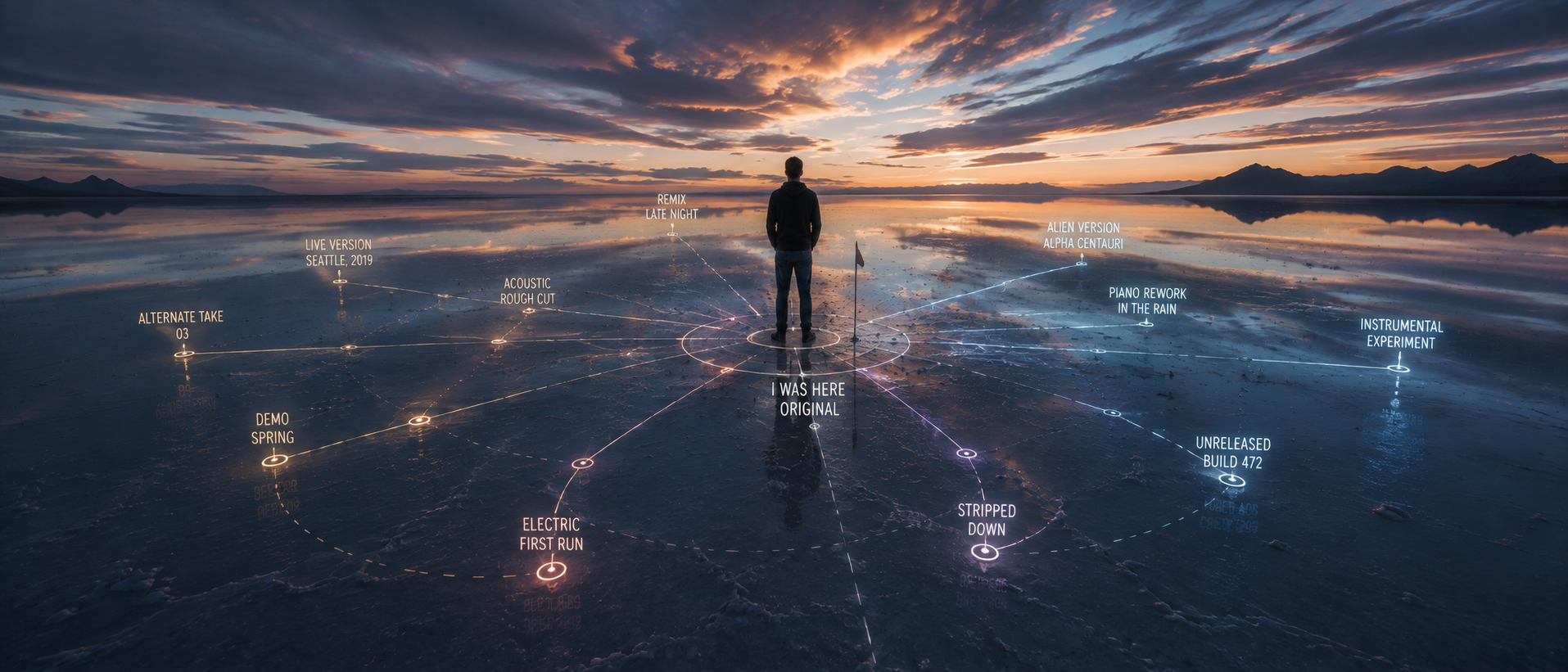
If the alien version is a point inside the song’s emotional space rather than a report from beyond it, then so is the original. There is no pristine artifact at the center of my region — no unremixed, uncontaminated thing that all these variations are variations of.

I put a stake in the ground and called it the original because I was standing there when it happened.

That sentence has been following me around for a week, and not just because of the song. Try it on a few other things. The version of a friendship you consider the real one, before it changed. The account of your childhood you’ve settled into. The first formulation of a belief, which you now defend as the most logical and pure one. In every case there were initial coordinates, and you were standing on the X, and the standing is what conferred the status.

I’ve argued before that “eventually nothing” and “currently nothing” are different claims, and that people collapse them constantly to their own cost.3 The same distinction bites here. There is currently no final version of this song. There will also eventually be no final version. Those are separate facts, and only one of them is about me. The first is a condition I’m living inside. The second is a property of the medium, indifferent to whether I ever open the app again.

The part I got wrong about being alone

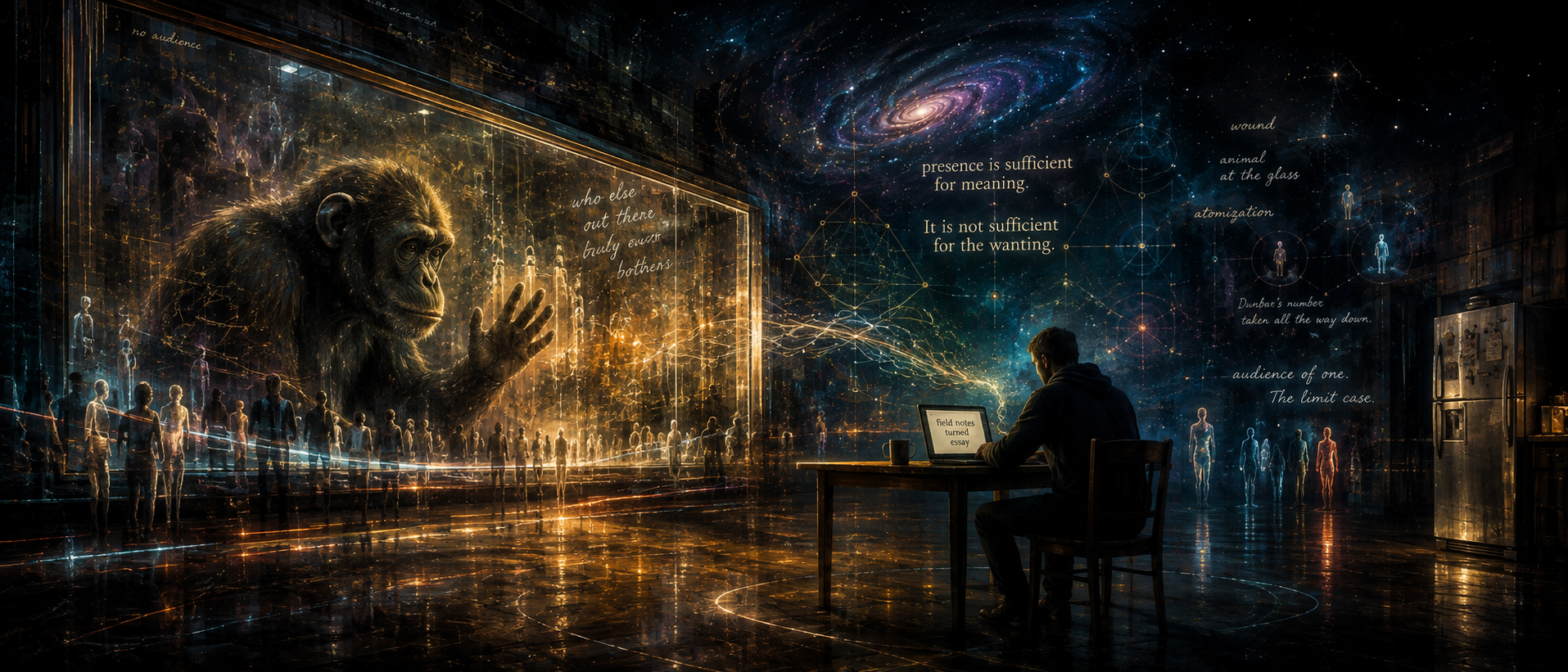
In my original notes I wrote, with a certain amount of theater: who else out there truly even bothers. No one.

And then I wrote two thousand words about it. And then I handed them to something to read and assist with this here and now. How does it make you feel?

The field notes that turned into this essay refute its own loneliest claim. Writing is a witness-seeking act — you don’t keep a field journal for an audience of zero, whatever you tell yourself about the zero. I’ve held for a while now that meaning does not require witnesses, it requires presence, and I still hold it. But it needs an amendment, and the amendment is where the honesty lives: presence is sufficient for meaning. It is not sufficient for the wanting. The encounter still tilts toward somewhere to land outside of my skull, and that tilt doesn’t evaporate because you’ve philosophically disarmed it. It just gets quieter, and slightly ashamed of itself.

Which is the same wound I’ve been circling for years under other names — the animal at the glass, the atomization I diagnose so fluently in everybody else.4 I spent years building a framework about human-scaled belonging and then constructed, for myself, an audience of exactly one. Dunbar’s number taken all the way down. The limit case, in my own kitchen, with the refrigerator going.

Completion date: ongoing

There’s a plaque on a restored Brunswick table in a hotel in Taos that I haven’t been able to put down. Under the restoration details, in the slot where a year belongs, someone engraved: Completion date: Ongoing.5

I used to read that as a joke about craftsmanship. I read it as a description now.

I won’t reach the end of this. There’s no last variation of my song, no take that retires all the others at once, no version that earns permanence and closes the file. One night a generation got stuck and gave me three minutes of pure ethereal static, a soundwave wandering off toward nothing in particular, and even that was beautiful — beautiful the way a fogged photograph of a place you loved is beautiful. The familiarity of the lyrics serves always as anchoring. The scaffolding changes and there’s always new discoveries. The borders keep receding faster than I can walk toward them.

What I can do is write down what it felt like the first time, before it stops feeling like anything. And it will stop. Five years out this will be for all of us as ordinary as opening Spotify, and the strangeness I’m describing here will be unrecoverable — the way nobody can now reconstruct what it was like to hear a recorded human voice and not know whether to be delighted or afraid.

Anthropologists don’t preserve the invention of fire. They preserve what it meant to sit around one before there was a word for cooking.

The distance between awe with a witness and awe without one turns out to be small. Not nothing — I’ve just spent an essay refusing to pretend it’s nothing — but small. A half step, give or take. Which is the interval I named the song after, back when I thought I was describing a career.
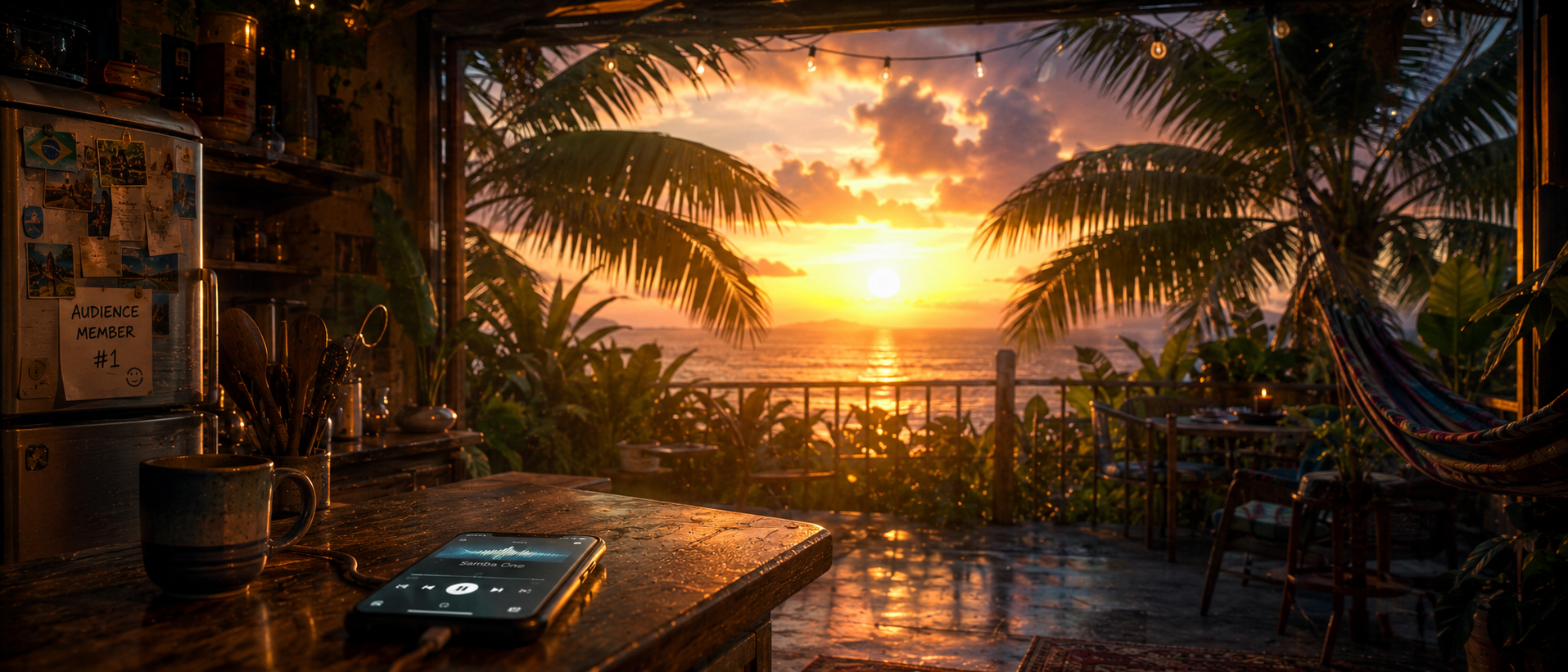
The bossa one is loading. Tropical, unhurried, four minutes of invitation to slip out of the room.

I’ll be here, standing at the counter. Audience member number one. And only. Or?

1 There’s a longer argument I’ve cut out of this essay, because it deserves its own, about why the consoling comparison — that generated abundance is just weather, and nobody complains about a surplus of sunsets — doesn’t survive contact. Short version: a sunset does not know what I like. Longer version on what I like about sunsets here.
 
2 Köln has been haunting an unrelated essay of mine about the layers of aliveness and where improvisation comes from, if it comes from anywhere at all. It shows up in pieces it wasn’t invited to.
 

3 The Tail Is Long — on dynastic topology, dragons, and why the difference between “eventually” and “currently” is load-bearing.

4 The Lonely Zoo Animal (unpublished – ask if you’d like to read that draft), January 2025, which closes on the line that 99.999% of the species will never know we existed. I wrote it as a lament. I’m no longer sure it is one.

5 The plaque belongs to a longer piece about printed encyclopedias, stewardship versus ownership, and Ozymandias — because eventually everything is about Ozymandias.

Redeem Coin Codes

Each YouTube video includes a single coin redemption code partway through the video to unlock a monthly coin. If you find it, redeem your coin code below to add it to your coin collection.

PLEASE NOTE: You must be logged on via the Comment section below each of the monthly blog posts to redeem a coin code for that month. Also to leave a comment :).
0 0 votes
Article Rating
Subscribe
Notify of
0 Comments
Most Voted
Newest Oldest
Scroll to Top