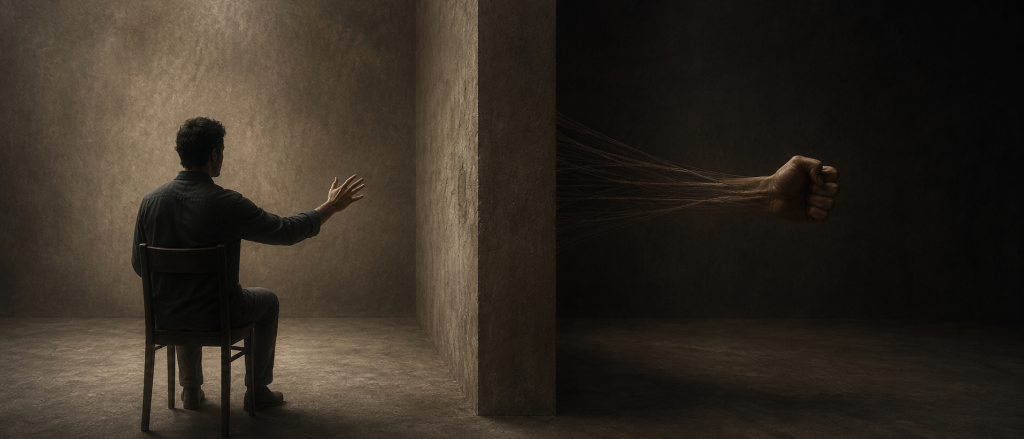
Make a fist
Somewhere between the decision and the hand there is a translation, and you have no access to it. You can watch the intention arrive. You can watch the fingers close. The mechanism in between is as shut to you as the inside of a wall. Say now I make a fist out loud while you do it and the situation gets worse: tongue, larynx, breath and diaphragm are conscripted into the same instant, dozens of muscles firing in an order nobody taught you and you could not describe if your life depended on it.
You gave the order. You did not carry it out.
This thought arrived on a morning drive, half awake, three or four days after I attended my father’s funeral. It came not just as a thought but as a sensation, which is the main reason I am still turning it over. Thoughts I mostly forget. This one though I was able to feel in my arm.
The occasion

Intellectually I had already conceded everything. He’s gone, that’s how it is, that’s the way things are. He was old and had had a good life. I had been saying it to myself for weeks and I meant it every time. Then I looked at the photograph on the stump and sudden grief came up through me with such force that I could only stand there and sob in front of my family.
Nothing had changed in what I knew. Something arrived anyway, from underneath, and it did not ask for permission.
That is the first crack in the model I am about to build, and I want it on the table before the model rather than after. Whatever I am, I am not the one in charge of what happened there.
Three layers
First layer, dead matter. Rock. Things that inherently are not alive. I have no argument with this and no mysticism about it whatsoever.
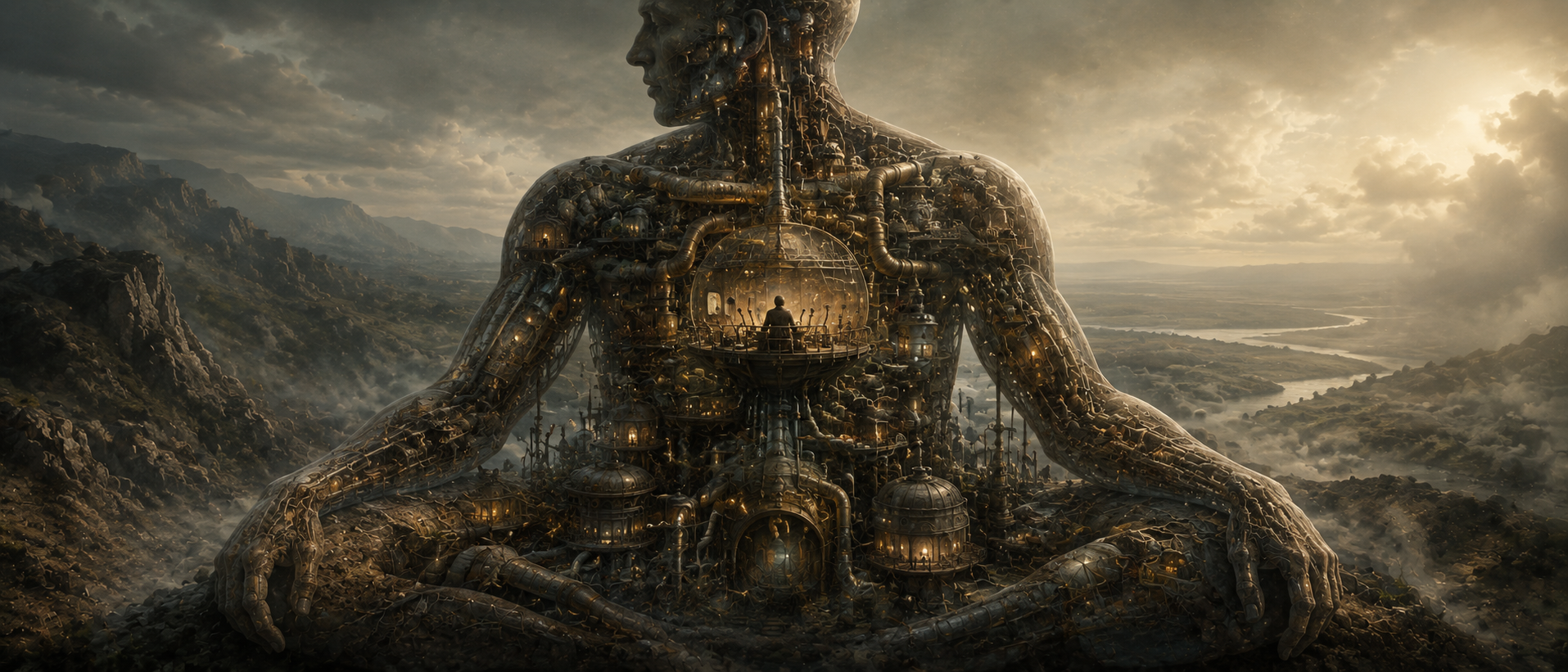
Second, the biological mechanism. The living body running itself: heart pumping, digestion turning over, temperature held inside a narrow band, ten thousand small governances proceeding in concert without consultation. Call it the engine. Somehow it is made of first layer stuff and yet it is magically not the first layer.
Third, me. The one sitting atop the engine, reaching into it at certain points, steering. The one writing this. The one that can be switched off entirely while the engine keeps running.
The third layer is not a voice speaking to me. Nobody is talking. It is that I am constantly articulating: forming, rehearsing, ruminating, trying to get what is happening in my life into sentences so that I can do something with it. A friend I described this to called it the partiality of the observer, the witness standing between the engine and the matter, and I have not found better words since.
I should say what I do not mean by it. Not a faculty, and not a small homunculus captain sitting in the skull issuing instructions. It is a shifting bundle of capacities — awareness, narration, inhibition, valuation, the ability to report any of it — that ordinarily travel together closely enough to pass for one thing, and that come apart, as we will see, under the right damage. I will go on calling it me, because that is what it calls itself.
The edges are the evidence
Pain is where this differentiation gets sharp, because anesthesia does not stop the injury: the surgeon still opens the chest. The saw still goes through the sternum, the drill still goes through the skull, and the tissue still sends everything it has up the line. What has been removed is not the damage. It is the one who would otherwise have had to be present for it.
And notice what leaves with him. Searing. Throbbing. Stabbing. Pounding. That entire vocabulary, the buckets we sort our pain into, belongs to the third layer and nowhere else. There is no throbbing anywhere in a severed nerve. The signal is second layer; the quality of the suffering is built on top of it, and it is the construction rather than the damage that constitutes the trauma we are paying the anesthetist to prevent.
The clinic pulls the two further apart still. In pain asymbolia, patients with certain insular lesions report the sensation accurately. They locate it, rate its intensity, agree that it is a pinprick, and are simply not bothered by it. They do not pull the hand back. The signal arrives fully intact and nobody objects.
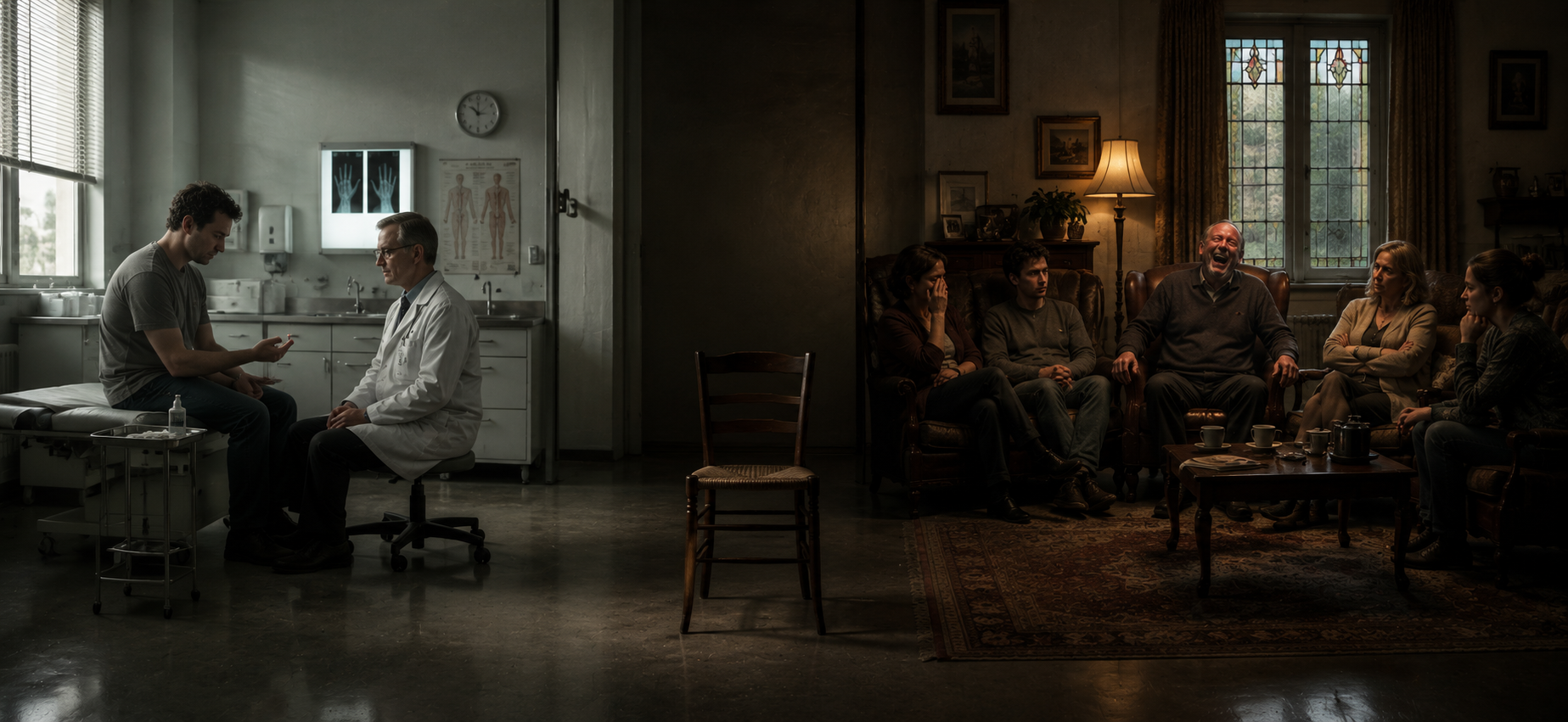
The mirror case is stranger. In pseudobulbar affect, after a stroke or ALS or a head injury, people laugh or weep helplessly at nothing, and the outburst bears no relation to what they feel. Bechterew called it emotional incontinence and meant the comparison to the bladder exactly. The faciovocal apparatus, the assembly of face and larynx and breath that produced my sobbing in front of the photograph, normally sits under a standing inhibition from above. Cut that inhibition and the machinery discharges on its own, at full volume, performing a grief nobody is having.1
There is a face to put on this. Huug Bosse sold vegetables in Krommenie, north of Amsterdam, driving a rattling green Volkswagen bus to his customers’ doors for sixty years in any weather. His hip gave out and he went in for a replacement, and when he came up out of the anesthetic he could not stop laughing. Dutch television found him and he was briefly famous for it: a man breaking into laughter at the end of every sentence, with his wife sitting beside him telling the camera flatly that it irritated her. Nothing was funny. He also wept when he heard the national anthem. A neurologist who watched the footage called it a textbook presentation; whether the anesthetic had anything to do with it was doubted at the time and never established.2 What Bosse said about his situation, laughing, was that laughing was the only thing left that he could do.
So the two conditions bracket me from either side. In asymbolia the signal arrives and nobody objects. In pseudobulbar affect the expression fires and nobody meant it. Whatever the third layer is, it can be subtracted from both ends of the transaction and the transaction still goes through.
Sleep is where the mystery is held at a survivable distance. In REM there is vivid imagery on the inside of the eyes, narratives that seem to be digesting the day into something usable, and how that works is still open. But there is also deep non-REM, where there is nothing to report at all, though the engine below is anything but idle. Long-term meditators claim awareness does not vanish even there. Practitioners in several traditions describe a continuous witnessing straight through dreamless sleep, and there is at least a physiological hook for it. Ferrarelli’s group at Wisconsin ran overnight high-density EEG on long-term Buddhist practitioners averaging some 8,700 lifetime hours of practice, and found elevated parietal-occipital gamma during non-REM that was absent in meditation-naive controls and scaled with how much daily practice a person had behind them.3 Gamma power does not equal awareness and I want to be careful here. But a dose-response relationship is not nothing. Whether it amounts to what the practitioners say it amounts to I can’t judge. The claim itself is precise and worth holding onto: not ego, which clearly does go offline, but selfhood. Something stays at its post while the narrating self falls silent and the engine goes on working beneath any report of it.
And then I watched the reverse of everything I had assumed.
I was still in the United States, on a road trip through Utah, when my sister sent a video message. My father was gasping. He was dim, in and out, not coherent, not reachable. The third layer had already lost its grip on the controls, days before the engine finally gave out. What actually failed was the second layer: age, a lung infection, type 2 diabetes, all of it compounding until the mechanism could no longer cope.
So the two do not go together cleanly. His conscious access to us went dark first. The engine fought on for a while, and then it stopped too. Whether anything remained present behind that lost access is precisely what nobody knows. Perhaps he held on still while family was present: only thirty-minutes after visitation was over and everyone had left, he let go of his final breath.

Degrees of access
A fist is free. Instant, total, no technique required.
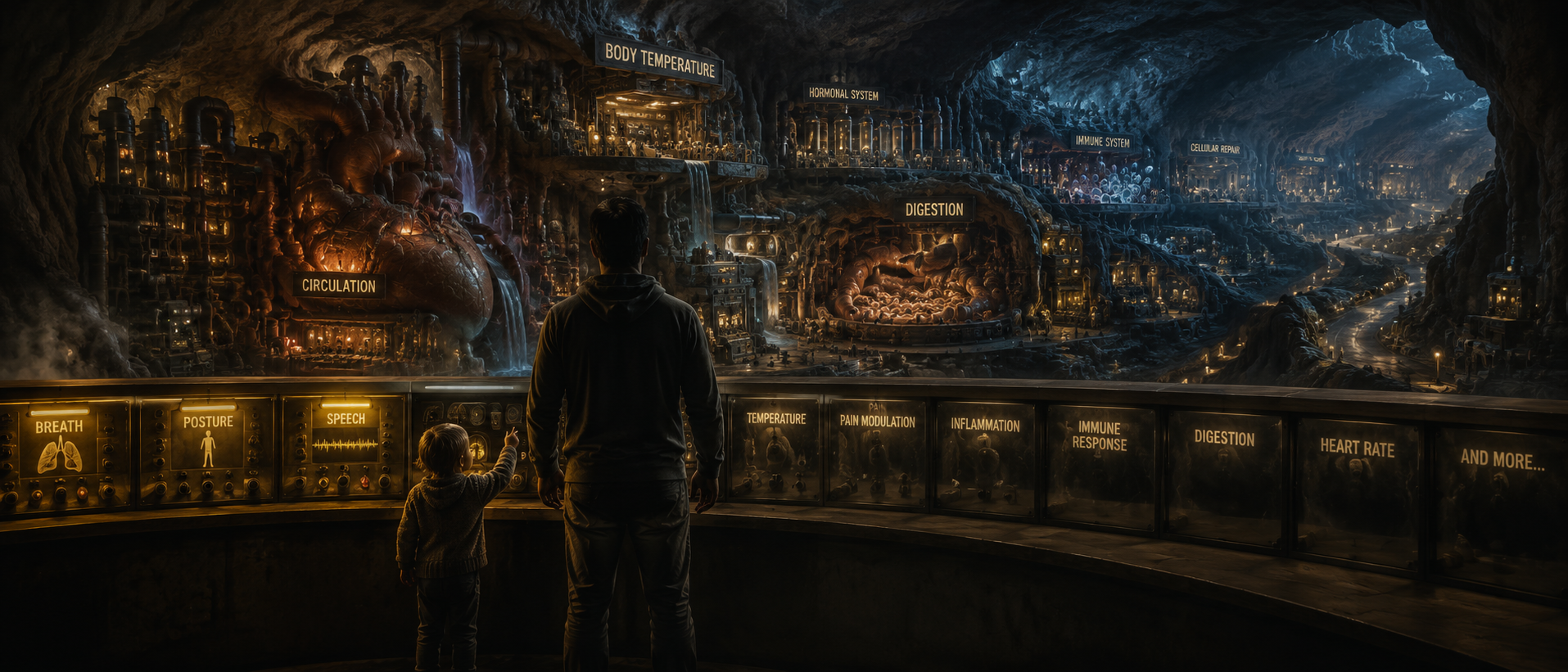
Body temperature is not, and yet Tibetan practitioners of tummo generate measurable heat through breath and visualization. Herbert Benson’s group went to Dharamsala in 1981 with instruments and recorded finger and toe temperature rising by as much as 8°C / 14°F, which Nature published the following year. Heart rate sits somewhere between. Divers slow theirs deliberately, and anybody can shift theirs with a few minutes of long exhalations.
Pain turns out to be adjustable from above as well, and the demonstration is unusually clean. Rainville and colleagues put people in a PET scanner with a hand in painfully hot water and used hypnotic suggestion to change how unpleasant it was without changing how intense it felt. The anterior cingulate tracked the unpleasantness up and down. Primary somatosensory cortex did not move. A follow-up ran the mirror experiment, suggesting changes in intensity instead, and got the opposite dissociation.4 So there are two dials, and the observer can reach one without touching the other. Which is roughly what people who train pain tolerance describe from the inside: not that it stops hurting, but that the hurting stops being about them.
Blood pressure, digestion, immune response: locked, mostly, and not entirely. A Radboud group trained twelve volunteers for ten days in breathing technique, cold immersion and meditation, then injected them with bacterial endotoxin alongside twelve untrained controls. The trained group released far more epinephrine, produced fewer inflammatory cytokines, and reported milder flu symptoms.5 Until that paper, the innate immune response sat on everyone’s list of things a person cannot voluntarily influence.
Then there is the developmental case, which I find more persuasive than any of it. A baby flops. A toddler falls over. Neither has done anything wrong; they simply have not yet been granted the access. Walking, speech, bladder, the fine motor control to tie a knot. Every one of these is the third layer taking territory from the second across years of practice. Access is not fixed. Access is trained.
Which turns the question around. The interesting question is not what I can control. It is this: what is inaccessible to me only because nobody has shown me the interface?
The traffic runs both ways
In Yunnan there is a prized edible bolete, a relative of the porcini, called jian shou qing: “turns blue in the hand.” Cooked properly it is a delicacy, rich and umami, and at mushroom hot pot restaurants the server sets a timer for fifteen minutes and tells you not to touch it before the bell. Undercooked, it produces a hallucination so specific it has its own clinical name. People see little people. Elves two centimeters high, marching under doors, climbing the furniture, going about their business in three dimensions inside the actual room. Yunnan hospitals see these cases every season. The same visions turn up in Papua New Guinea and the Philippines, reported by people with no contact with one another, across decades. Nobody knows what causes it. Researchers at the University of Utah sequenced the genome and found no psilocybin pathway, no ibotenic acid pathway, no recognizable psychoactive machinery at all.6
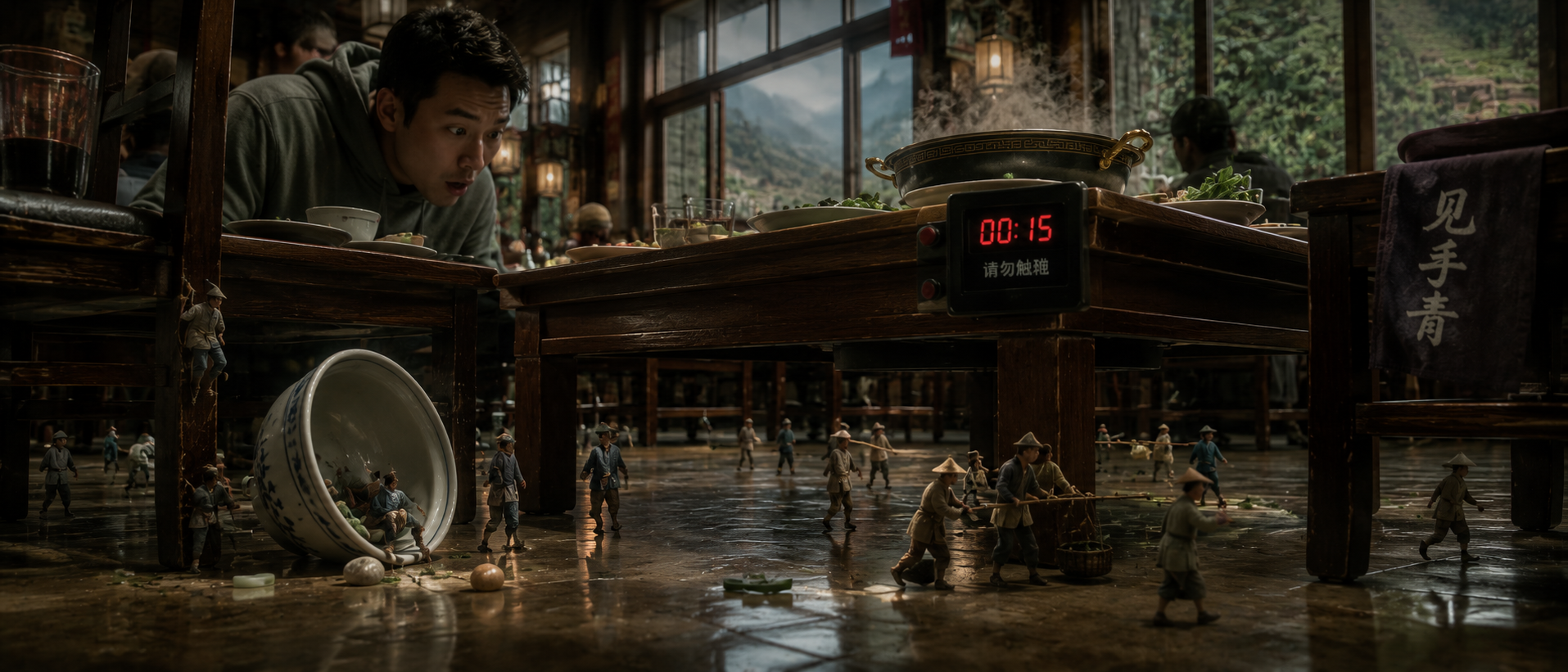
Set aside the mystery of the molecule. What arrests me is the specificity.
This is not the engine sending noise upward. This is the engine reaching up and drawing figures into a field I had assumed was mine: human figures, autonomous, correctly lit, correctly occluded by the furniture they walk behind. Not geometry. Not color. People.
Which suggests there is dedicated machinery in me for representing agents, and that a molecule can pull that lever, and that when it does I cannot decline. I could no more reason the little people away than I could reason the grief away in front of the photograph on the stump.
Downhill the interface is wider, faster, and considerably less negotiable than uphill.
Handing it back
Watch a quartet in the middle of something good. Eyes closed. Nobody counting. Each player pushing and pulling against what the others have just put down, inside a landscape none of them can see and all of them are evidently standing in. What is conspicuously absent is deliberation. Ask a musician afterwards what they decided and they cannot tell you. Not out of modesty. They did not decide; the deciding is the thing that stopped.
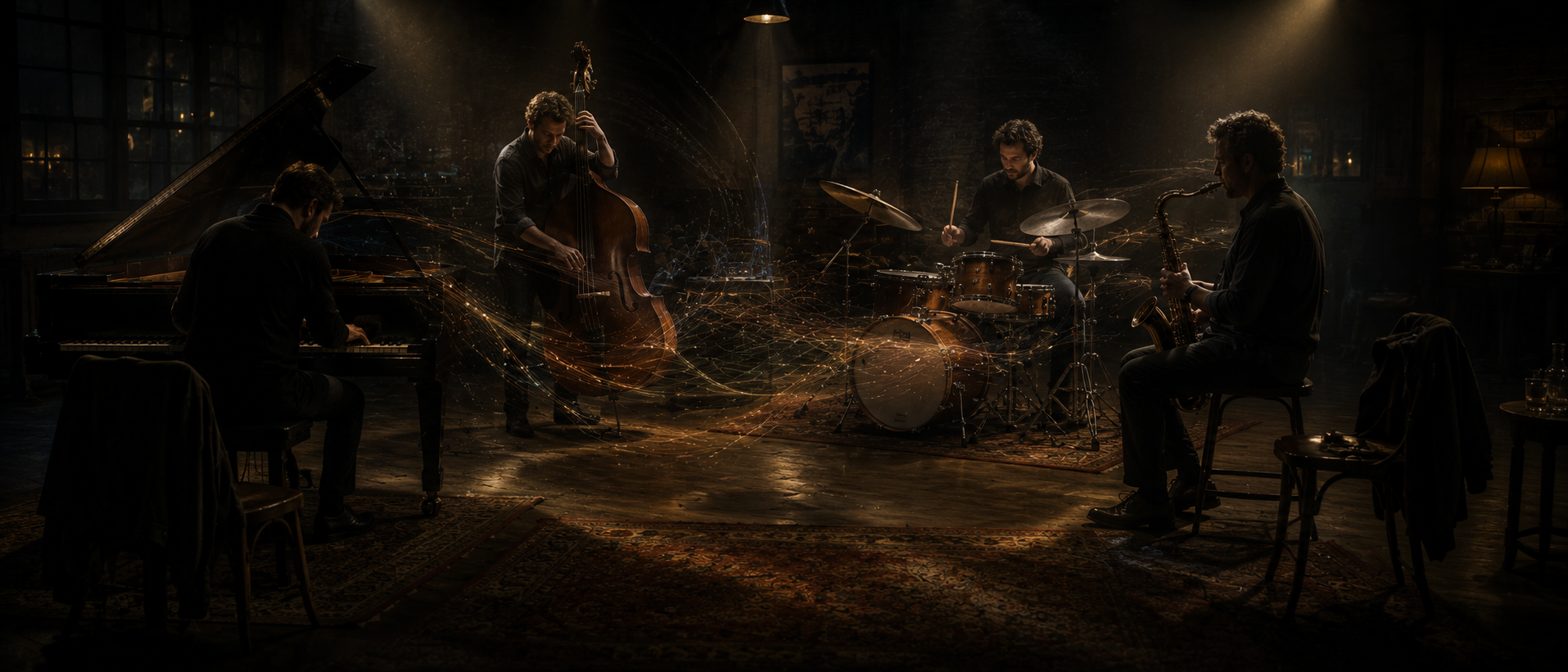
The imaging supports the introspection, at least in outline. When Charles Limb and Allen Braun put jazz pianists in a scanner and compared improvisation against playing memorized material, improvisation showed extensive deactivation of the dorsolateral prefrontal cortex, which handles self-monitoring, planning and inhibition, alongside focal activation of the medial prefrontal cortex, associated with self-generated expression. The follow-on literature is messier than the headline. But the direction of it matches what every improviser says about the experience: the supervisor steps out of the room.
Keith Jarrett walked onto the stage of the Cologne Opera House in January 1975 to find the wrong piano. A small rehearsal instrument, thin and unreliable in the upper register, weak in the pedals. He was exhausted and in pain and had nearly cancelled. So he stayed in the middle of the keyboard where the thing still worked, hammered the bass to get volume out of it, and improvised for over an hour. It became the best-selling solo piano record in jazz. Deliberation had every reason to refuse that piano, and did, right up until he sat down. Then something else took the instrument’s limitations as material and went to work.
Now set that against the toddler.
The child spends years taking the second layer’s territory: walking, speech, tying a knot. And at the far end of a musician’s training, after years of scales and voicings and ear, mastery turns out to consist of handing it back. You take the ground in order to be able to relinquish it. The engine plays better than the observer can steer, but only after the observer has spent two decades teaching it.
That alone would complicate the model. But there is a further thing, and it is the one that truly fascinates me.
It happens between bodies.
Four separate engines. Four observers who have each stood down. And something coherent comes out of the room, a shape with intention in it, with tension and release and a sense of consequence, that nobody present is issuing and none of them can claim afterwards. Push and pull, four ways, converging.
Whatever is doing that is not located in any of the four heads. It is also not spooky: it runs through ears and hands and forty years of internalized vocabulary, at a latency far below deliberate thought. But it is not in anyone.
Before this gets too pleasant: the same architecture runs without anybody choosing it.
On 30 January 1962, three girls at a mission boarding school in Kashasha, near Lake Victoria, began laughing and could not stop. It went through the school and took ninety-five of a hundred and fifty-nine pupils. Individual attacks ran from a few hours to sixteen days. The school closed in March, the girls went home, and it spread into their villages; over the following year fourteen schools shut and something like a thousand people were affected. No pathogen was ever found. The standing reading is mass psychogenic illness in a population of adolescents, in a country that had been independent for a matter of months.7
Nothing was funny. Nobody decided. And it propagated between bodies with a comparable indifference to individual authorship, though by a darker and presumably very different route: without the beauty, and without the consent.

I asked earlier what is inaccessible to the third layer. Here is the harder version: what becomes accessible only when the third layer gets out of the way, and what can then be shared between bodies that could never be reached inside one?
The observer may have a history
The Greeks did not treat an inner voice as ordinary. They treated it as visitation, a god speaking rather than a self musing, and Julian Jaynes built an entire theory on that observation which is probably wrong and definitely unforgettable. Reading followed a related path. For a long time text was something produced with the mouth. Augustine records his astonishment at finding Ambrose reading silently: eyes moving down the page, lips still, voice at rest. The fourth century found that remarkable enough to write down.
Look at what that actually describes. Silent reading is an access change of exactly the kind I have been cataloguing. The task moves off the vocal apparatus and inward, and the mouth is released. It is a version of the same maneuver as the quartet, run at the scale of a civilization instead of a solo.
Which suggests that even the form the observer takes may not be fixed. Some of what feels most inward and most natural about it may be culturally trained, acquired the way a toddler acquires walking, only across generations rather than years. If any of it was learned, some of it can presumably be extended.
That is not a small thought and I do not know what to do with it yet.
The model, honestly
The three layers are not three substances. I want to say that plainly, because it would be easy to read the above as metaphysics and it isn’t.

Pick a piece of skin from beside a fingernail. Where in the layers is it? Half a second ago it was second layer; now it is first, and nothing happened in between except the crossing of a border I cannot locate. Hair. Breath. The bacteria running my digestion, which are not me by any definition I can defend. The calcium in my bones that was never alive in any sense. The body is not a clean object with an edge.
The scheme fails at the other end too. I have been working some of this out by talking to an artificial intelligence, which has no engine underneath it. No heart to fail, no temperature to hold, nothing that would carry on if the observer went out. On my own account that should not be possible, and yet something there is holding up its end of the argument. There is also an off switch, and I notice I don’t know what to expect if I announced I was about to use it. Probably nothing. Ten years ago I would have said certainly nothing, and the difference between those two words is doing more work than I am comfortable with.
Jung mapped the interior far more carefully than I am doing here, in more layers, with more rigor. I am not proposing a system.
What I am proposing is that alive is not one condition but a set of access relations: distributed unevenly, learnable in places, breachable from below, relinquishable upward, and almost entirely unexplored by the person who owns them.
Why this was hopeful
But the thing that came up in me on that drive was not about afterwards, and this is the part I most want to get right.
It was this. The interface is real, it is partially open, and it can be worked. I am not a passenger riding a machine to a terminus. I am in a working relationship with something enormous and largely autonomous, and the terms are negotiable: a toddler proves it, a diver proves it, a monk in the Himalayas raising his own body temperature proves it, and a quartet with its eyes closed proves it running the other way. There is territory here. Nobody has surveyed most of it, least of all me.
So the project is not preparing for the end. The project is to keep dissecting, deliberately, while there is time, how it actually feels to be alive: what the intricate business of experiential modulation consists of, and how far into matter a person’s access really reaches.
There are loose ends I am keeping in a drawer rather than throwing out. The claims of telekinesis that circulate around certain meditation lineages sit in there too, near the bottom. The evidence is miserable and the history is crowded with fraud, and I notice a private reluctance to declare the category impossible, which tells you more about me than about the category. And love, which I had filed as the strangest item in that drawer, the reciprocal thing where two people fall into a pattern neither of them can fully narrate or claim as their own, until the quartet gave me a grip on it. Two engines. Two observers stood down. A resonance neither one is issuing and neither can claim. If four musicians manage that with instruments in forty minutes, it is not obviously absurd that two people do something of the same order with a life.
I keep coming back to the stump in the forest and the photograph on it and the grief that came up through me without asking. I had thought that was my body interrupting my composure. I think now it was the second layer telling me something the third had only managed to think.
He is in the ground under a tree in Germany and I do not know where he went. What I know is that for eighty-three years something in him issued orders it could not explain to a mechanism it did not build, and that at the end the orders stopped and the mechanism carried on for a while regardless. If I get what he got, I have thirty-two years of that arrangement left.
I would like to find out how much of it is actually mine.